
When you start reading through Plasma’s documentation, one thing becomes clear almost immediately: this chain knows exactly what it wants to be. It’s not trying to compete with every Layer-1 out there and it’s definitely not chasing hype by promising to do everything at once. Plasma is focused, almost stubbornly so. Its entire design revolves around one simple idea-making stablecoins work like actual digital money.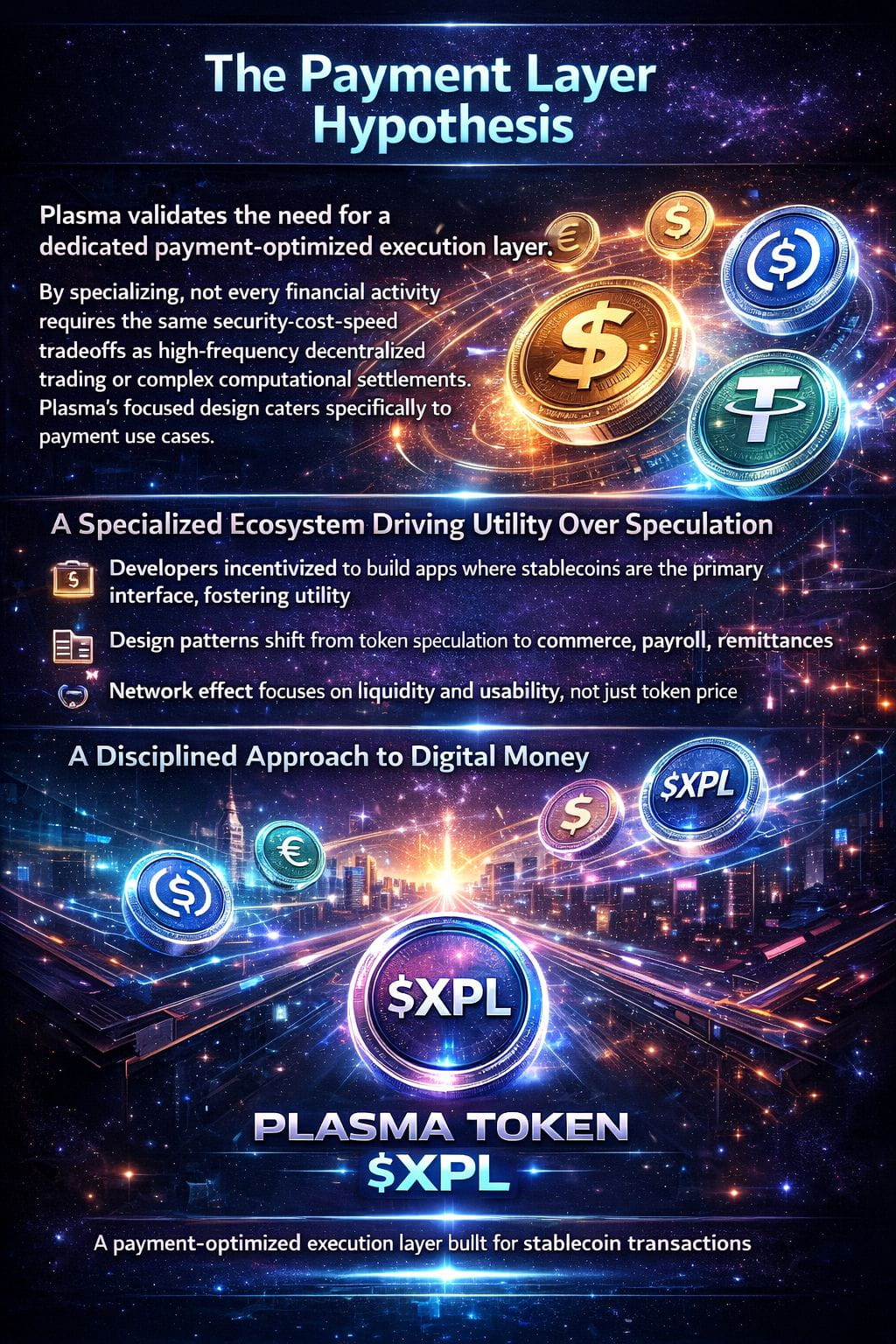
That focus matters. Plasma wasn’t built as a general smart-contract platform that later tried to bolt payments on as an afterthought. It was designed from the ground up with stablecoins at the center, especially assets like USDT. That decision shapes everything: the architecture, the transaction flow, and even how users experience the network. Instead of feeling like “another blockchain,” Plasma feels more like financial infrastructure-a dedicated rail built specifically for moving stable value efficiently.
Stablecoins Aren’t an App Layer -They’re the Foundation
What really sets Plasma apart is how deeply stablecoins are embedded into the protocol itself. On most chains, stablecoins are just tokens living on top of a neutral ledger. On Plasma, they’re treated as first-class citizens. They’re the base unit the network is optimized for.
This shows up in very practical ways. Gas logic is designed around stablecoin transfers, not generic computation. Transactions are optimized for speed and predictability, closer to how digital cash should behave rather than how complex smart-contract calls usually do. Even the core contracts are structured around secure, efficient value movement.
For users, the difference is obvious. There’s no need to hold a volatile native token just to send money. Stablecoin transfers can be zero-fee from the user’s perspective, which is huge for things like remittances, micropayments, or everyday spending. The usual friction-figuring out gas, managing balances, worrying about fee spikes-largely disappears. What you’re left with is something that actually feels usable.
Familiar Tools, Purpose-Built Infrastructure
Despite its specialized focus, Plasma doesn’t ask developers to relearn everything. Full EVM compatibility is a deliberate choice, and it shows a lot of restraint. Instead of reinventing the wheel, Plasma leans into the existing Ethereum ecosystem.
If you already build with Solidity, use Hardhat or Foundry, and interact through MetaMask, you’re at home immediately. There’s no exotic language, no experimental VM, no unnecessary abstraction layer. That lowers the barrier to entry and lets teams focus on building products, not adapting to new infrastructure.
The documentation also hints at something bigger: future Bitcoin integration. Plasma clearly sees Bitcoin not as a competitor, but as a source of deep liquidity that can be brought into a stablecoin-native, programmable environment. That opens the door to financial workflows that combine Bitcoin’s value with stablecoin-based settlement and logic-something that’s been talked about for years but rarely designed into a chain from day one.
Docs Written for Builders, Not Spectators
The documentation itself reflects Plasma’s mindset. It’s practical, direct, and clearly written for people who want to build, not just read. You’re guided quickly from understanding the concept to actually running code.
There are clear getting-started guides, straightforward explanations of how the layers fit together, and concrete references for stablecoin-native contracts. Even node operation is well covered, which signals that decentralization and network participation aren’t afterthoughts.
It feels less like marketing material and more like a manualsomething you’d keep open while actually working.
Payment-Grade by Design
Across the docs, the same themes keep coming up, and they all point in one direction:
Gas costs that are invisible to users
Fees paid directly in the stablecoin being used
Predictable, fast settlement
Privacy for payment details without ignoring compliance realities
Deep stablecoin liquidity as a launch priority
All of this adds up to infrastructure that behaves like a payment network, not a speculative playground. Plasma isn’t trying to optimize for memecoins or experimental DeFi loops. It’s optimizing for reliability, cost, and clarity.
Who Plasma Is Really For:
Plasma’s audience is easy to identify once you step back. It’s built for people and businesses who actually want to use stablecoins:
Cross-border payments that are fast and affordable
Remittances without middlemen taking a cut
Merchants and POS systems that need predictable fees
DeFi built around stable assets, not constant volatility
Programmable finance where USDT is the accounting unit, not just a trading pair
This isn’t a distant vision. These are problems that exist right now, and Plasma feels designed to solve them immediately.
The Bigger Picture
Plasma doesn’t try to be everything and that’s its strength. It’s a chain with discipline. By committing fully to stablecoins as the core primitive, it avoids the compromises that general-purpose chains often make.
EVM compatibility brings developers in. Stablecoin-native design keeps the user experience clean and practical. Together, they form something closer to digital financial infrastructure than a typical crypto platform.
If stablecoins are going to evolve into true digital money—used daily, globally, and without friction—then they need rails built specifically for that job. Plasma feels like one of the first protocols to genuinely understand that, and to design accordingly.@Plasma #plasma $XPL


