
Decentralized applications have hit a crossroads:infrastructure isn’t just a background concern anymore it’s the heart of the whole thing.Early dApps showed everyone that decentralization could work, but at a cost.They struggled with speed, composability,and control.Plasma approaches these problems from a different angle.Instead of treating execution as an afterthought,it puts it front and center.This shift is what makes Plasma stand out in the next wave of decentralized app development.
Most first gen dApps were boxed in by the blockchains they lived on.Developers bent over backwards to fit their ideas into someone else’s framework.The result? Slow apps,clunky user experiences,and workarounds that made everything less usable.Plasma flips that script.Its execution native design gives developers more control apps run smoother,faster,and just feel more predictable.
From an academic standpoint,Plasma signals a move away from generic smart contract platforms.It’s not about cramming every app through the same narrow pipeline anymore. Plasma lets you match the environment to the specific needs of your application.That’s huge for more complex dApps that need low latency,deterministic outcomes,and real scalability while holding on to decentralization.
What really caught my attention with Plasma is how it confronts the failures of earlier dApp designs.I’ve spent enough time with dApps that look great on paper but fall apart in practice slow,expensive,and unreliable enough to erode trust. Plasma feels like an answer to those headaches.It doesn’t try to reinvent decentralization. It’s about making it actually usable.
With Plasma,you get a platform where logic, state,and performance are aligned from the start.Developers can create apps that work more like traditional software, but without giving up the benefits of decentralization. The whole process is less painful for both builders and users.
Composability is another area where Plasma stands out.Too many dApps today rely on shared contracts and external pieces,which opens the door to vulnerabilities.Plasma’s approach keeps things modular while drawing clearer boundaries.From what I’ve seen in past ecosystem failures,this kind of isolation matters for long term health.
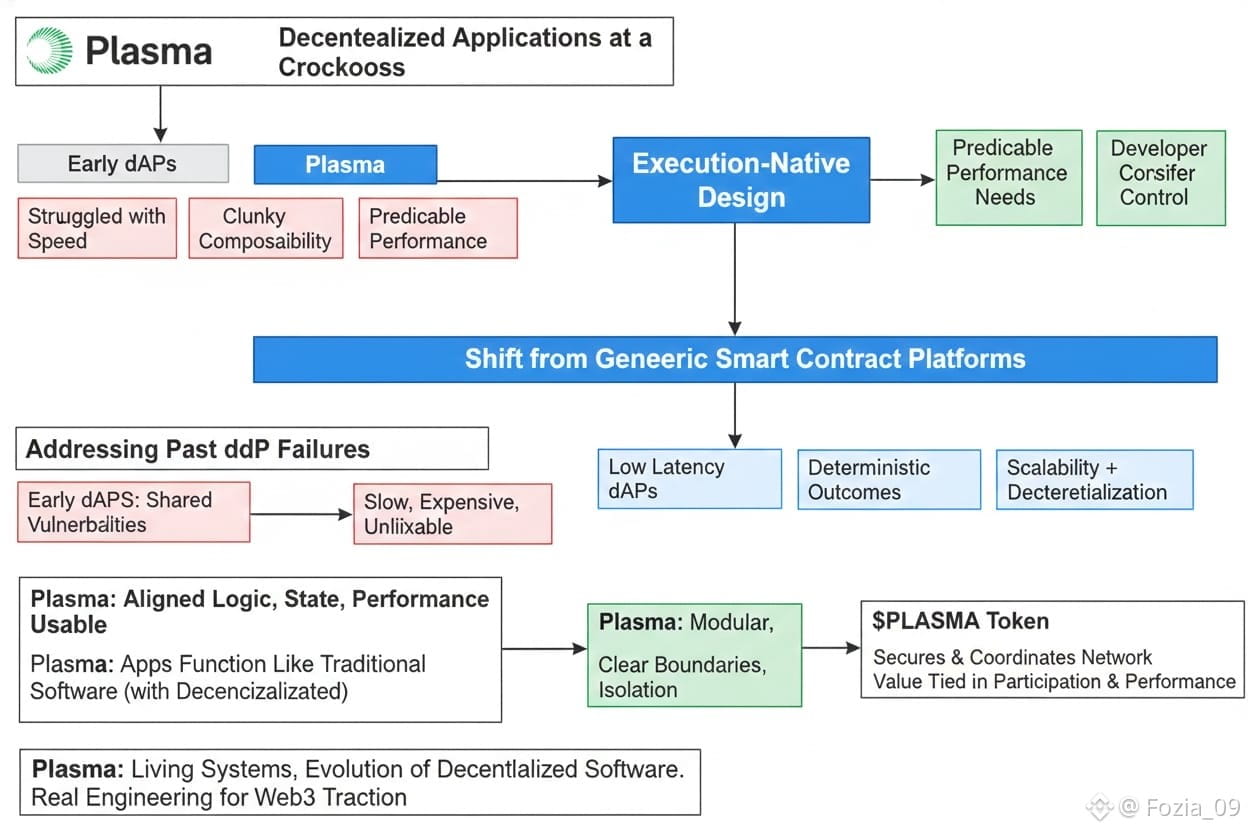
The PLASMA token isn’t just another speculative asset.It secures and coordinates the network,and its value is tied directly to actual participation and performance not just hype.That’s important.I’ve watched too many projects where the token price floats away from any real usage.Plasma feels different.Its economics are tied to real demand for execution.
What sticks with me most is how Plasma treats decentralized apps as living systems not just static contracts frozen in time.Apps grow,change,adapt.Plasma’s infrastructure supports that evolution,making it a serious foundation for decentralized software,not just short lived experiments.
In the bigger Web3 picture,Plasma is a sign that decentralized app design is finally growing up.The conversation is shifting from ideology to real engineering.From what I’ve seen,this is the direction dApps need to go if they’re going to stand a chance against centralized options and get real traction.