
AI infrastructure exposes a flaw that blockchains have managed to sidestep for years:when you cram execution, coordination,and settlement into the same place,scale breaks down fast and it doesn’t fail gently.Most single chain AI designs borrow from DeFi-era blueprints,back when computation was cheap,state transitions were predictable,and a single fee market could smooth out the bumps.AI doesn’t play by those rules.It shatters all three assumptions.
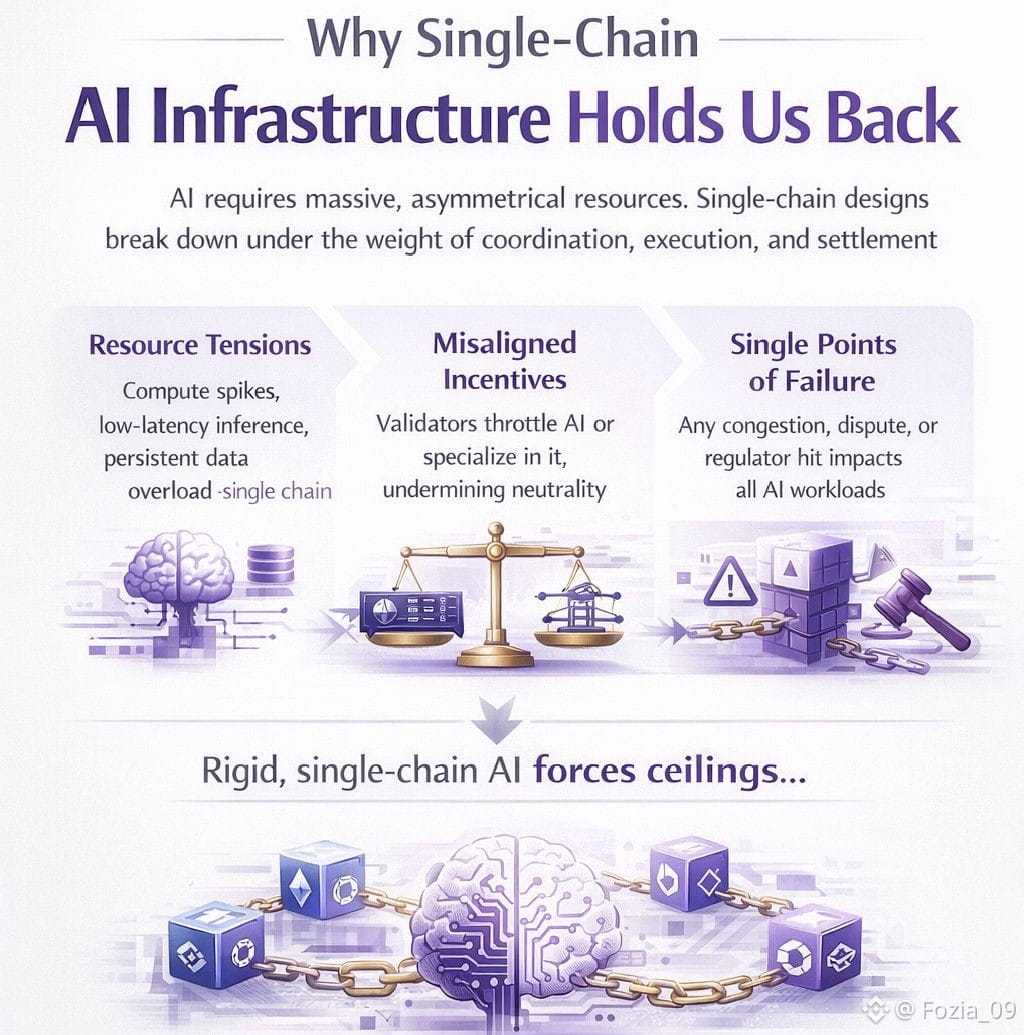
The heart of the issue is resource asymmetry. AI systems eat up compute,storage, bandwidth,and verification in wildly uneven ways.Training is all about sudden spikes in demand;inference needs low latency responses; persistent data availability matters more than raw throughput.A single chain tries to price all this with one congestion signal,which never fits.That leads to structural waste:either AI traffic floods the chain and locks out other users,or the network clamps down on AI just to stay afloat.Both scenarios shrink the system’s real world value.
Look at it through the lens of incentives it gets even clearer.Blockchains are built for coordination first,execution second.AI flips that.When execution takes over,validators and node operators end up chasing incentives that don’t match what’s good for the network.They either start optimizing hardware just for AI (which edges toward centralization),or they slow AI to a crawl to keep block production steady.Either way,the chain loses its neutrality.For investors,that’s a hidden risk buried deep beneath glossy numbers like TPS and TVL.
Single-chain approaches also mash all failure domains together.If governance deadlocks, congestion explodes,or regulators come knocking,every AI system on that chain takes the hit at once.In classic distributed computing,we’d call that a single point of failure and it’s unacceptable.Yet plenty of AI on chain projects still tie themselves to one execution environment,hoping future upgrades will patch over what is fundamentally an architectural flaw.
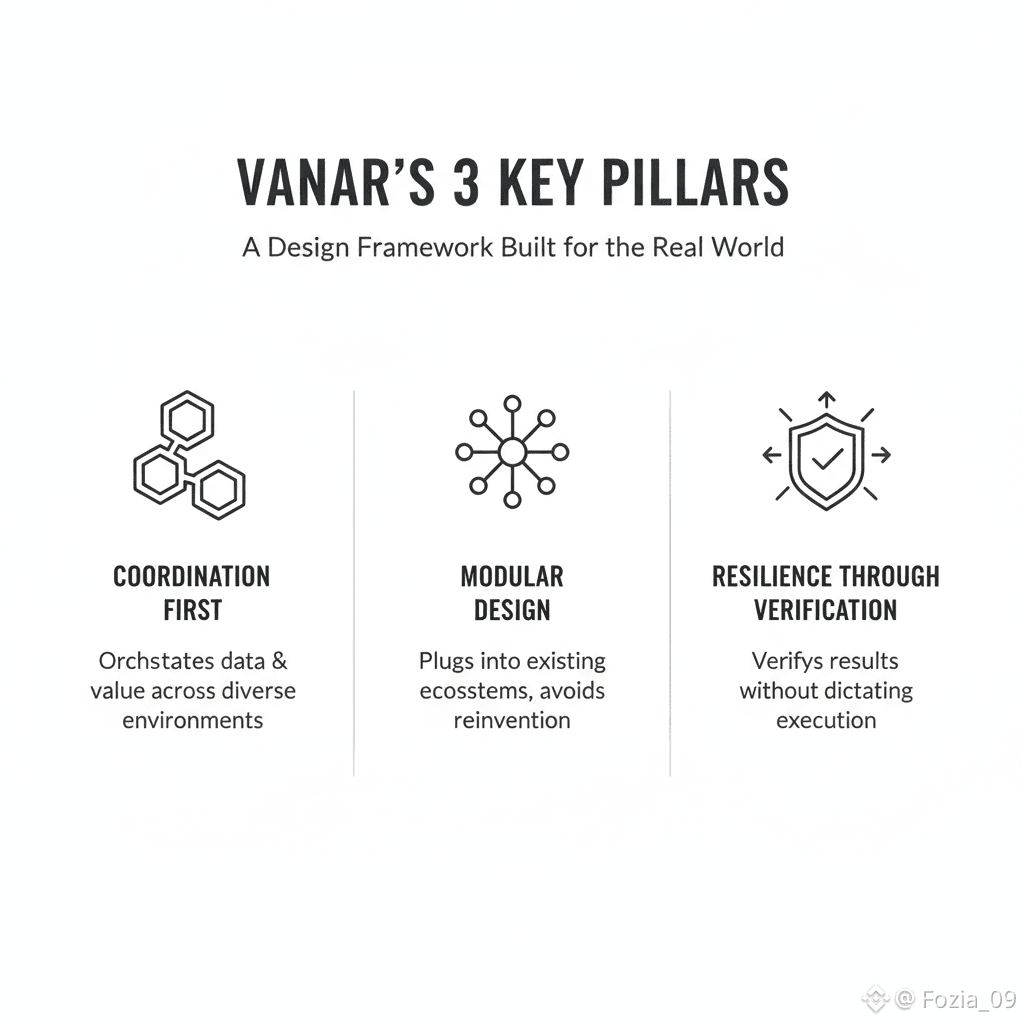
This is where Vanar’s approach stands out. Instead of stuffing all AI infrastructure into one chain,Vanar treats it as a coordination problem that spans multiple execution environments.The focus isn’t on pushing every AI workload on chain.It’s on verifying results,orchestrating data,and settling value without dictating where the heavy lifting happens.That subtle difference matters.It fits the way AI systems already work,instead of fighting against it.
From what I’ve seen,AI focused Web3 teams usually hit a wall not because their models are bad,but because infrastructure demands exclusivity. Integration costs tooling,liquidity, user access pile up fast.Single chain stacks make this worse.Vanar’s modular design takes the edge off,letting AI plug into existing ecosystems rather than trying to reinvent everything from scratch.
Of course,there are trade offs.Coordinating across environments adds complexity and strains verification logic.Latency between layers needs close attention.But these are growth pains,not hard limits.Single chain AI, on the other hand,hits a brick wall as soon as demand outpaces what the environment can handle economically or technically.
The market’s already made its preference clear.Liquidity lives across chains. Developers juggle multi stack tools because they have to.Modular blockchains,restaking layers,and specialized compute networks didn’t pop up for fun;they emerged because monolithic designs couldn’t keep up.AI just speeds up this fragmentation.Betting on consolidation into one chain means betting against what’s actually happening.
For traders and investors,the lesson is pretty direct.Single chain AI stories look shiny at first because they concentrate activity and metrics.But that’s not the same as resilience. Systems like Vanar,built for coordination instead of confinement,might take longer to build momentum but they’re better equipped for the long run as AI demand gets bigger and messier.
So here’s the bottom line:judge AI infrastructure by how well it handles imbalance,fragmentation,and failure not by how cleanly it fits into a single chain.When AI scales up for real,ceilings matter more than surface polish.