
Moving assets around blockchains isn’t the hard part.The real challenge is making sure those assets actually do what they’re supposed to once they get where they’re going.For years,crypto bridges and wrapped assets have mostly solved the transport problem,but they hand off the hard questions who decides what happens to the money? to some trusted group:multisigs,custodial validators,or murky governance schemes. Plasma flips this on its head.It doesn’t ask, “Who do we trust with the keys?”It asks, “What exact logic should these assets obey, and how do we prove that logic gets enforced every time they interact with a smart contract?”
Here’s the core issue:most asset connections today are built around process,not logic.You lock tokens on one chain,mint them on another,and hope everyone in the middle plays fair.That’s fine when things are stable. But when markets get wild or incentives misalign,the failure isn’t usually technical it’s the off chain coordination that falls apart. Plasma sees this differently.It treats connectivity as a state transition problem. Assets aren’t handed off to people or committees;they’re governed by verifiable execution rules,not external actors.
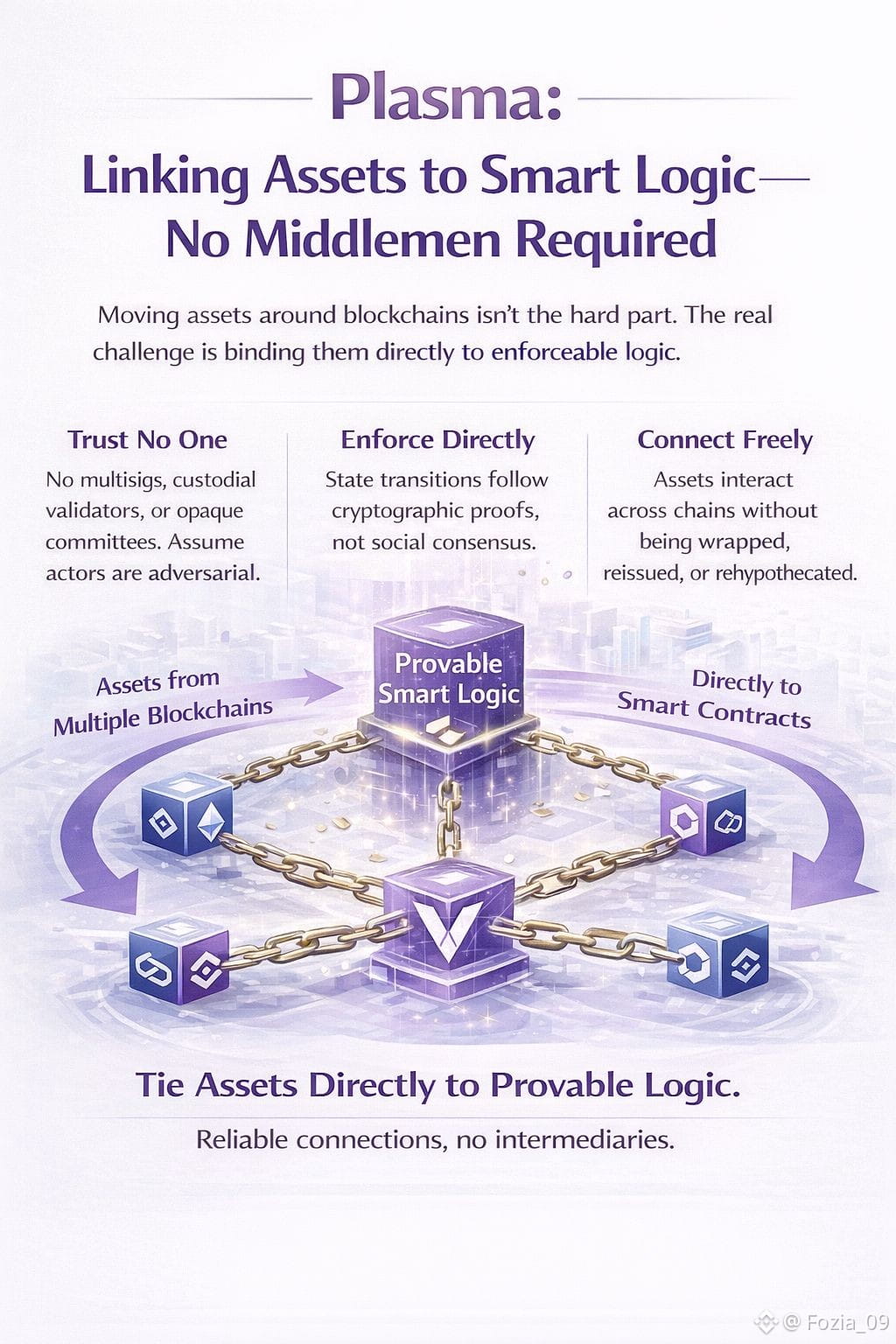
Technically,Plasma splits custody,execution logic,and verification into separate,well defined pieces.Assets don’t rely on a bridge operator’s honesty.They obey deterministic rules,checked by cryptographic proofs and challenge systems.This shift matters because financial logic is always adversarial if there’s value at stake,someone’s trying to poke holes in the system.By cutting out discretionary control,Plasma makes those holes a lot harder to find.
The economic side is just as crucial.When you rely on intermediaries,you build in hidden costs:insurance,governance bloat, delays,wasted capital.These don’t show up in glossy TPS metrics,but you definitely notice them during crashes,hacks,or regulatory clampdowns.Plasma’s model pushes risk outward,letting users pick their own execution environments,while keeping settlement neutral and verifiable.That’s closer to how robust financial systems work in the real world.
Think of Plasma less as a bridge and more like a logic router.Assets don’t get reissued or socially governed at every stop they can flow through multiple smart environments while sticking to the same set of rules.This unlocks more nuanced strategies:cross chain liquidity,if this then that execution,building complex products from simple parts without piling up layer after layer of trust.
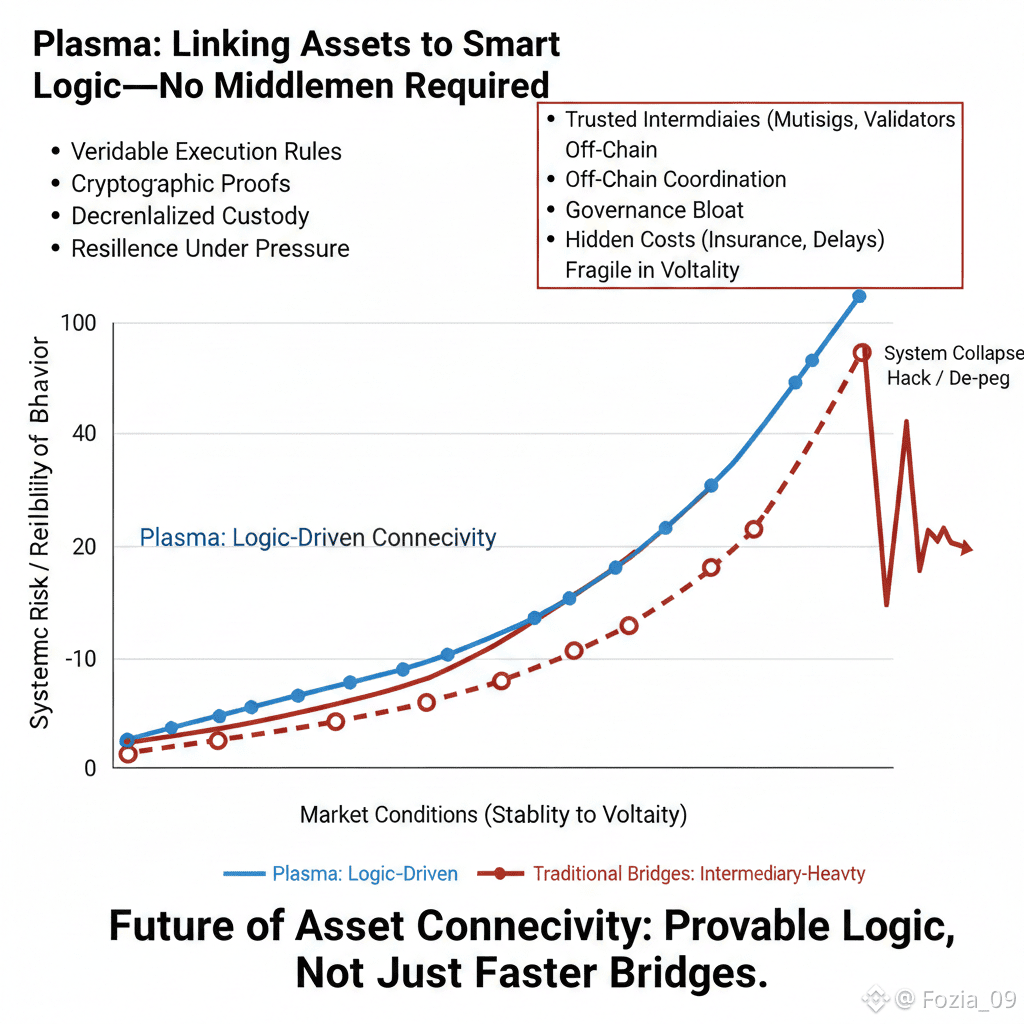
Of course,there are trade offs.Logic driven systems need stronger verification and clearer ways to handle failure.There can be more lag between what happens and when it gets final approval.The user experience also needs careful design so people don’t get lost.But these are engineering problems,not deep flaws in the model.Intermediary heavy designs,by contrast,quietly build up systemic risk that only shows up when everything goes wrong.
To me,this is where Plasma stands apart.It doesn’t chase speed or abstract composability.It’s about making asset behavior clear,especially under pressure.In a world where money moves faster than trust can recover,that’s not just a design philosophy it’s a practical necessity.
Bottom line:The future of asset connectivity isn’t about faster bridges.It’s about tying assets directly to provable logic.Plasma points to a world where we judge financial infrastructure not by how quickly assets move,but by how reliably they behave when things get tough.