
For decades, money has always required human intention.
We click “send,” we approve transactions, we sign contracts.
But the digital economy is quietly shifting toward a world where machines transact with machines — and this is where Plasma introduces a very different narrative compared to ordinary stablecoin discussions. Instead of focusing only on trading or remittances, Plasma positions itself as infrastructure for autonomous financial activity, where payments are executed by software agents rather than people.
The Limitation of Human-Centric Money
Traditional stablecoins are built with human behavior in mind:
•Manual approvals
•Delayed settlements
•Dependence on exchanges and liquidity bursts
•Emotional decision-making during volatility
AI agents, automated bots, and algorithmic platforms do not operate like humans. They require:
•Instant settlement
•Predictable liquidity
•Deterministic rules
•Zero emotional volatility
•Continuous uptime
Human-designed financial systems introduce friction for machine-driven economies. Plasma approaches money as a system property, not a user interface.
Why Autonomous Payments Are Emerging
Three accelerating trends are driving this shift:
1. AI Agents Performing Tasks
From data retrieval to automated trading, AI systems increasingly require micro-payments.
2. Machine-to-Machine Commerce
IoT devices, cloud services, and digital platforms begin charging each other for resources.
3. Real-Time Digital Services
Subscription APIs, streaming data, and on-demand computing require instant and continuous settlement.
These scenarios are not compatible with slow or incentive-dependent stablecoin mechanisms. Plasma focuses on building a predictable settlement environment where money flows automatically without liquidity fragility.
Deterministic Liquidity Instead of Incentive Liquidity
Most stablecoins rely on incentives, yield programs, or temporary liquidity injections to maintain stability. Plasma’s philosophy is different: stability must be engineered, not encouraged.
Deterministic parameters mean:
•Liquidity behaves consistently during stress
•Peg defense is structural, not emotional
•Settlement logic is algorithmic
•Systems remain operational without external hype
For autonomous systems, predictability is more important than temporary profitability.
Money as Infrastructure, Not a Product
In many blockchain discussions, stablecoins are treated as tokens or financial products. Plasma reframes them as infrastructure components, similar to electricity or bandwidth.
When money becomes infrastructure:
•Developers can design systems assuming constant reliability
•AI agents can transact without manual intervention
•Platforms can automate pricing and settlement
•Financial logic becomes programmable at the system level
This is not just financial innovation; it is architectural transformation.
Micro-Transactions and Continuous Settlement
Autonomous economies do not rely on large payments; they rely on high-frequency micro-transactions. Plasma’s infrastructure model enables:
•Per-API-call payments
•Data-per-query billing
•Streaming service settlement per second
•Dynamic pricing models
•On-chain subscription loops
In such environments, transaction reliability matters more than transaction size. Plasma’s design emphasizes consistency over spectacle.
Psychological Shift: Trusting Systems Instead of Interfaces
A key transformation is psychological. Users traditionally trust wallets, exchanges, and user interfaces. Autonomous finance requires trusting underlying systems rather than front-end controls.
Plasma reduces reliance on visual interfaces by embedding stability and liquidity logic directly into its infrastructure layer. This allows financial activity to occur even when no human is watching — a prerequisite for AI-driven economies.
Risks and Adoption Challenges
Autonomous payment infrastructure introduces new complexities:
•Regulatory clarity for machine-driven finance
•Security standards for automated transactions
•Developer education and tooling maturity
Market understanding of deterministic liquidity models
However, these challenges are transitional rather than structural. As AI and machine economies expand, infrastructure that supports automated settlement becomes increasingly necessary.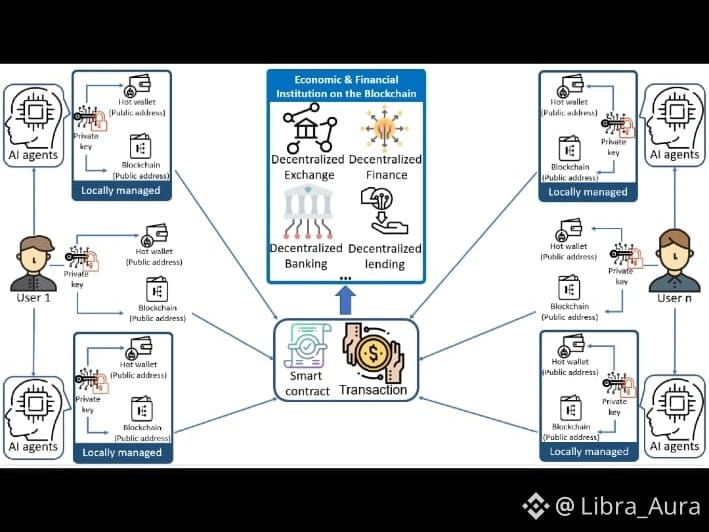
Conclusion
Plasma represents a shift from “money for people” to “money for systems.” By emphasizing deterministic liquidity, predictable settlement mechanics, and infrastructure-level stability, it prepares financial networks for a future where payments occur continuously and autonomously.
In a world where AI agents negotiate services, devices purchase bandwidth, and digital platforms exchange value in real time, financial reliability becomes more important than financial speculation. Plasma is not merely attempting to improve stablecoins — it is attempting to redefine money as a self-operating layer of digital infrastructure, capable of moving even when no human hand is involved.