Introduction
History of Plasma (XPL)
Plasma was first conceptualized in 2018 as a solution to blockchain scalability challenges, focusing on enabling faster, cheaper transactions by offloading some operations from main chains. The network officially launched in 2020, targeting creators and developers who needed high throughput, predictable infrastructure for decentralized applications. From the beginning, Plasma aimed to provide a stable, low friction environment for moving digital value, particularly in contexts requiring frequent micropayments and repeated interactions.
Plasma evolved beyond simple scalability solutions. Its architecture was optimized for continuous, real-time economic activity, making it an ideal foundation for Creator Pads where creators transact, collaborate, and distribute content regularly. The coin $XPL , became the native token supporting these operations, serving both as a medium of exchange and a network utility token, facilitating fast settlement and predictable execution costs.
Introduction: A Different Layer for a Different Kind of Creator Economy
As Web3 matures, the definition of “creator infrastructure” is expanding beyond minting NFTs or collecting tips. Creators increasingly operate as micro-businesses, managing communities, distributing digital goods, coordinating collaborators, and handling high-frequency transactions that resemble real economic activity rather than occasional on-chain events. @Plasma and XPL enter this landscape not as a general-purpose narrative, but as infrastructure designed to support continuous, creator-driven commerce without sacrificing cost predictability or user experience.
Unlike networks that retrofit creator use cases onto financial rails, Plasma is optimized for environments where creators publish, transact, and collaborate daily. This alignment makes Plasma particularly relevant for Creator Pad ecosystems focused on long-term creator sustainability rather than short-term hype.
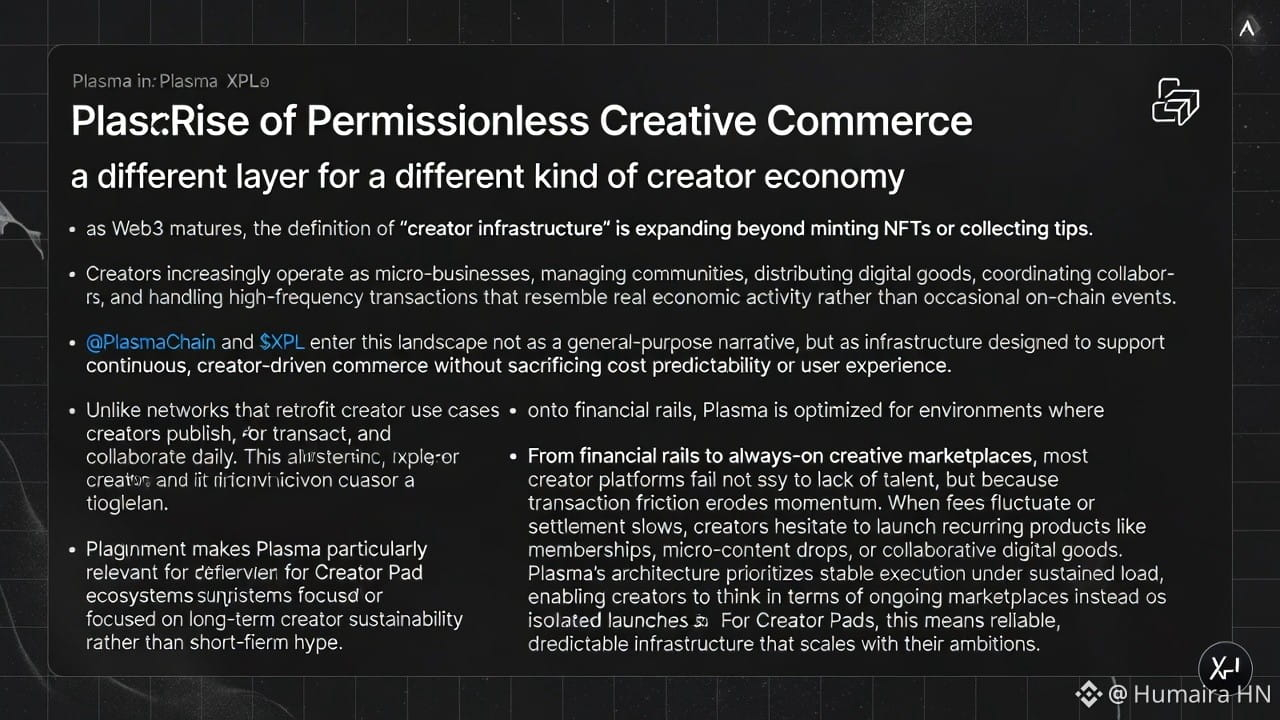
Most creator platforms fail not due to lack of talent, but because transaction friction erodes momentum. When fees fluctuate or settlement slows, creators hesitate to launch recurring products like memberships, micro-content drops, or collaborative digital goods. Plasma’s architecture prioritizes stable execution under sustained load, enabling creators to think in terms of ongoing marketplaces instead of isolated launches. This unlocks new product design For Creator Pads. Creativity no longer needs to be packaged into rare on-chain events. Instead, Plasma supports continuous value exchange between creators, collaborators, and audiences mirroring how creative economies operate in the real world.
One of Plasma’s defining characteristics is its deep integration with stablecoin liquidity. In creator ecosystems, stablecoins are less about speculation and more about operational clarity. They allow creators to price access, services, and digital goods in familiar units, reducing friction for global audiences.
Within Creator Pad frameworks, this enables predictable subscriptions, revenue-sharing models, and cross border collaboration without exposing participants to volatility. Plasma’s stablecoin first environment turns value transfer into an invisible utility rather than a recurring concern.
Creators increasingly operate in real time live content, rapid drops, and continuous community interaction are becoming the norm. Plasma’s fast finality and consistent throughput support these dynamics by removing uncertainty from transaction execution. For Creator Pads, this reliability changes behavior. Launch timing no longer revolves around network congestion or fee optimization. Instead, creators can operate continuously, allowing culture and creativity to move at internet speed.
When infrastructure friction disappears, experimentation increases. Plasma reduces the cost both financial and psychological of trying new formats, pricing strategies, and collaborative structures. This is especially important for emerging creators who need flexibility rather than rigid economic frameworks.
Creator Pads built on Plasma can encourage iteration without penalizing failure. Over time, this leads to healthier ecosystems where innovation emerges organically instead of being filtered by infrastructure constraints.
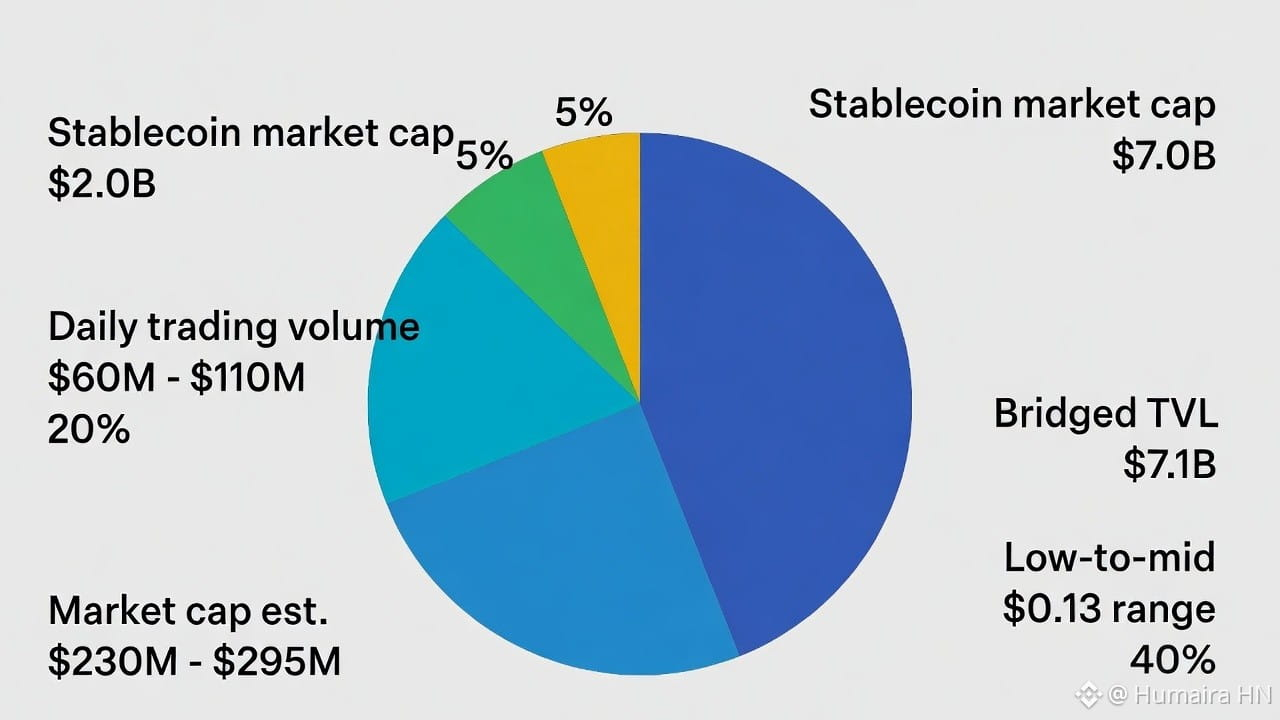
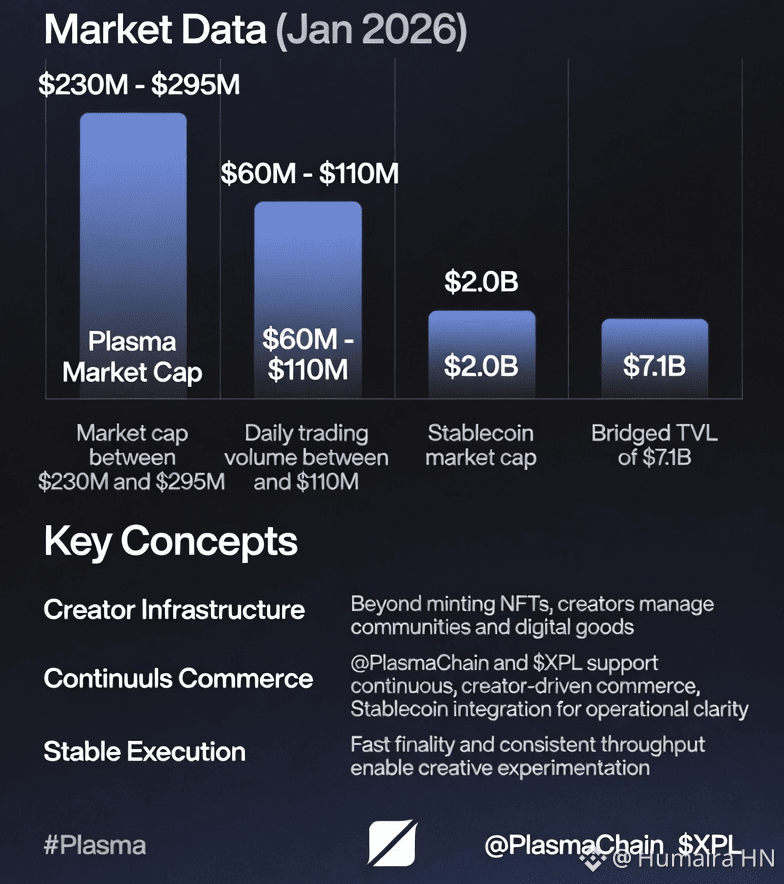
Current data helps anchor this discussion. As of late January 2026, $XPL trades in the low-to-mid $0.13 range, with reported market capitalization estimates commonly ranging between $230 million and $295 million, depending on methodology. Daily trading volume is frequently observed between $60 million and $110 million, suggesting consistent liquidity.


On chain analytics platforms report Plasma supporting approximately $2.0 billion in stablecoin market capitalization and around $7.1 billion in bridged TVL, while chain fees remain extremely low—often amounting to only a few hundred dollars over 24 hours. These figures do not guarantee long-term success, but they reflect alignment between Plasma’s design goals and actual network usage.
Creator Pads aim to onboard creators who may not consider themselves crypto-native but still expect professional-grade infrastructure. Plasma abstracts complexity while maintaining performance, allowing creators to focus on content, community, and collaboration rather than network mechanics. This separation of concerns becomes increasingly valuable as creator ecosystems scale. Infrastructure that stays out of the way ultimately becomes the strongest foundation.
Conclusion
The most effective infrastructure is rarely the loudest. Plasma’s role in the creator economy lies in its ability to operate quietly in the background, supporting high frequency creative commerce without demanding constant attention. For Creator Pads transitioning from experimentation to durable ecosystems, this reliability is essential.
As creator economies evolve into structured digital enterprises, @Plasma and $XPL demonstrate how blockchain infrastructure can support creativity without constraining it providing a practical foundation for sustained, creator-led growth.