
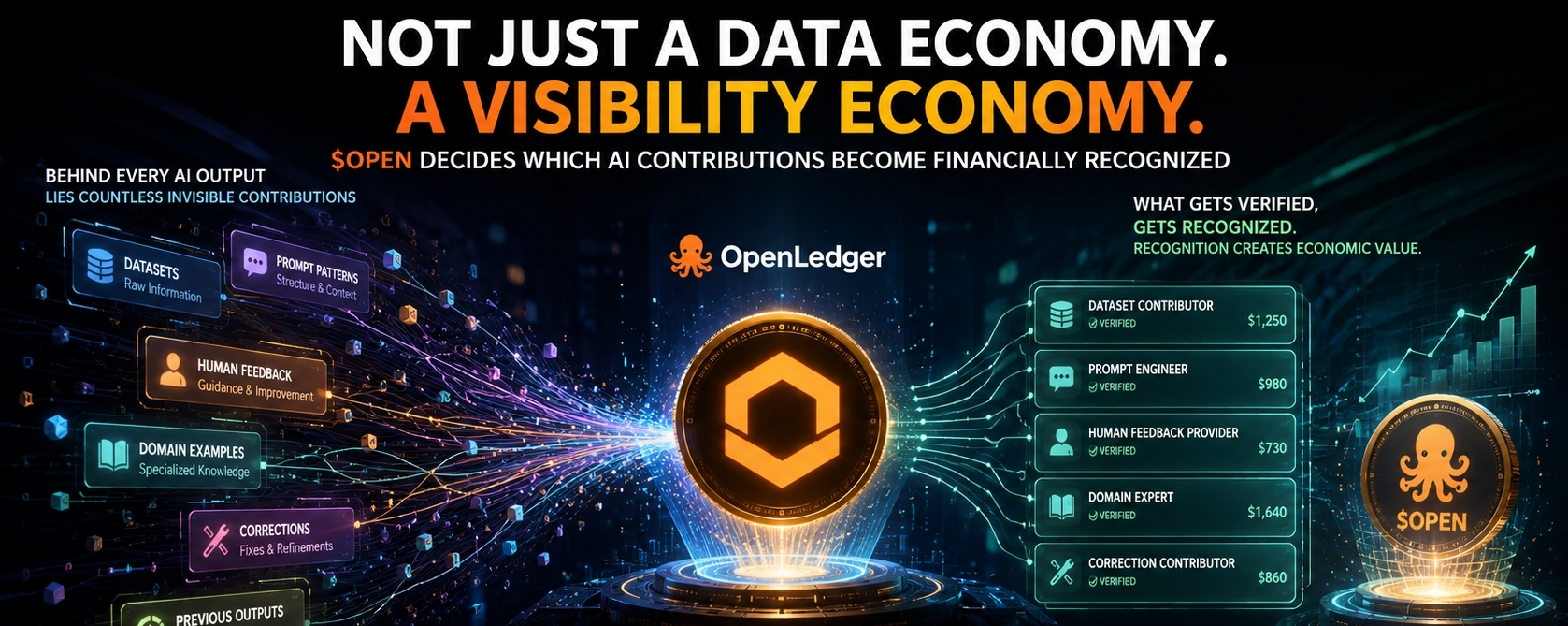
@OpenLedger There is something about the way people casually label projects as part of the “AI data economy” that always makes me slow down a little. The phrase sounds smooth and easy to understand, almost too easy, as if the difficult questions have already been solved before anyone even asks them. With OpenLedger, the surface explanation feels simple enough: contributors provide data, builders use it, rewards circulate through the network, and helps coordinate everything. That version is not exactly wrong, but it also feels incomplete. The more I think about it, the more it seems like the real idea behind OpenLedger may not be centered on data itself. It may be centered on something much more complicated — deciding which contributions inside AI systems become visible enough to carry economic value later on.
That distinction matters because contribution inside AI is rarely clean or isolated. Most useful improvements do not come from one perfect upload or one obvious action. A single model response can quietly depend on thousands of overlapping influences: niche datasets, prompt structures, corrections, domain-specific examples, reinforcement feedback, small edits, or tiny human interventions that improved the system without anyone noticing at the time. The problem is that markets are usually bad at rewarding things they cannot clearly see. When contribution becomes difficult to trace, it often stops being treated like ownership and starts becoming invisible labor. Valuable, yes, but impossible to properly recognize. What makes OpenLedger interesting is that it seems to be exploring whether contribution can remain economically visible instead of disappearing into the background once the model absorbs it.
That is why the common “marketplace” framing feels a little too shallow to describe what could actually be happening here. Traditional marketplaces are designed around direct exchanges. Someone sells, someone buys, the transaction finishes, and the value transfer is complete. But AI contribution behaves differently. A useful dataset or correction may continue influencing outputs long after the original contribution was made. In some cases, the value of that contribution only becomes obvious once it has been reused across different agents, applications, or models. Other times, something that initially looked unimportant becomes critical months later because the surrounding ecosystem changes. So the real challenge is not simply allowing participation. The deeper challenge is preserving enough structure around contribution that it can still be recognized, verified, and financially referenced later on instead of fading into model memory forever.
That is also where $OPEN starts to feel more important than just another token attached to platform activity. The system is not only dealing with incentives. It is dealing with eligibility. And eligibility is where things become complicated very quickly. Every network eventually needs rules that decide what counts, what deserves reward, which actions qualify, which contributions matter more, and which ones get ignored. Those decisions always look technical at first, but they slowly become economic and social questions because visibility itself has value. Once a system determines who can be recognized, it also determines who remains unseen. If OpenLedger successfully coordinates that layer, then $OPEN may not simply move through a data economy. It may sit much closer to the mechanism that decides which forms of AI contribution become economically real in the first place.
I keep thinking about the difference between disclosure and proof because the gap between those two things is probably larger than people realize. Disclosure is easy. Anyone can say they contributed something useful. But proof is different. Proof means the system can actually connect a contribution to meaningful outcomes in a way that others trust. Markets care about proof because proof creates pricing power. Without it, everything becomes noise. If OpenLedger can make contribution traceable without turning the entire process into a slow manual verification system, then the real product may not be data at all. It may be financial visibility — a structure that allows useful work inside AI systems to remain visible, reusable, and economically recognized over time.
At the same time, I do not think this automatically turns into a perfect bullish narrative, because visibility systems attract manipulation almost by default. The moment people understand that recognition leads to rewards, behavior changes. Participants stop focusing only on usefulness and start optimizing for what can be measured. Crypto has already lived through this cycle many times. Airdrop farming, engagement farming, liquidity mining, fake activity loops — entire ecosystems can appear active while producing very little durable value underneath. That is why short-term participation numbers alone probably will not say much about OpenLedger’s long-term strength. The more important thing to watch is whether builders, applications, or AI agents become dependent on verified contribution records over time. Dependency matters more than activity because dependency suggests the system is creating memory that others actually rely on instead of temporary incentives people abandon once rewards shrink.
That is where the market dynamic around $OPEN could become genuinely interesting. If the network only attracts contributors chasing emissions, then the token may struggle to hold deeper economic meaning. But if AI builders start needing verified contribution histories because those records reduce uncertainty, improve model quality, simplify payment logic, or make collaboration easier to trust, then the token begins sitting closer to the core coordination layer of the ecosystem. In that situation, OpenLedger would feel less like a simple data marketplace and more like infrastructure for financial recognition inside AI systems. And maybe that is the more important angle people are still underestimating. The real scarcity may not be data itself. It may be the ability to remain visible to the system as someone whose contribution mattered. Not social visibility or attention, but economic visibility — the ability to be recognized as useful, reusable, and worth rewarding long after the original contribution disappears into the machine