
After months of trading, I've realized something that completely changed my approach:
The market spends far more time ranging than trending.
Most traders are obsessed with predicting the next breakout or crash. They jump into every "Long now!" or "Short now!" call they see on social media. In reality, those predictions are often wrong, and constantly chasing them can quickly drain both your capital and your confidence.
Instead of trying to guess every move, I prefer building a system that can work while the market moves sideways.
Why I Like the Neutral Grid Strategy
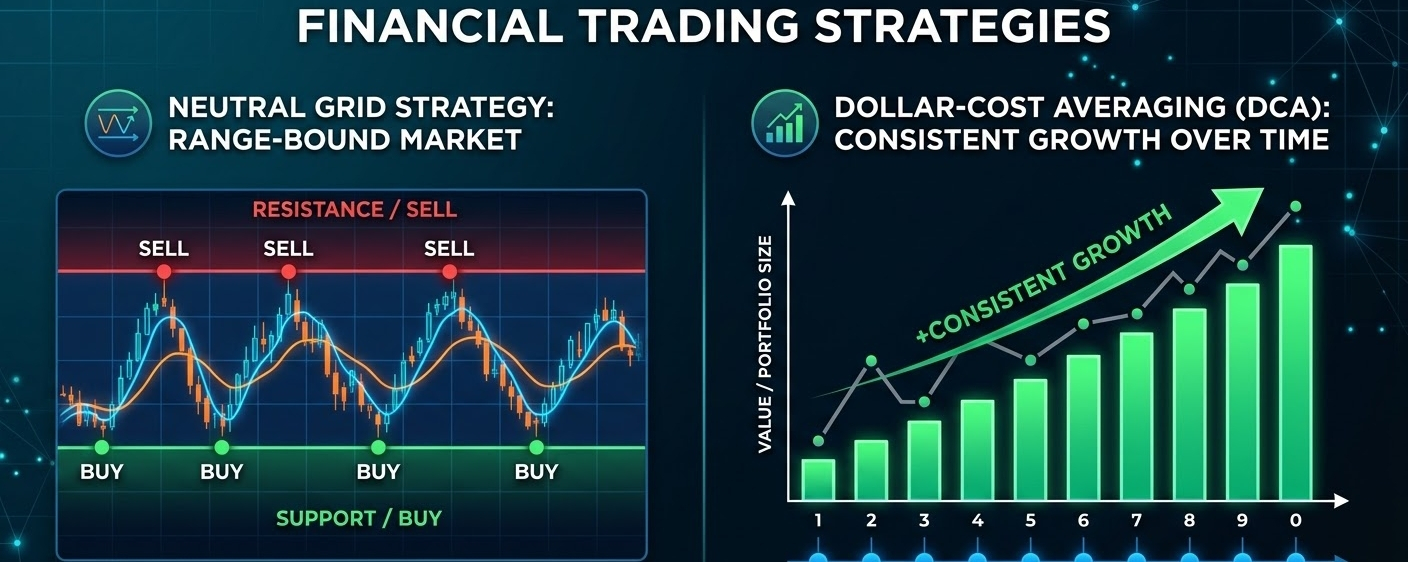
For range-bound markets, the Neutral Grid is one of my favorite tools. Rather than betting on a single direction, it aims to capture repeated price swings within a predefined range.
For example, if I believe an asset may trade between $55 and $85, I might allocate only 2% of my portfolio to a neutral grid strategy. This keeps most of my capital available for other opportunities.
If the price drops below the range, I still have the flexibility to accumulate spot positions. If it breaks above the range, I can reassess and take profits on existing holdings based on my own trading plan.
My Long-Term Edge: Consistent DCA
The strategy I trust most isn't predicting tops or bottoms—it's consistency.
Every week, I buy spot through Dollar-Cost Averaging (DCA) regardless of market sentiment. No panic. No FOMO. Just a disciplined process that removes emotion from investing.
Over time, I've found that discipline often outperforms excitement.
Final Thoughts
Successful trading isn't about making the perfect prediction. It's about managing risk, protecting capital, and following a strategy you can stick with through different market conditions.
The market will always be uncertain. Your trading plan shouldn't be.
This reflects my personal approach, not financial advice. Always do your own research and use risk management before making any investment decisions.