
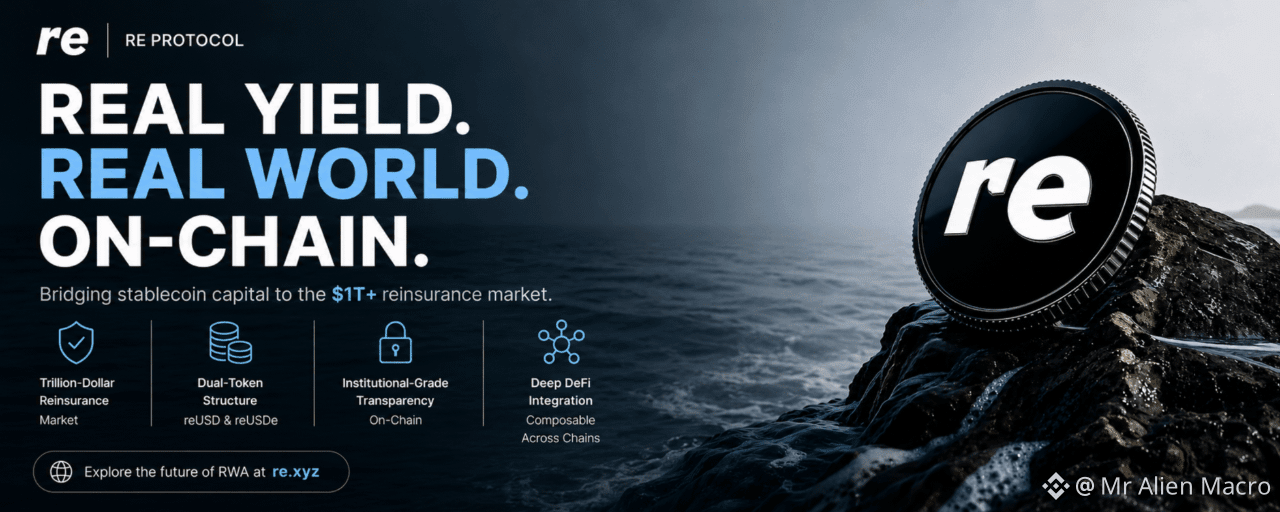
In the DeFi space, we’ve seen countless yield opportunities — lending, staking, basis trades, and more. Yet most of them remain highly cyclical and tightly correlated with crypto market sentiment. Today, I want to introduce a project that is taking a fundamentally different approach: Re Protocol, the bridge bringing stablecoin capital into the world of regulated reinsurance.
Reinsurance: A Massive, Underrepresented Asset Class
Reinsurance — often described as “insurance for insurance companies” — is a trillion-dollar market that protects primary insurers against large-scale claims from accidents, natural disasters, and other real-world events. Its returns are driven by insurance premiums and are structurally uncorrelated with traditional financial markets or crypto cycles.
However, this market has historically been opaque, intermediary-heavy, and accessible only to large institutions. Re Protocol changes that by allowing KYC-verified users to deploy stablecoins into fully collateralized quota-share reinsurance contracts through licensed reinsurers. This is real yield backed by real-world insurance premiums — not just token incentives.
This is the core thesis: onboarding a trillion-dollar traditional asset class on-chain for the first time (Angle 1).
Dual-Token Structure: One Yield Source, Two Risk Profiles
At the heart of Re Protocol are two innovative yield-bearing tokens built on the same underlying yield (a blend of SOFR and sUSDe basis trade rates, plus a token-specific spread):
reUSD (Senior Tranche – Basis Plus): Lower risk, +250 bps spread. Prioritizes capital preservation with faster redemptions when liquidity is available. Ideal for conservative yield seekers.
reUSDe (Junior Tranche – Insurance Alpha): Higher risk/reward, +850 bps spread. Absorbs losses after the reinsurer’s equity but offers significantly higher yield potential. Redemptions occur quarterly.
This senior/junior tranche design mirrors traditional finance structures while bringing them fully on-chain. Users can now choose their preferred risk level within the same reinsurance portfolio (Angle 2).
Institutional-Grade Transparency and Security
One of Re Protocol’s strongest differentiators is its end-to-end transparency and robust security:
Funds are swept daily into Fireblocks custody.
Off-chain bank balances are attested daily by The Network Firm and published on-chain via Chainlink oracles.
Every Surplus Note drawdown and repayment is visible on-chain.
Smart contracts have been dual-audited by Certora and Hacken.
Critical operations use MPC multi-signature wallets with role separation and a 48-hour timelock.
The project recently secured strategic investment from Coinbase Ventures, further validating its institutional credibility. Users can monitor everything in real-time through the official Transparency Dashboard (Angle 3).
Deep DeFi Composability and Ecosystem Integration
Both reUSD and reUSDe are standard ERC-20 tokens deployed across multiple chains (Ethereum, Base, Arbitrum, Avalanche, and more). They are already integrated into leading DeFi protocols including Curve, Pendle, Morpho, and Euler — allowing users to not only earn reinsurance yield but also stack additional returns through LP positions, lending, or fixed-rate strategies.
The Re Points program further incentivizes participation with attractive multipliers (e.g., 5x for reUSD, up to 30x for certain Pendle LPs). This composability turns reUSD into a true RWA-native yield primitive within the broader DeFi ecosystem (Angle 4).
Current Metrics and My Analyst Perspective
Re Protocol has already attracted significant capital, with a diversified underwriting portfolio across low-volatility lines such as homeowners, commercial auto, and workers compensation. reUSD has built notable market presence, and secondary market liquidity continues to grow through integrations.
My take: Re Protocol represents the next evolution of RWA — moving beyond tokenized Treasuries into genuinely differentiated, real-economic-activity-backed yield. In a maturing DeFi market searching for sustainable, uncorrelated returns, this could become a core holding for diversified portfolios.
That said, risks remain:
Insurance risk (mitigated by collateralization and junior buffers).
Redemption mechanics (potential queues for reUSD, quarterly windows for reUSDe).
KYC/AML requirements and jurisdictional restrictions.
As always, position sizing and thorough due diligence are essential.
Final Thoughts
Re Protocol is more than just another yield product — it is infrastructure that connects DeFi capital to one of the world’s largest and most essential financial markets. For those seeking real yield, transparency, and portfolio diversification, it deserves serious attention.
What are your thoughts? Would you allocate to the safer reUSD or the higher-yielding reUSDe? Drop your opinions below — I’m reading every comment.
Useful Links:
App & Dashboard: https://re.xyz/ & https://app.re.xyz/
Documentation: https://docs.re.xyz/
Transparency: https://app.re.xyz/transparency
Thesis: https://re.xyz/thesis
Disclaimer: This is for educational and informational purposes only. It is not financial advice. Always DYOR and manage your own risk.
Follow @re_protocol on Binance Square for the latest updates.