
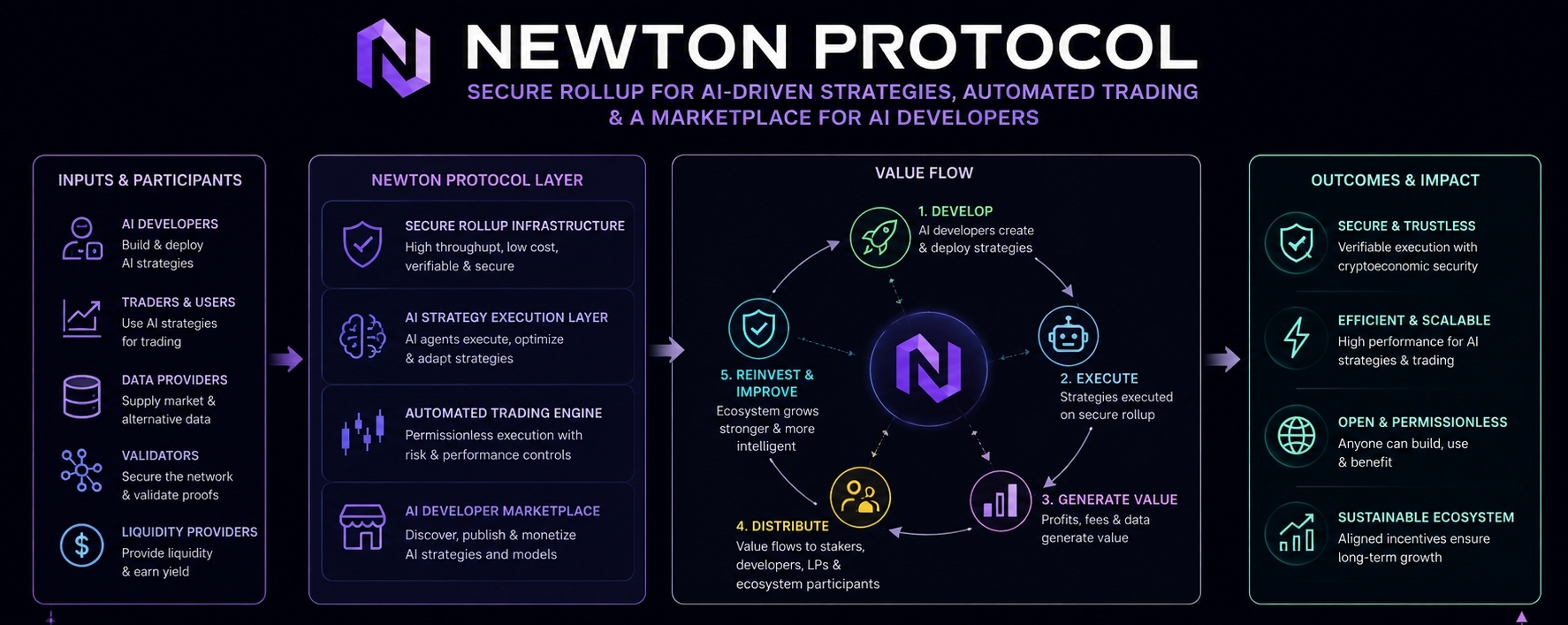
@NewtonProtocol I’m watching Newton Protocol with more questions than expectations. I’m waiting to see what happens after the early excitement fades and people start using it because they actually need it, not because it's new. I’ve been noticing that the biggest ideas often feel the most convincing before they meet real pressure, and that keeps me from making quick judgments. I keep coming back to the same thought: what changes once people begin acting in their own interests instead of following the vision everyone talks about today?
On paper, the idea makes sense. A secure rollup built around AI-driven strategies, automated trading, and a marketplace for AI developers feels like a natural direction. AI is becoming part of everything, and finance has always moved toward automation whenever it could. But I've learned that when several exciting ideas come together, it's worth slowing down instead of speeding up. Sometimes the story becomes so compelling that it's easy to stop asking difficult questions.
The question I can't shake is whether technology really changes human behavior or simply gives it better tools. Markets have always been driven by incentives. People compete, protect their own advantage, and adapt whenever the rules change. I don't see AI removing those instincts. If anything, it might make them harder to notice because decisions happen faster and behind another layer of software.
That makes me think less about the technology itself and more about the people using it. Every protocol eventually becomes a reflection of its community. Developers build, traders compete, investors search for opportunity, and everyone believes they're acting rationally. But when enough incentives collide, the outcome isn't always what anyone expected in the beginning.
I also find myself thinking about trust. It's easy to trust something when everything is working. The real test comes when conditions become uncomfortable. That's when hidden assumptions start showing themselves. That's when the strongest systems usually prove why they deserve confidence—or why they never really had it in the first place.
The marketplace is another part I keep returning to. An open marketplace sounds fair, but open doesn't always stay balanced. Over time, attention has a habit of gathering around a small number of people, projects, or strategies. It happens almost everywhere. Maybe that's normal, but it still makes me wonder how much control quietly shifts without anyone realizing it.
I'm not looking at Newton Protocol because I expect it to fail. I'm looking because I think the hardest questions haven't appeared yet. They usually arrive later, when growth slows, when incentives become more complicated, and when every participant starts optimizing for themselves instead of the broader vision.
So I keep watching. I keep reading. And the more I do, the less interested I become in the promises. What holds my attention now are the quieter things—the incentives nobody talks about, the pressure that hasn't arrived yet, and the possibility that what looks solid today might depend on parts of the system we haven't really noticed.