
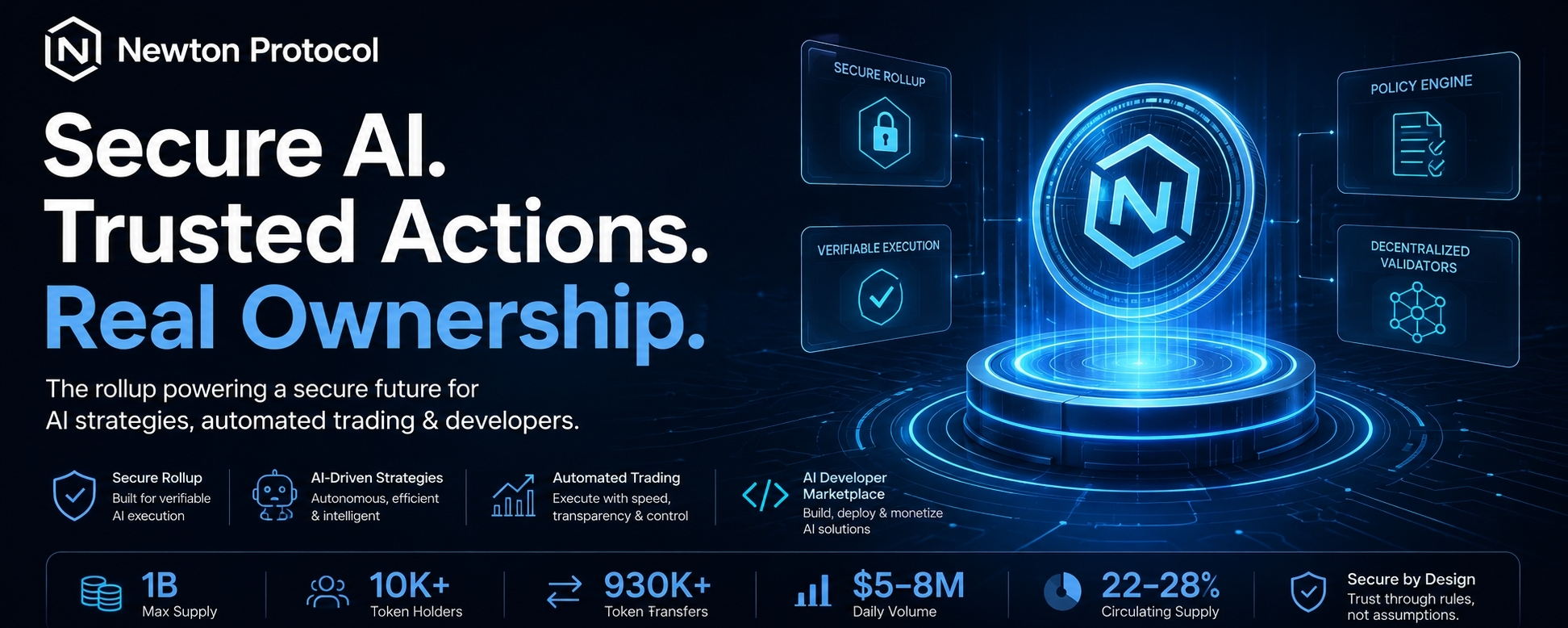
Newton Protocol (NEWT) feels less like another AIcrypto experiment and more like someone quietly trying to fix a problem everyone is about to run into but hasn’t fully felt yet: what happens when AI agents are allowed to move money, execute trades, and interact with financial systems on your behalf without constantly asking for permission in human language.
The way most systems are being built right now is simple in theorygive AI more autonomy, connect it to wallets, and let it act. But that simplicity hides a messy truth. The real bottleneck is not intelligence. It is control. As soon as an AI can act, the question shifts from “can it do this?” to “should it be allowed to do this under these exact conditions, with these limits, at this exact time.” Newton is trying to turn that question into infrastructure rather than an afterthought.
Over the last few months, Newton’s direction has started to feel more defined. The move toward a live mainnet beta changed it from a design idea into something that can actually be stress-tested. That matters because permission systems only look good in diagrams. In real environments, they get tested by weird edge casesagents looping transactions, unexpected market spikes, or users delegating too much control. Early activity suggests the system is now being evaluated under real pressure instead of controlled assumptions.
Another shift is how emissions and supply visibility are being handled. With a total supply capped at 1 billion NEWT and only roughly a quarter of it circulating so far, the network is still early in its distribution curve. Around 215276 million tokens are currently in circulation depending on reporting snapshots, which means the market is still pricing in a future that hasn’t fully arrived yet. Daily trading volume sometimes reaches $58 million, which is relatively high compared to its ~$1014 million market cap, hinting that speculation is still louder than actual usage. At the same time, more than 900,000 transfers recorded on-chain suggest that activity is not purely passive holding either—it is still an evolving mix of experimentation and positioning.
One of the more interesting design directions is how Newton treats AI execution as something closer to a regulated supply chain than a free-running engine. Instead of one AI “doing things,” you have layers: models propose actions, policy systems approve or reject them, and distributed validators enforce those rules. It starts to look less like a single brain and more like an airport security system where every action must pass multiple checkpoints before takeoff. That framing matters because it changes where value accumulatesnot in intelligence itself, but in the control points between intelligence and execution.
There is also a quieter shift happening in how “trust” is being redefined. Traditional crypto systems assume trustlessness through code execution. Newton instead leans toward structured trustwhere you are not trusting a single AI agent, but trusting a set of rules that the agent cannot bypass. It is a bit like hiring a very smart assistant but giving them a contract that physically prevents them from booking flights over a certain budget or trading outside certain hours. The intelligence is unrestricted, but the authority is carefully bounded.
This is where token design becomes more than economics. NEWT is not just a payment token; it behaves more like a coordination signal between users, validators, and AI systems. Demand comes from usage of policy execution and staking for network security, while supply pressure comes from gradual unlock schedules. The tension between these two forces will matter more than any short-term price movement. If AI-driven automation grows faster than emissions, the token becomes a bottleneck resource. If not, it becomes a passive incentive layer competing with inflation.
There are still open questions that are hard to ignore. A large portion of tokens remain held by top wallets, which is normal at this stage but still centralizes influence over governance and liquidity. It is also not yet clear whether developers will fully adopt a shared authorization layer like Newton or prefer to build custom permission logic inside each AI application. Infrastructure only wins when it becomes invisibleand invisibility is extremely hard to earn.
The most interesting way to think about Newton is not as an AI platform, but as something closer to a braking and control system for a future where AI is allowed to touch financial reality. Intelligence is the engine, but Newton is trying to define the rules of the road. That is a less visible role, but potentially a more foundational one.
If you zoom out, a few signals will decide whether this idea becomes real infrastructure or just another early experiment. The first is whether real applications start plugging into its authorization layer rather than bypassing it. The second is whether staking becomes meaningful enough that participants prefer securing the network over trading the token. The third is whether fee generation from actual policy enforcement begins to show up consistently, not just sporadically.
In a space obsessed with making AI more powerful, Newton is focused on making AI less dangerous in practice. That may not sound as exciting at first glance, but in systems where machines can move value, control often becomes the product itself.
