A few days ago I found myself reading through Newton again.
Not because of a big announcement.
Not because everyone was talking about it.
Actually it was the opposite.
The project seemed to be quietly building while most attention was focused elsewhere. That usually makes me curious because some of the most important design choices in crypto are made when nobody is paying attention.
While reading, I kept coming back to a thought that had nothing to do with transaction speed, fees, or adoption numbers.
I started thinking about intentions.
That sounds strange because blockchains do not understand intentions.
They understand instructions.
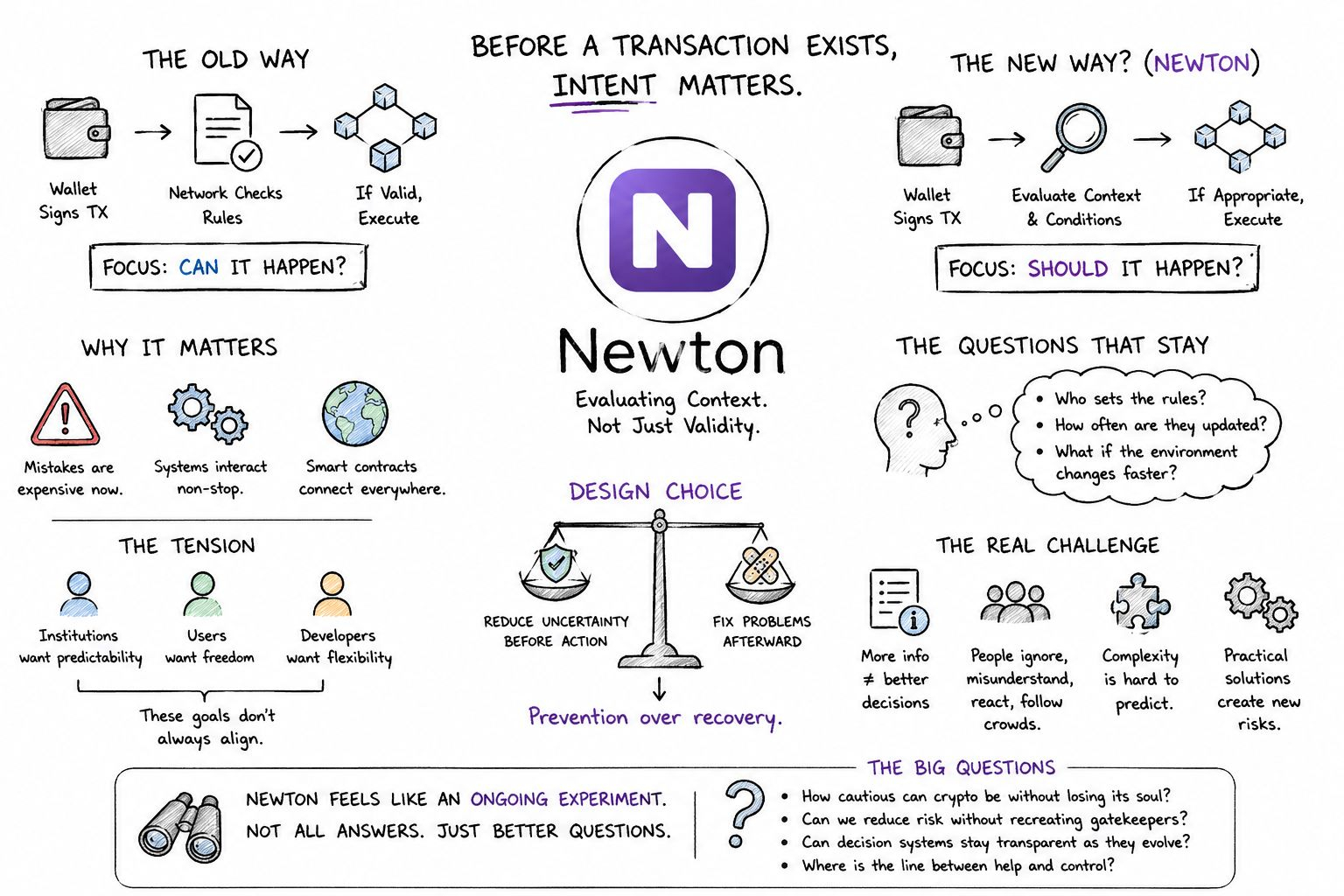
A wallet signs a transaction. The network checks whether the transaction follows the rules. If everything is valid, the action moves forward.
That process has worked for years.
But the longer I spend around crypto, the more I notice that validity and good decision-making are not always the same thing.
A transaction can be completely valid and still create a terrible outcome.
I think that is where Newton caught my attention.
Most protocols seem designed around the assumption that users know exactly what they are doing. The network acts almost like a machine that follows commands without asking questions.
Newton appears to be exploring something different.
What if some evaluation happens before execution?
What if the system becomes more aware of context rather than only checking whether a signature is correct?
The interesting part is that this idea feels both useful and dangerous at the same time.
Useful because crypto has reached a point where mistakes are becoming expensive.
A single click can move large amounts of value.
Automated systems interact with each other continuously.
Smart contracts connect across different environments.
The ecosystem today is much more complicated than it was a few years ago.
At the same time, adding more decision layers creates new risks.
Who defines the conditions being evaluated?
How often are those conditions updated?
What happens when the environment changes faster than the rules?
These questions stayed in my head longer than I expected.
The reason is simple.
I have seen many crypto projects try to solve one problem while quietly creating another.
Sometimes stronger security reduces flexibility.
Sometimes better efficiency reduces transparency.
Sometimes automation removes human judgment exactly when human judgment is needed most.
Every design choice creates consequences somewhere else.
While thinking about Newton, I started comparing it to how most crypto infrastructure evolved.
Traditionally, networks have focused on creating neutral environments.
The chain does not care whether a transaction is smart, reckless, profitable, or harmful.
The chain only cares whether it is valid.
That neutrality became one of crypto's strongest characteristics.
Newton seems to be testing the edges of that idea.
Not by replacing neutrality completely.
More by asking whether pure neutrality is enough for the next stage of adoption.
I think that question deserves more attention than it gets.
When people talk about bringing larger organizations into crypto, the conversation usually revolves around regulation, liquidity, or user experience.
Rarely do people discuss decision quality.
Yet decision quality affects everything.
An institution entering crypto often wants predictability.
A retail user often wants freedom.
Developers often want flexibility.
These goals do not always align.
The more participants enter a network, the harder it becomes to satisfy everyone at the same time.
That tension feels visible inside Newton's design.
One thing I find interesting is that the project seems focused on reducing uncertainty before actions happen rather than fixing problems afterward.
Many systems are built around recovery.
Newton appears more interested in prevention.
At first glance that sounds like a better approach.
Then I started questioning my own assumption.
Can prevention become too restrictive?
Can systems become so focused on avoiding mistakes that they reduce experimentation?
Crypto grew partly because people could try things without asking permission.
That freedom created innovation.
It also created chaos.
Both things happened together.
Sometimes I think people forget that.
We often celebrate the innovation while acting surprised by the chaos.
In reality they came from the same source.
That is why Newton feels difficult to evaluate.
The trade-offs are not obvious.
The benefits are easier to imagine than the long-term consequences.
What happens when decision frameworks become increasingly sophisticated?
Do they remain understandable to ordinary users?
Or do they slowly become another layer that only specialists can interpret?
I do not have an answer.
I am not sure anyone does.
Another observation kept bothering me while reading.
Crypto often assumes that more information automatically leads to better decisions.
Real life does not work that way.
People ignore information.
People misunderstand information.
People react emotionally.
People follow crowds.
Any system designed around human behavior eventually encounters these realities.
Newton appears aware of that problem.
At least from what I have observed, the project seems less interested in perfect users and more interested in imperfect environments.
That feels practical.
But practicality creates its own challenges.
The closer a protocol gets to human behavior, the harder outcomes become to predict.
Code is easier to model than people.
Rules are easier to understand than incentives.
That uncertainty may end up becoming the most important test for Newton.
Not whether the technology works.
Whether the assumptions about behavior hold up under real-world pressure.
For now, I mostly find myself watching rather than judging.
The project feels less like a finished answer and more like an ongoing experiment.
Maybe that is why I keep returning to it.
Not because everything looks solved.
Because some of the questions it raises seem larger than the project itself.
Can crypto remain open while becoming more cautious?
Can networks reduce risk without recreating old gatekeepers?
Can decision systems stay transparent as they become more complex?
And if a protocol starts helping users make better choices, where exactly is the line between assistance and control?
I have been thinking about those questions more than the actual features lately.
That alone probably tells me why Newton continues to stay on my radar.