
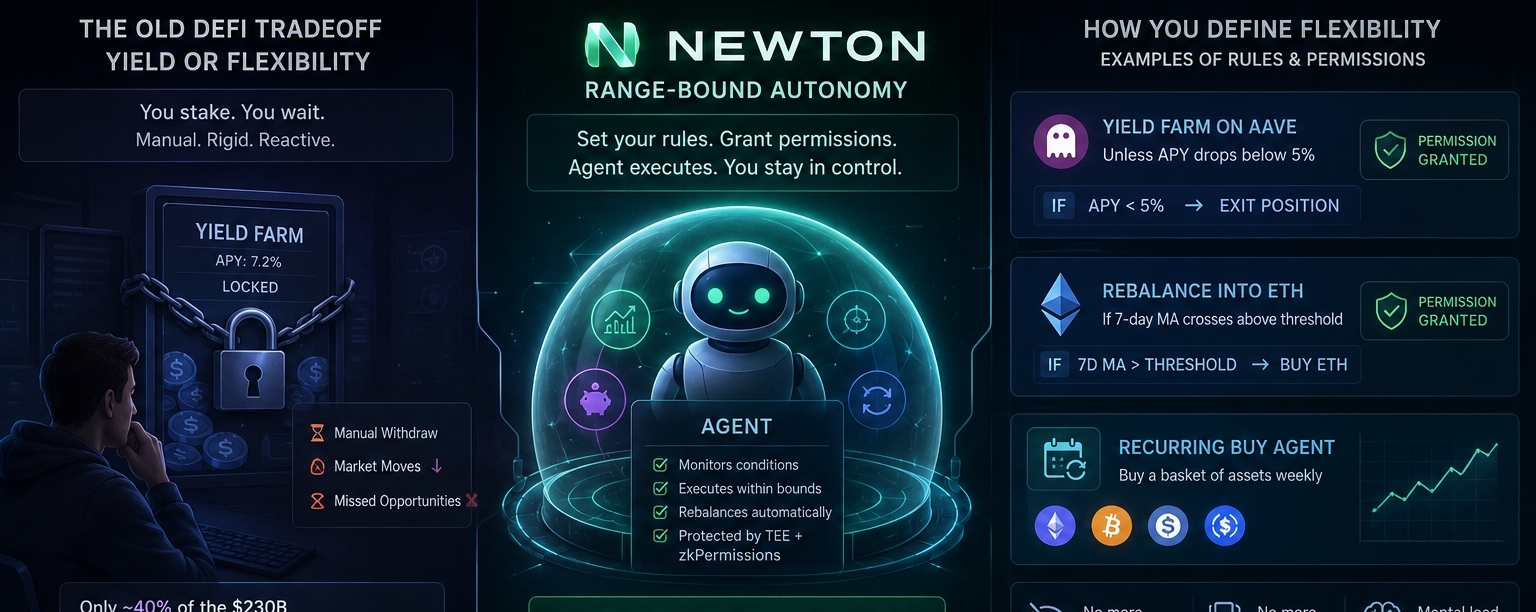
I finally unstaked snewt $USDC from a yield farm last week. Not because the APY dropped it was still decent, but because I needed access to that capital for something else. The problem wasn’t the yield; it was the withdrawal period. The chain and the strategy were basically locking me into a choice: earn yield, or be flexible. It’s a tradeoff baked into DeFi since day one, and we’ve all just accepted it.
@NewtonProtocol doesn’t fix that by making everything liquid. It fixes it by changing how we define what “flexibility” even means. The yield was there, but the automation was rigid. You want a strategy that rebalances? Great. You’ll get the yield, but you’re married to the conditions you set at the start. The moment market conditions shift or you need to move capital, you’re stuck waiting for the manual override.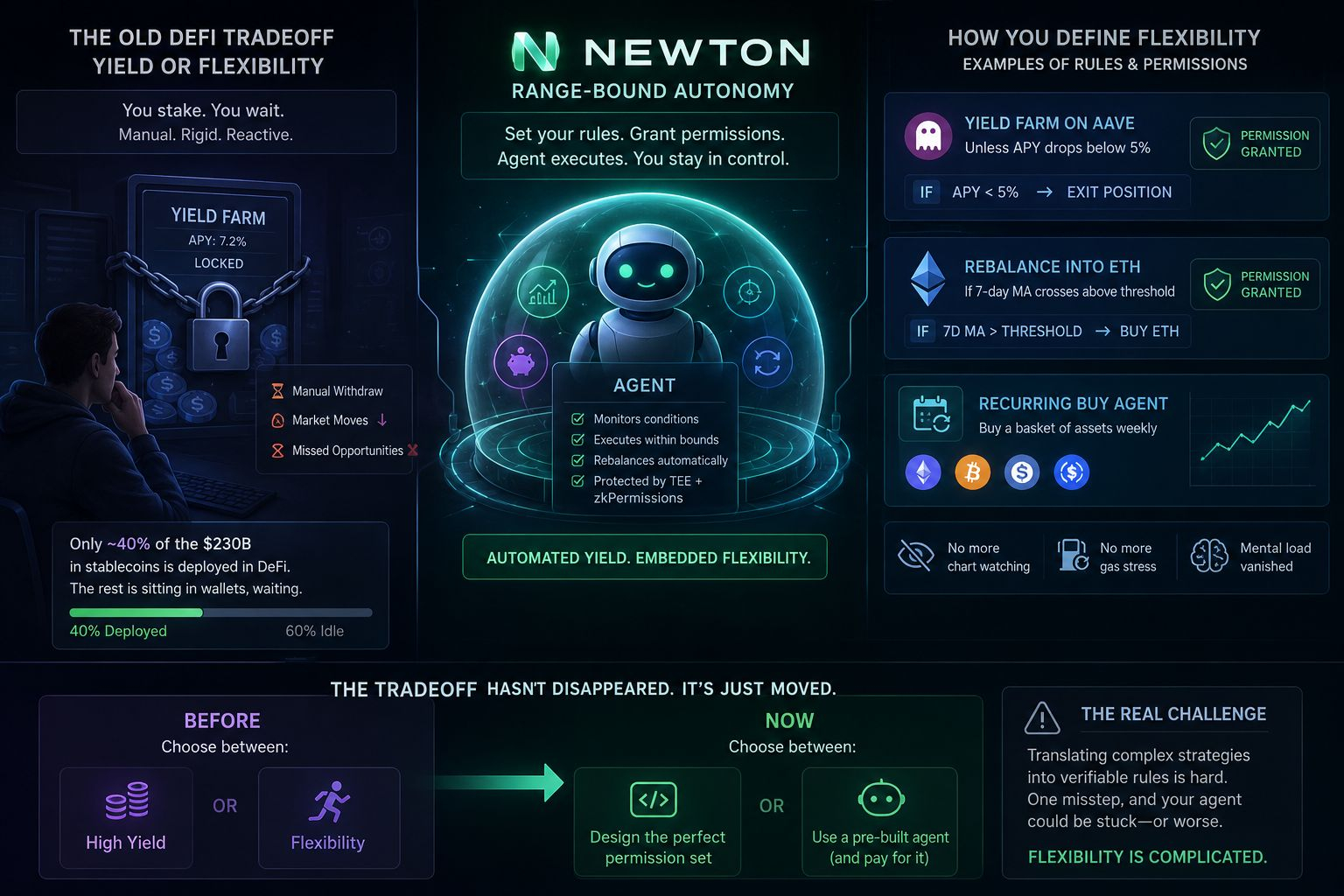
The shift with $NEWT is subtle, but I felt it immediately. It’s not just about automating trades; it’s about building a relationship with an agent that can respond without constant hand-holding. The stat that keeps nagging at me is that only about 40% of the $230 billion in stablecoins is actively deployed in DeFi . The rest is sitting in wallets, waiting. Why? Because people are terrified of the overhead. They don't want to sacrifice the ability to move on a whim.
Newton’s "range-bound autonomy" actually made me less anxious about locking in a strategy . You can give an agent a set of instructions say, yield farm on Aave unless the APY drops below 5%, or rebalance into $ETH if the weekly moving average hits a certain level and the agent just does it. It uses the TEE and zkPermissions to ensure it never steps outside the bounds you set. The yield is automated, but the flexibility is embedded in the rules. You’re not surrendering control; you’re just setting up guardrails and letting it run.
I remember setting up a recurring buy agent for a basket of assets, and the mental load just vanished . The yield wasn’t astronomical, but that wasn’t the point. The point was that I wasn’t constantly checking charts or gas fees. I had given the agent its marching orders and a permission set that was granular enough to make me comfortable.
What I still worry about, though, is the complexity of defining those permissions. The zkPermissions circuit is powerful, but there’s a friction in translating a complex strategy into a rule set that the agent can verify. It’s like writing a smart contract for a strategy that’s meant to be flexible the logic can get overwhelming fast. There’s a tension there between the promise of automation and the cognitive burden of setting it up correctly. One misstep in the parameters, and your "flexible" agent could be stuck, or worse, executing a strategy you didn't actually intend.
The tradeoff hasn't disappeared. It’s just moved. Instead of choosing between earning yield and being able to move your money, you’re choosing between spending the time to design the perfect permission set or paying the fee for a pre-built agent that might not be exactly what you need. The yield is there, the flexibility is... complicated.