
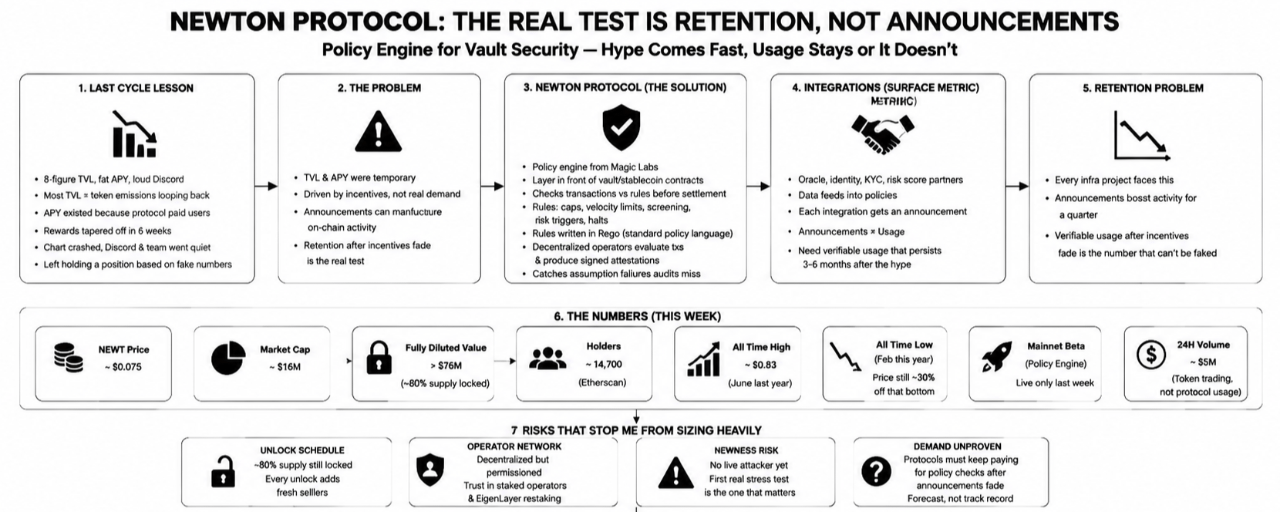

I still think about a vault protocol I rode hard in the last cycle. The dashboard showed eight figures in TVL, a fat APY, and a Discord that felt like a trading floor at 2pm on a Tuesday. None of that was fake exactly, it was just temporary. Most of the TVL was the token's own emissions looping back into the vault, and the APY existed because the protocol paid people to show up. Six weeks after the rewards tapered off, the chart looked like someone pulled a plug. The Discord went quiet, the team went quiet, and I was left holding a position sized on numbers that were never really there.
Newton Protocol is trying to solve a problem adjacent to that one. It's a policy engine from Magic Labs, the embedded wallet company: a layer in front of a vault or stablecoin contract that checks a transaction against a set of rules before it settles. A curator can write a policy that caps withdrawals, adds velocity limits, screens counterparties, or halts activity if a price feed or risk score crosses a line, with the check happening on-chain instead of in a spreadsheet. Builders write the rules in Rego, a standard policy language, and a decentralized set of operators evaluates each transaction and produces a signed attestation anyone can check later. The pitch is that it catches assumption failures audits miss, when a contract behaves exactly as written but the behavior turns out wrong under stress.
Here's where my old scar starts itching again. Newton has racked up a real list of integrations this year, oracle and identity partners feeding price data, KYC checks, and risk scores into its policies, and each one gets its own announcement post. That's the surface metric, and surface metrics are exactly what got me last time. An announcement tells you a contract got deployed, not whether that policy engine is still getting called on real transactions three months from now when nobody's writing about it. The actual retention problem here is the same one every infrastructure project faces: announcements can manufacture on-chain activity for a quarter, but verifiable usage that keeps showing up after incentives fade is the number that can't be faked.
The numbers this week back up the caution. NEWT trades around seven and a half cents, with a market cap a little north of $16 million against a fully diluted value above $76 million, meaning roughly four fifths of supply is still locked and waiting to hit the market. CoinMarketCap shows about 14,700 holders on Etherscan, an all time high near $0.83 set in June last year on listing momentum, and a fresh all time low this past February, with price still under 30 percent off that bottom. The mainnet beta of the actual policy engine, the part doing the vault security work, only went live last week, so anyone claiming months of usage data on the product itself is making it up. Volume printed around $5 million in the past 24 hours, which sounds fine until you remember volume measures token trading, not protocol usage.
A few things would stop me from sizing this heavily even if I liked the architecture. The unlock schedule is the obvious one: with four fifths of supply still to enter circulation, every unlock adds fresh sellers regardless of how the technology performs. The operator network is decentralized but permissioned, a meaningful caveat, since you're trusting a defined set of staked operators and the EigenLayer restaking model underneath them, not a fully open validator set. There's also plain newness risk: a system built to catch edge cases audits miss hasn't faced an actual attacker yet, and the first real stress test of any security product tends to be the one that matters most. And demand is still unproven, since every integrated protocol has to keep paying for policy checks once the announcement stops being newsworthy, and right now that's a forecast, not a track record.
What I'm actually watching is boring on purpose. Fee revenue from policy checks growing month over month once the launch noise dies down matters more to me than the next partnership tweet. I want repeat transaction counts from the same integrated protocols three and six months out, the kind of number nobody screenshots, more than a running tally of total integrations announced. And I want quiet weeks, stretches with no announcements at all, where the chain data still shows the engine getting used anyway. That's the version of this story that doesn't end with a Discord going silent.
If you're in this, treat it as a bet on an engineering thesis playing out over a couple of years, not the next leg of price action, because the unlock math alone will fight you on short timeframes. I'm not telling you to buy it or avoid it, I'm telling you what would change my mind, and right now the product is a week old wearing a year-old token's scar tissue. So here's what I actually want to know: are you tracking fee revenue and repeat usage anywhere, or still judging infrastructure projects by announcement frequency? And if a security layer's real test only comes from a live attacker, how many quiet months would you need before trusting it with size?