Newton Protocol introduces a missing layer in Web3: the authorization layer between transaction intent and onchain execution. Today, blockchains execute transactions instantly after signing without built-in compliance, identity checks, or risk controls; Newton adds a pre-execution decision system that can approve or reject transactions before settlement, similar to Visa-style authorization in traditional finance. It is not a blockchain, wallet, or custodian, but infrastructure that works across chains and applications to enable programmable, verifiable authorization without central control. Its design is built on three pillars: Verifiable Credentials, where users can prove attributes like KYC, jurisdiction, accreditation, or sanctions status without revealing raw identity data; Programmable Policies, where compliance rules are written in Rego (OPA) and evaluated by a decentralized operator network for deterministic enforcement; and Cross-Chain Interoperability, where a single policy layer can enforce rules across multiple blockchains. The system works through a flow of transaction intent → policy evaluation → decentralized attestation → smart contract execution or rejection. Importantly, Newton does not custody funds, replace wallets, or act as a centralized compliance vendor; instead, it preserves credible neutrality through decentralized operators, open standards, and verifiable execution. The result is a structural shift from permissionless execution alone to programmable, verifiable authorization before execution, where finance becomes code, trust becomes verifiable, and compliance becomes programmable infrastructure.$NEWT #Newt @NewtonProtocol 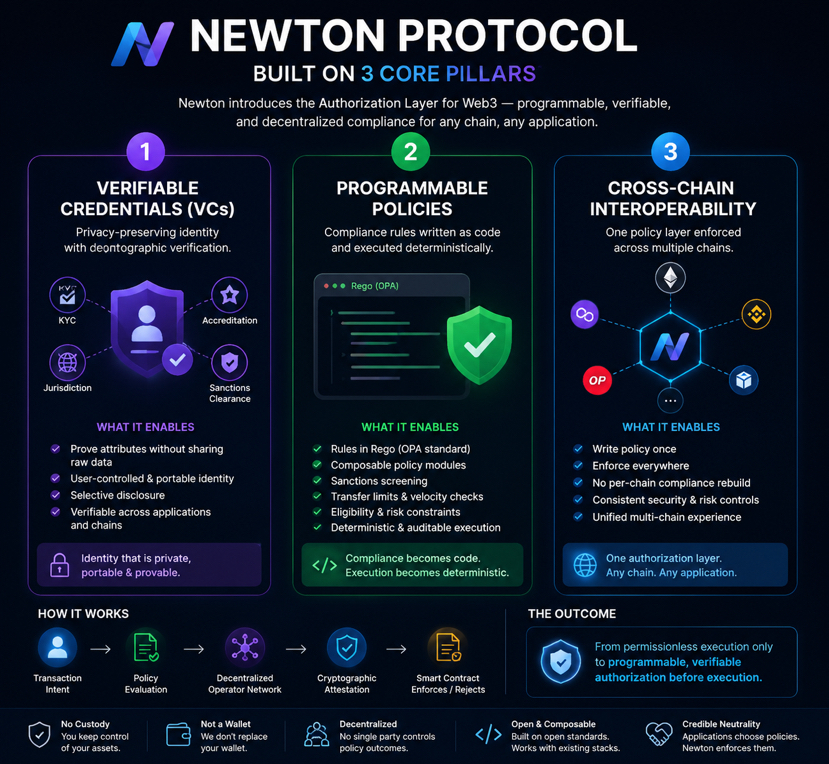

Статья
Newton Protocol — The Missing Authorization Layer in Web3
Отказ от ответственности. Содержит мнения третьих сторон. Не является рекомендацией. Binance AI не предоставляет гарантий. См. Правила и условия.