
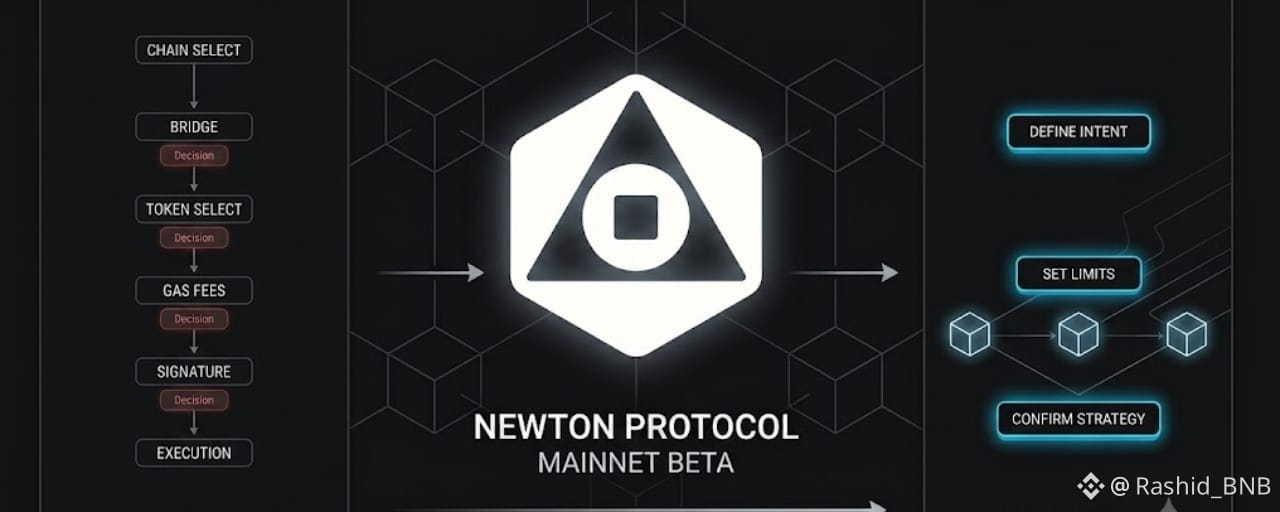
It took me a while to realize that the biggest obstacle to DeFi adoption may not be technical limitations, but the amount of mental effort required from users.
For years, conversations have focused on throughput, fees, scalability, and security. Those improvements matter, yet many people don’t leave DeFi because blockchains are too slow—they leave because every interaction demands another decision.
Choosing a network, selecting a bridge, connecting a wallet, swapping tokens, estimating gas, approving signatures—each transaction becomes a sequence of choices. Even when everything functions perfectly, users are expected to stay constantly attentive.
That feels less like a blockchain problem and more like a usability challenge.
We’ve often treated decentralization as if it means users must manage every detail themselves. But those ideas don’t have to be inseparable.
The internet followed a similar path. Early users needed to understand technical infrastructure just to accomplish simple tasks. Over time, most of that complexity moved into the background, allowing people to focus on outcomes rather than mechanics.
Perhaps DeFi is approaching a similar transition.
What stands out about Newton Mainnet Beta isn’t simply another feature—it’s the philosophy behind the design.
Rather than optimizing how users execute transactions, it appears to focus on reducing the number of decisions users need to make.
That may sound like a subtle distinction, but it has meaningful implications for user behavior.
In today’s DeFi, people monitor markets, compare data across platforms, and manually trigger each action. The protocol responds only after the user acts.
Newton’s approach explores a different model, where automated agents can execute predefined instructions based on conditions chosen in advance by the user.
If that model proves effective, users may shift from carrying out every action themselves to defining objectives and boundaries while automation handles execution.
That’s a notable change.
Automation isn’t only about saving time. Its larger impact may be freeing attention for higher-level thinking instead of constant reaction. The difference between planning and reacting often comes down to how much cognitive load the system places on the user.
Naturally, this introduces a new trade-off.
As more execution is delegated to intelligent agents, trust moves away from manual clicks and toward the rules governing those agents. The question changes from "Did I make the right move?" to "Did I define the right intent?"
That’s a different form of responsibility.
Maybe that’s the most interesting part.
Many technologies promise to reduce effort, but the real transformation usually comes from changing which decisions humans still need to make.
If Newton Mainnet Beta succeeds in moving DeFi toward an intent-driven model—where users specify goals and the system manages execution—the biggest shift may not be the protocol itself, but the way people interact with decentralized finance.
Years from now, we might look back and realize that DeFi’s defining breakthrough wasn’t faster blockchains or lower fees, but making the blockchain fade into the background of the user experience.