"Oracle health is an infrastructure problem, leverage and counterparty risk are financial problems, and bundling them into one risk evaluation is mixing categories that don't actually belong together." That's a real objection I've heard about Newton's risk domain, and it deserves more than a dismissive response, because it's not obviously wrong on its face.
The case for keeping these separate has some real logic behind it. Oracle health is, technically, a data infrastructure question, is a price feed live, is it within an acceptable staleness window, has it been manipulated. Leverage and counterparty exposure are financial questions, how much borrowed capital is backing a position, how exposed is a vault to a single counterparty failing. Treating an infrastructure question and a financial question as one evaluated condition can look, from a systems-design perspective, like conflating two different layers of a stack that would be cleaner kept apart.
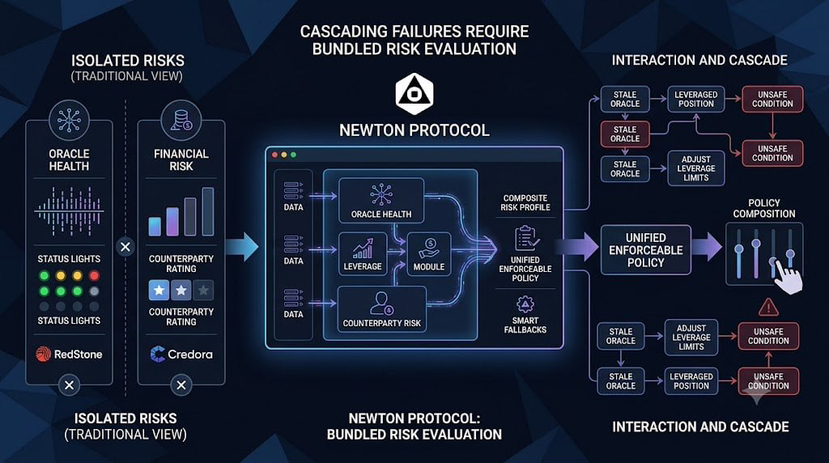
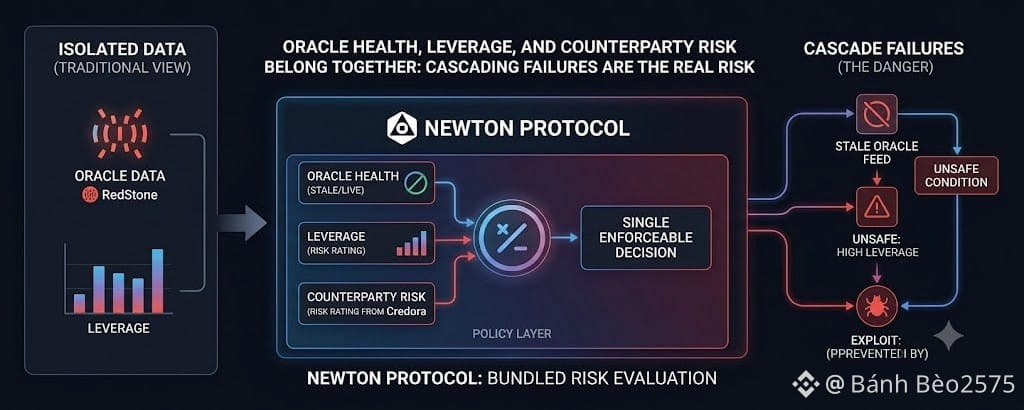
The case against keeping them separate is that real liquidations rarely happen because of one clean, isolated failure. A position with healthy leverage and a strong counterparty profile can still get liquidated wrong if the price oracle feeding it goes stale for ninety seconds during a volatile move, producing a momentarily false read on collateral value. A position with a perfectly fresh oracle feed can still implode if leverage is stacked too aggressively against a counterparty whose own exposure was never properly modeled. The failures cascade into each other rather than staying neatly contained inside their own category, which is exactly the pattern Newton's risk domain is designed around.
Newton's actual architecture treats these as one evaluated condition specifically because isolating them misses the cases where they interact. RedStone supplies the price data, Credora supplies the risk ratings, and Newton's policy layer composes both into a single enforceable decision rather than running two separate checks that don't talk to each other. A curator can define a policy where a stale oracle feed triggers a more conservative leverage threshold automatically, rather than treating "the data might be wrong" and "the position might be too leveraged" as unrelated questions a system has to reconcile manually after the fact.
Whether one side of this debate outweighs the other depends heavily on the specific vault and strategy in question. A simple, single-asset vault with deep, liquid markets and a reliable, long-standing price feed has less to gain from bundled risk evaluation, the failure modes that justify the complexity are rarer in that environment. A multi-asset RWA vault, or a strategy involving thinner markets where oracle manipulation is a more realistic threat, has much more to gain, because that's exactly the environment where infrastructure failures and financial failures are most likely to cascade into each other in the way Newton's architecture anticipates.
There's a rhetorical question worth sitting with honestly rather than resolving too cleanly: is there a risk model sophisticated enough to never need a fallback state, a scenario the curator simply didn't anticipate when composing the policy? Almost certainly not. Newton's litepaper builds in explicit fallback mechanisms, denying or restricting actions when adapters go stale, because the team seems to understand that no composed risk evaluation, however thoughtful, eliminates every edge case. The honest position isn't that bundled risk evaluation is strictly superior in every scenario, it's that the cases where it matters most are also the cases where the cost of getting it wrong is highest.
What tips the balance, on the available evidence, toward Newton's bundled approach is that the alternative, isolated single-metric checks, has a documented failure pattern across the industry: traders and protocols getting liquidated or exploited not because any one number was wrong, but because several things drifted slightly wrong at the same time and nothing was checking for that interaction.
Newton Protocol's risk domain treats counterparty exposure, leverage, and oracle health as one evaluated condition because the failures that actually hurt vaults tend to come from interactions between these factors rather than any single one in isolation, a design choice that costs real complexity but addresses a documented failure pattern competing single-metric systems structurally can't see. The fair caveat is that bundled complexity is itself a risk, and a policy curator who composes these interacting conditions poorly could create new failure modes the simpler, separated approach would never have introduced.