
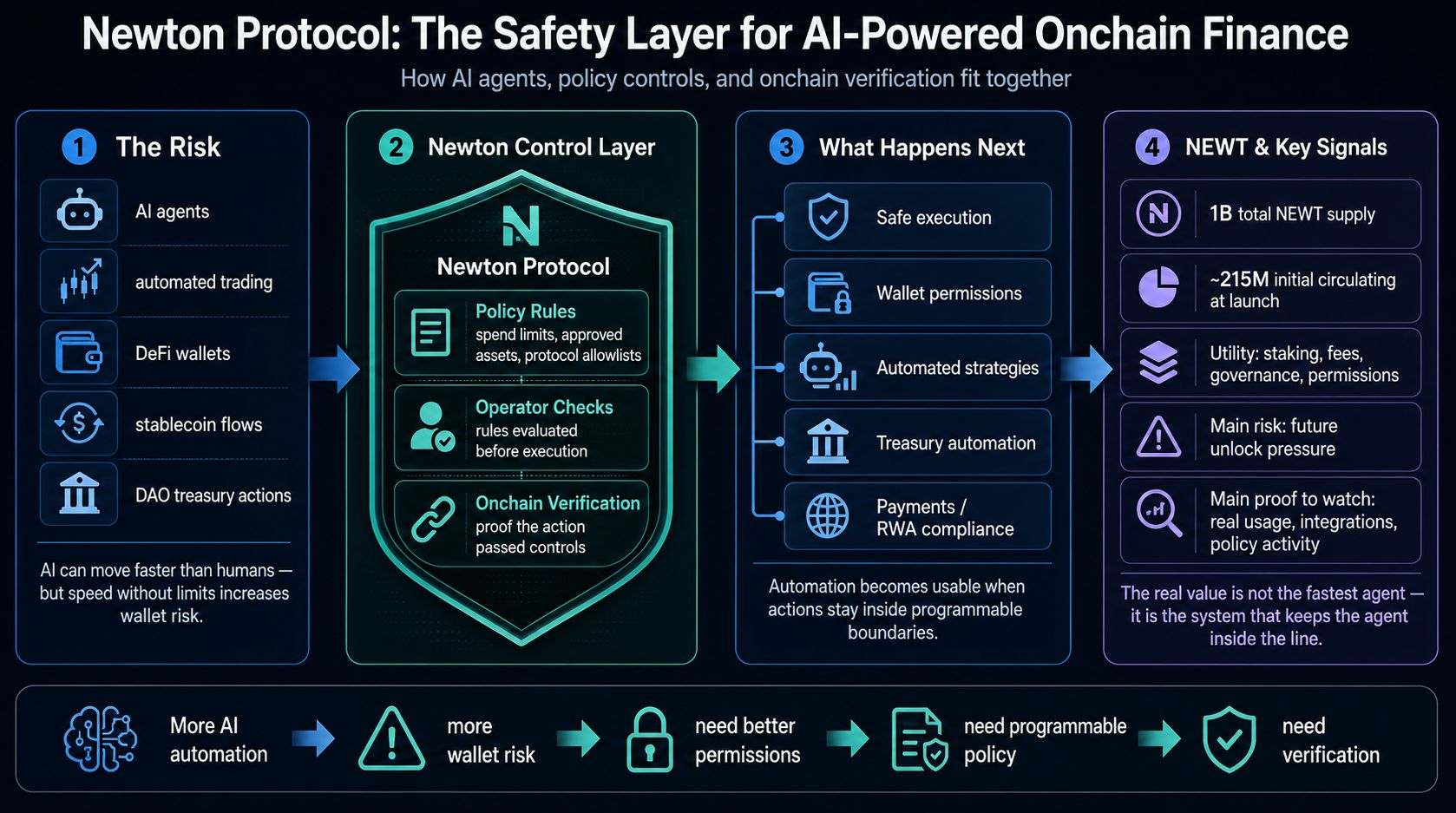
Crypto has always been full of automation. Bots already watch liquidity, chase arbitrage, rebalance positions, and react to market moves much faster than any normal trader can. But AI agents bring a different kind of risk. They are not just simple bots following fixed instructions. They can read conditions, make decisions, interact with protocols, and move value based on what they think is the right next step.
That sounds exciting, but it also makes me think about one basic question: who checks the agent before it touches the money?
This is where Newton Protocol starts to feel interesting. It is not only trying to ride the AI trading narrative. The bigger idea is about creating a safer control layer for AI-driven strategies, automated trading, and developer-built agent services. Basically, Newton is trying to make sure these systems do not just move fast, but move inside clear limits.
The easiest way to look at it is like a traffic system for AI agents. The agent is the car, the wallet is the engine, and DeFi is the road. But without signals, speed limits, permissions, and checkpoints, that road becomes dangerous very quickly.
Most people talk about what an AI agent can do. Can it trade while I sleep? Can it find yield? Can it manage a wallet? Can it react faster than me?
Newton is more focused on what the agent is allowed to do.
That difference matters. If an AI agent has access to onchain funds, users need rules. Maybe it can only spend a certain amount per day. Maybe it can only trade approved assets. Maybe it cannot interact with risky contracts. Maybe it needs to pass a policy check before moving stablecoins. Maybe a DAO wants automation, but only if the action matches treasury rules.
Without that kind of control, AI automation becomes too risky. You either trust the agent too much, or you approve everything manually. Neither option is ideal. Full trust can be dangerous, and manual approval removes the whole point of automation.
Newton sits somewhere in the middle.
A lot of AI-crypto projects sound exciting because they talk about smart agents and future use cases. Newton feels different because its most important part is not flashy. It is the rulebook behind the agent. It is the layer that says, “yes, this action is allowed,” or “no, this crosses the line.”
That is why I think the project has a more serious angle than just AI trading. If AI agents become part of DeFi, payments, DAOs, stablecoins, and RWA platforms, then the market will need ways to prove that actions followed the right rules before they happened. This becomes even more important when real capital, treasury funds, or regulated assets are involved.
Newton’s idea is built around that. Policies define what is allowed. Operators check whether a transaction follows those rules. Onchain verification confirms that the checks happened before execution.
The logic is pretty simple. More AI automation means more wallet risk. More wallet risk means users need better permissions. Better permissions need programmable rules. And programmable rules need verification. That is the lane Newton is trying to build in.
The NEWT token is tied to the system through staking, governance, fees, permission updates, agent operations, and access to services in the ecosystem. That gives the token a clear role on paper. But the real question is whether the protocol can create enough actual usage to make that utility matter.
This is where I stay cautious. A token can have utility in the design, but the market only starts respecting that utility when people actually need to use it. For NEWT, that means developers deploying agent models, operators participating in the network, users setting permissions, and protocols using Newton for policy checks.
Newton has a total supply of 1 billion NEWT. At launch, around 215 million NEWT was reported as circulating, which means a large part of supply still sits in future unlocks, ecosystem rewards, contributors, backers, and treasury allocations. That matters because supply pressure can affect price even when the idea is strong.
Market trackers have also shown different circulating supply numbers for NEWT, and I think that is something traders should pay attention to. When supply data is not perfectly aligned, market cap and FDV can be harder to read. For smaller tokens, that detail matters more than people admit.
NEWT has traded across many markets, so exchange access does not seem like the main issue. The more important question is whether volume is coming from real demand or just narrative rotation. AI narratives can bring attention fast, but sustained usage is what keeps a project alive after the hype cools.
The token has also seen a deep drop from its earlier high. That does not automatically make it bad. In crypto, early excitement often gets repriced. But it does mean the next stage has to be based on stronger proof, not just a good story.
Unlocks are another thing to watch. If more tokens enter circulation while usage is still weak, the market can feel that pressure. But if Newton’s ecosystem starts showing real adoption before major unlocks, the market may absorb supply better. That is why adoption signals matter more than the chart alone.
Onchain activity around NEWT is useful to watch, but it should not be overread. Token transfers can come from exchanges, claims, rewards, or simple trading. They do not always prove real protocol usage. The better signs would be more activity around policy creation, agent permissions, registry use, operator participation, and developer integrations.
For me, the strongest sign would not be a short-term pump. It would be seeing Newton actually used in the background by wallets, DAOs, DeFi tools, or AI developers. If developers can publish useful agents and users can access them through safe permissions, Newton could become more than infrastructure. It could become a controlled environment where AI services are easier to trust.
But that is not easy to build. Developers need incentives. Users need simple tools. Protocols need safe integrations. Operators need rewards that make sense. The system has to be secure without feeling too heavy.
That is the real challenge.
Newton is solving a real problem, but the solution comes with tradeoffs. More checks can improve safety, but they can also add friction. Developers may avoid it if integration feels difficult. Users may ignore it if the product feels too technical. Institutions may like the concept, but they usually move slowly and need strong reliability before trusting new infrastructure.
There is also another layer of trust. Newton can reduce blind trust in individual bots or centralized automation systems, but users still need confidence in the operator network, policy logic, smart contracts, and data sources used for checks. So the project does not remove trust completely. It tries to move trust into a more structured and verifiable place.
That is why Newton feels interesting to me. Not because it promises that AI agents will make everyone rich, but because it focuses on what happens when AI agents are allowed to move money.
In the future, AI systems may manage strategies, rebalance portfolios, follow treasury rules, handle stablecoin flows, or interact with DeFi without constant human input. Before that becomes normal, people will need better ways to control what these agents can and cannot do.
That is the part Newton is trying to build.
NEWT still has risks. Supply unlocks matter. Market data needs to be checked carefully. Token utility has to become real demand. The ecosystem needs stronger proof of adoption, not just an interesting concept.
But the core idea makes sense. If machines are going to move money onchain, the most valuable layer may not be the fastest agent. It may be the system that makes sure the agent does not cross the line.
Newton Protocol is trying to build that line.