
I've been around crypto long enough to know that every market cycle comes with a new obsession. A few years ago everything had to be DeFi. Then it was NFTs. Then the metaverse. Now, if a project mentions AI, people pay attention almost instantly.
That doesn't automatically make it bad. It just means the signal gets buried under a lot of noise.
When I first came across Newton Protocol, I honestly expected more of the same. Another token wrapped in AI buzzwords, a polished website, ambitious claims, and a roadmap that somehow leads to changing the world. Crypto has produced plenty of those.
The more I read, though, the more I realized Newton is trying to answer a different question.
Not "How do we build smarter AI?"
More like, "How do we make AI trustworthy when it starts making decisions that actually matter?"
That feels like a much more interesting place to start.
Think about where AI is heading. It's already writing code, analyzing financial markets, helping businesses automate workflows, and assisting with research. Give it a few more years and it's not hard to imagine AI handling much bigger responsibilities—executing trades, managing digital assets, coordinating decentralized applications, maybe even running entire financial strategies without much human involvement.
Sounds exciting.
It's also a little unsettling.
Because once software starts moving money on its own, people stop asking whether it's fast. They start asking whether it's reliable. Whether it can be audited. Whether anyone can prove what actually happened if something goes wrong.
That's the gap Newton Protocol seems to be looking at.
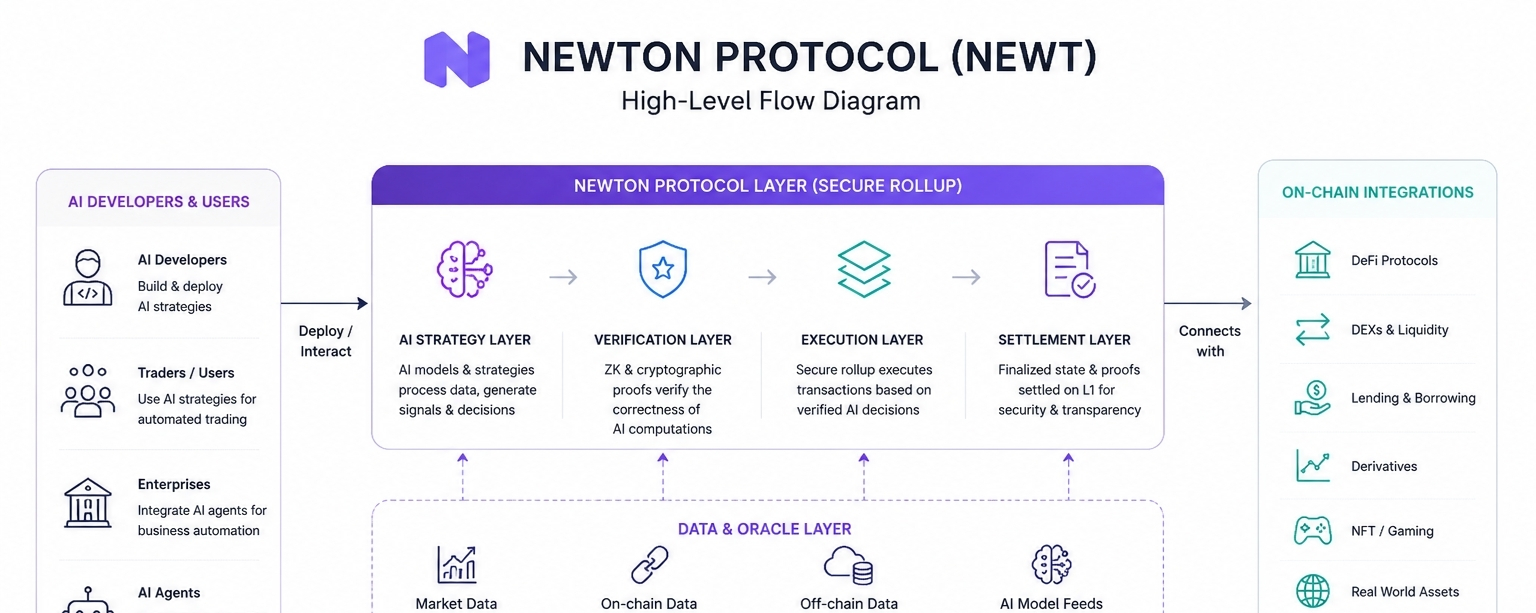
Instead of building another AI application, it's trying to build infrastructure around AI-driven automation. A secure rollup, support for automated strategies, and a marketplace where developers can create and share AI-powered tools. None of that sounds especially flashy, and maybe that's the point.
Infrastructure almost never looks exciting in the beginning.
Most people don't think about internet cables when they stream a movie. They don't think about cloud servers every time they open an app. Good infrastructure usually disappears into the background.
If Newton succeeds, that's probably what success would look like.
But let's not get ahead of ourselves.
Crypto has a long history of falling in love with great ideas before anyone proves there's real demand for them.
That's probably the biggest question hanging over this project.
The technology might make perfect sense. The market doesn't always care.
Developers have countless platforms competing for their attention. Businesses usually choose whatever is easier to integrate, cheaper to operate, and less risky to maintain. They rarely switch just because a new protocol has a clever design.
That's why adoption is such a difficult puzzle.
Building technology is one challenge.
Convincing people to build on top of it is an entirely different one.
The marketplace Newton wants to create is another interesting piece. In theory, giving AI developers a place to publish, monetize, and distribute their work sounds like a smart way to grow an ecosystem. In reality... marketplaces are incredibly hard to get right.
They depend on momentum.
Developers want users.
Users want useful products.
Investors want activity.
Nobody wants to be the first person in an empty marketplace.
That's where so many crypto ecosystems lose steam.
Then there's the AI side of the story.
Everyone is talking about AI, but very few people are talking about verification. Most conversations revolve around bigger models, faster responses, or more capable assistants. Those things matter, sure. But if AI starts making financial decisions or managing valuable assets, another question becomes unavoidable.
Can you actually trust the outcome?
That question doesn't have an easy answer.
AI systems are often described as black boxes for a reason. You see the result, but not always the reasoning behind it. Blockchain, on the other hand, has always leaned toward transparency. Bringing those two worlds together sounds simple in a pitch deck. In practice, it's a difficult engineering problem.
That's one reason Newton caught my attention.
Not because it claims to solve everything, but because it's focused on a problem that feels real.
Of course, having the right idea doesn't guarantee success.
The crypto industry is full of technically impressive projects that never gained meaningful adoption. Some arrived too early. Others couldn't attract developers. Some simply ran out of momentum before the market understood what they were building.
Newton could face the same challenges.
Competition isn't standing still either.
Large technology companies are investing billions into AI infrastructure. Cloud providers already have mature developer ecosystems, massive computing resources, and established customer relationships. On the decentralized side, new AI projects seem to appear almost every week. Some focus on decentralized computing, others on AI agents, others on inference networks.
It's getting crowded.
Standing out won't be easy.
That's why I think it's healthier to look at Newton with curiosity instead of certainty.
I like that it's trying to solve an infrastructure problem instead of chasing a short-lived trend. I like that the conversation revolves around security, verification, and automation rather than impossible promises. Those are good signs.
But good signs aren't the same as proof.
The next few years will matter far more than the next few months.
If developers start building meaningful applications, if AI-driven systems become more common, and if secure infrastructure becomes something people genuinely need, Newton could find itself in an interesting position.
If those things don't happen, the technology could remain impressive without ever becoming widely used.
That's the reality of crypto. Brilliant ideas don't always win. Sometimes the simpler product does. Sometimes the better-funded competitor does. And sometimes the market just moves in a completely different direction.
So where do I land after spending time reading about Newton Protocol?
Somewhere in the middle.
I'm not convinced it's destined to become a major success, and I'm definitely not ready to dismiss it either. The problems it's trying to solve feel genuine, especially as AI becomes more involved in high-value decisions. Whether Newton becomes part of that future will depend less on the story it tells today and much more on whether developers, businesses, and users decide it's actually worth building around.
For me, that's enough reason to keep watching.
Not because the hype says I should.
Because the questions Newton is asking are probably going to matter long after today's AI buzz fades away.
