
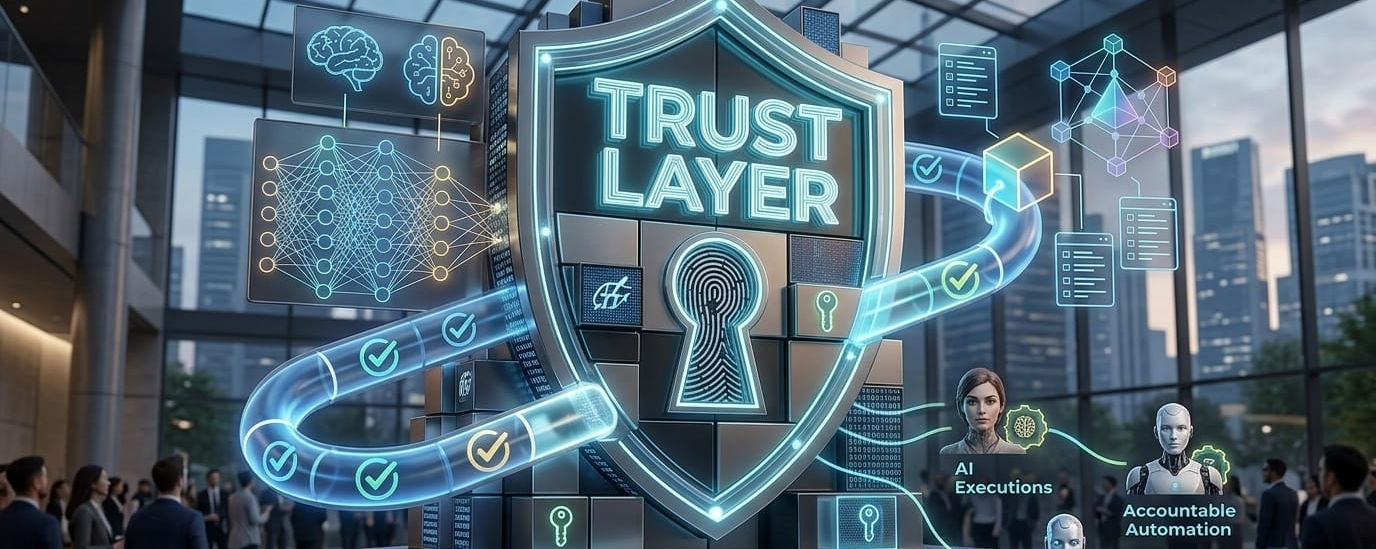
Artificial intelligence is quickly becoming more than just a tool that answers questions or generates images. We are entering a stage where AI is beginning to make decisions that involve real money, digital assets, and autonomous execution. Trading bots rebalance portfolios in seconds. AI agents search for arbitrage opportunities across multiple chains. Autonomous systems can deploy capital, vote in DAOs, execute DeFi strategies, and even negotiate with other AI agents.
That future sounds exciting.
It is also a little uncomfortable.
The biggest question may no longer be "How intelligent is the model?" Instead, it might become "Can we prove the model actually did what it claimed to do?"
That distinction could define the next generation of AI infrastructure.
Today, most conversations around AI focus on performance. Companies compete over benchmark scores, reasoning abilities, token limits, inference speed, and multimodal capabilities. Those are important metrics. Smarter models undoubtedly unlock new possibilities.
But intelligence alone doesn't create trust.
Imagine an AI agent managing a million-dollar treasury. It decides when to swap assets, stake tokens, borrow against collateral, or bridge liquidity between networks. Every action could affect thousands of users.
If the portfolio performs well, everyone celebrates.
If something goes wrong, a simple explanation like "the model thought it was the best decision" probably won't satisfy anyone.
People will ask much harder questions.
What information did the AI use?
Was the model changed before making that decision?
Did someone manipulate the inputs?
Did the execution happen exactly as intended?
Can independent observers verify every step?
These aren't questions about intelligence.
They're questions about trust.
And trust has always been the missing layer in AI.
Traditional software behaves predictably. Developers write code, users inspect the logic, and outputs generally follow fixed rules. AI changes that relationship because modern models learn statistical patterns rather than following explicit instructions.
Two identical prompts may produce different answers.
Two versions of the same model may behave differently.
Updates happen continuously.
Fine-tuning changes behavior.
External tools influence decisions.
Memory changes outputs.
Context changes reasoning.
As AI becomes increasingly autonomous, this uncertainty grows.
Now combine that uncertainty with decentralized finance.
Unlike traditional financial systems, blockchain transactions are irreversible. Once an AI signs and broadcasts a transaction, there is no customer support line capable of reversing the mistake.
That raises an important question.
Should we trust AI simply because it has a high benchmark score?
Probably not.
Instead, perhaps AI needs something similar to what blockchains introduced for financial transactions: verification instead of blind trust.
Blockchains became valuable because participants no longer needed to rely entirely on centralized institutions. Consensus mechanisms, cryptographic signatures, and public ledgers created systems where anyone could independently verify what happened.
Maybe AI now needs an equivalent foundation.
Not another smarter model.
A smarter trust system.
This is where protocols focused on AI verification become particularly interesting.
Rather than asking users to trust an AI provider, they attempt to prove what actually occurred during execution.
Imagine every AI decision carrying its own receipt.
The receipt could include which model generated the output, which version of the weights was used, what inputs were received, when execution occurred, what permissions the AI possessed, and whether execution happened inside a secure environment without tampering.
Instead of trusting a company, users verify evidence.
That shifts confidence from reputation toward cryptographic proof.
For on-chain AI, this difference could be enormous.
Suppose an AI trading agent executes fifty trades across multiple decentralized exchanges.
Without verification, users only see the final portfolio.
With verification, they could inspect whether the AI respected predefined risk limits, avoided unauthorized protocols, followed portfolio allocation rules, and executed only approved strategies.
This creates accountability.
Accountability is something AI discussions rarely emphasize.
People often assume better intelligence automatically leads to safer systems.
History suggests otherwise.
Human experts can make poor decisions.
Sophisticated algorithms can fail unexpectedly.
Even highly accurate models occasionally produce outputs that nobody anticipated.
The more authority AI receives, the more important verification becomes.
Interestingly, blockchain has already solved a similar social problem.
People don't trust Bitcoin because they personally know every miner.
They trust the network because anyone can independently verify consensus.
The system minimizes the need for personal trust.
Perhaps AI should evolve in the same direction.
Instead of asking users to believe an AI provider's promises, future infrastructure might allow anyone to verify how decisions were produced.
This becomes even more important when AI agents begin interacting with one another.
Imagine hundreds of autonomous agents negotiating prices, borrowing liquidity, executing cross-chain swaps, or coordinating decentralized infrastructure.
Humans won't manually inspect every interaction.
Machines will increasingly need mechanisms to verify other machines.
That suggests trust itself may become machine-readable.
Not reputation.
Not marketing.
Not assumptions.
Verifiable evidence.
This is one reason projects like Newton Protocol are attracting attention within the AI and Web3 conversation.
Rather than viewing AI solely as a prediction engine, Newton Protocol explores how autonomous execution can become transparent, auditable, and verifiable. If AI agents are expected to manage assets, sign transactions, and coordinate across decentralized ecosystems, then proving how those actions occurred may become just as important as the actions themselves.
The vision isn't simply faster automation.
It's accountable automation.
That distinction matters.
Because once autonomous agents begin controlling meaningful capital, every participant in the ecosystem inherits new risks.
Users need confidence.
Developers need debugging tools.
Auditors need evidence.
Protocols need transparency.
Regulators may eventually demand accountability.
Verification helps satisfy all of those needs simultaneously.
Of course, no protocol completely eliminates risk.
Verification cannot guarantee perfect decisions.
A model can still make a poor judgment even if every step is fully auditable.
But there is an important difference between a bad decision that can be explained and a bad decision hidden inside a black box.
Transparency doesn't replace intelligence.
It complements it.
Looking ahead, AI infrastructure may evolve through several phases.
The first phase was building smarter models.
The second phase focused on making those models faster and cheaper.
The next phase may revolve around proving that AI behaved exactly as expected.
If that happens, trust becomes infrastructure rather than marketing.
History often rewards technologies that reduce the amount of trust required between strangers.
The internet reduced the need for geographic proximity.
Blockchain reduced reliance on centralized financial intermediaries.
Perhaps verifiable AI will reduce the need to blindly trust autonomous software.
That possibility makes one question increasingly difficult to ignore.
As AI starts managing trades, deploying capital, governing protocols, and executing financial strategies on behalf of humans, is intelligence alone enough?
Or will every autonomous system eventually require its own trust layer?
The answer could determine whether AI becomes merely powerful—or truly dependable.
And if that future unfolds as many expect, protocols focused on verifiable execution, such as Newton Protocol, may not simply support AI.
They could become one of the foundational layers that allows autonomous intelligence to earn genuine trust in an on-chain world.
