
I Almost Bought More Newton Protocol. Then I Realized I Didn't Understand the Most Important Part.
A few days ago, I came very close to increasing my position in Newton Protocol.
It wasn't going to be a huge purchase. I had intentionally started with a small position because I wanted exposure while I continued researching the project. As I looked at the chart and considered adding more, I paused for a moment and asked myself a question that I think every investor should ask before pressing the buy button.
What is the one thing about this project that actually convinces me it deserves more of my capital?
Surprisingly, I couldn't answer.
I could repeat the marketing points.
I knew Newton was building around AI agents, automation, and programmable finance. I understood the broad vision, and like many people, I found it exciting.
But excitement isn't the same thing as conviction.
When I tried to explain—in my own words—what gave Newton a genuine competitive advantage, my answer became vague.
That was enough for me to stop.
Not because I thought Newton was a bad project.
But because I realized I was at risk of buying first and understanding later.
In crypto, that's a dangerous habit.
So instead of increasing my position, I spent the next several days reading.
I went back through the documentation, explored the protocol architecture, read technical discussions, looked at community conversations, and tried to ignore the market noise.
Eventually, one idea kept appearing over and over again.
It wasn't AI.
It wasn't transaction speed.
It wasn't automation.
It was something that sounds much less exciting.
Permissions.
At first glance, permissions don't sound revolutionary.
They're certainly not the type of feature that dominates social media discussions.
Nobody gets excited because a protocol has a better authorization model.
People prefer to talk about TPS, tokenomics, AI narratives, and ecosystem growth.
But after thinking about it longer, I started wondering whether permissions might actually become one of the most valuable layers of infrastructure in crypto over the next decade.
Crypto Has Become Very Good at Execution
If you look at how blockchain technology has evolved, one thing is obvious.
The industry has become incredibly efficient at executing transactions.
A user signs.
The network verifies.
The transaction settles.
Funds move.
Smart contracts execute exactly as programmed.
Execution has become fast, reliable, and increasingly inexpensive.
For years, that has been the primary innovation.
Everyone competed to build faster chains.
Lower fees.
Higher throughput.
Better scalability.
Those improvements absolutely mattered.
But I think we're approaching a point where execution itself is becoming less differentiated.
The harder problem may no longer be executing transactions.
The harder problem is deciding whether they should execute at all.
The Missing Question Nobody Talks About
Every blockchain transaction begins with a simple assumption.
If the signature is valid, the transaction proceeds.
That model has worked well because blockchains were originally designed for humans making individual decisions.
But what happens when humans stop being the primary decision makers?
What happens when wallets begin operating automatically?
What happens when DAOs automate treasury management?
What happens when businesses allow software to manage payroll, investments, liquidity, and financial operations?
And perhaps most importantly...
What happens when AI agents begin controlling assets on-chain?
Suddenly, signing isn't the difficult part anymore.
Decision-making becomes the difficult part.
Because automation doesn't eliminate risk.
It amplifies it.
An AI agent that can perform one thousand perfectly valid transactions per minute can also perform one thousand terrible transactions per minute if the rules surrounding it aren't carefully designed.
That's why authorization suddenly becomes far more interesting than execution.
Newton Changed How I Think About Authorization
The more I studied Newton Protocol, the more I realized it approaches authorization differently.
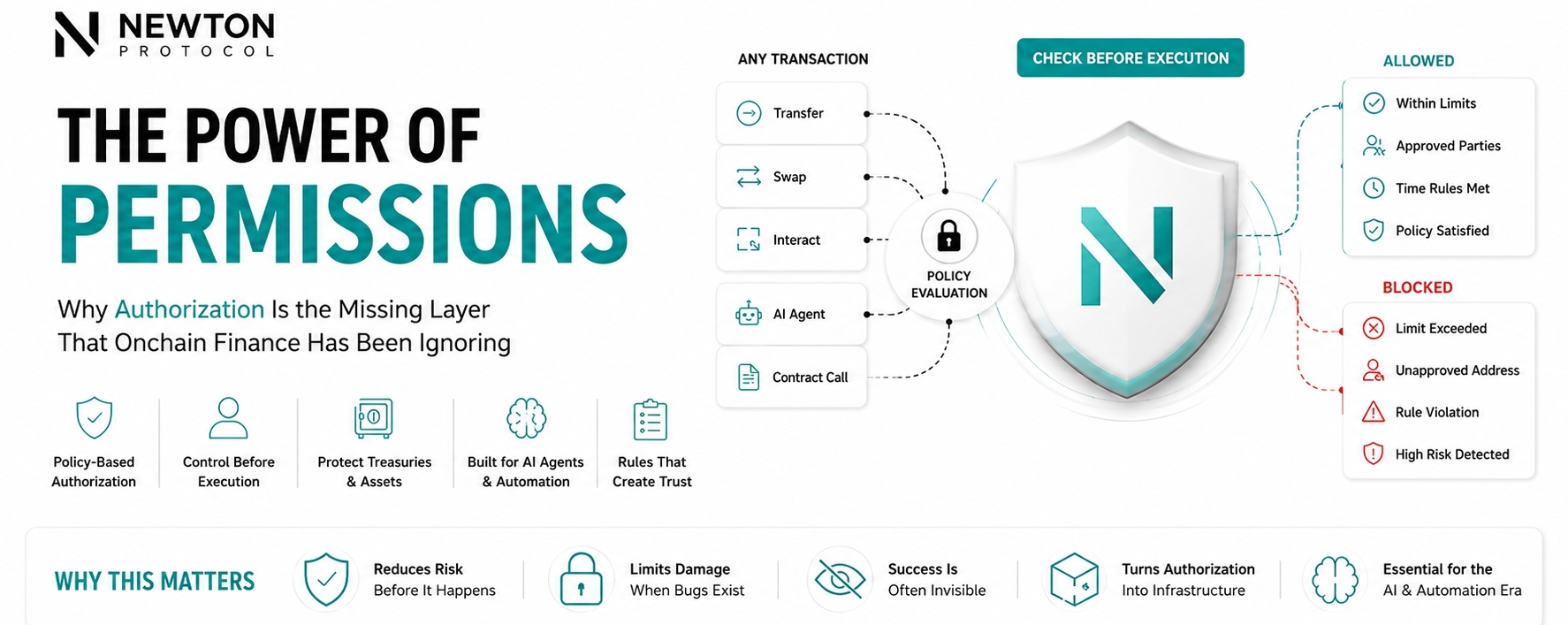
Instead of viewing wallet approval as the final checkpoint, Newton allows transactions to pass through policy-based validation before execution occurs.
That may sound like a small architectural difference.
I don't think it is.
Imagine a treasury wallet.
Instead of simply allowing anyone with signing authority to move funds whenever they choose, the wallet could operate under predefined rules.
Those rules might include:
- Daily spending limits.
- Approved recipient addresses.
- Time-based restrictions.
- Multi-step approvals.
- Governance requirements.
- Asset allocation policies.
- Risk thresholds.
- AI-specific behavioral constraints.
- Emergency shutdown conditions.
- Automated compliance rules.
Only after those conditions are satisfied would the transaction execute.
In other words...
The protocol asks permission twice.
First through ownership.
Then through policy.
That second layer may end up becoming far more important than people currently appreciate.
Reading Exploit Reports Made Me Think Differently
One thing I enjoy doing is reading postmortems after major protocol hacks.
Most people read them to understand the bug.
I read them to understand the assumptions.
Again and again, I noticed the same pattern.
Everyone focused on the vulnerability.
The coding mistake.
The exploit.
The attack vector.
Those discussions are obviously important.
But another question kept bothering me.
Why did the compromised transaction have enough authority to cause so much damage?
Imagine two identical vulnerabilities.
One exists inside a system with unrestricted permissions.
The other exists inside a system with strict authorization policies.
Even if both bugs are discovered, the outcomes could be dramatically different.
In one case...
Millions disappear.
In the other...
The transaction never satisfies policy requirements.
Or the spending limit blocks it.
Or governance approval fails.
Or the transaction expires before execution.
The vulnerability still exists.
The consequences become smaller.
That's a fundamentally different way of thinking about security.
Instead of assuming software will always be perfect...
You assume mistakes will eventually happen.
Then you design permission systems that reduce the damage when they do.
That philosophy feels remarkably practical.
Invisible Infrastructure Usually Becomes Essential Infrastructure
One of the interesting things about technology is that the most valuable systems are often invisible.
Think about the internet.
People rarely think about DNS servers.
Encryption.
Certificate authorities.
Routing protocols.
Background authentication.
None of these attract headlines.
Yet modern internet infrastructure wouldn't function without them.
Crypto is beginning to reach a similar stage.
The next generation of infrastructure may not be the most visible layer.
It may simply be the layer that quietly prevents catastrophic mistakes.
Nobody celebrates a transaction that never happened.
Nobody posts on social media because a treasury remained secure.
Nobody trends because authorization policies successfully rejected dangerous activity.
Success leaves almost no evidence.
Failure becomes the headline.
Ironically, that's exactly why permission systems are so difficult to value.
Their greatest achievement is preventing events that never become visible.
Trust Is Built Through Repetition
Developers already understand this concept.
Very few teams enjoy writing cryptographic primitives from scratch.
Instead, they rely on audited libraries.
Battle-tested contracts.
Proven frameworks.
Reusable infrastructure.
Why?
Because trust compounds.
Every successful deployment increases confidence.
Every audit strengthens reputation.
Every year without failure creates additional credibility.
Permission systems could evolve in exactly the same way.
Imagine an authorization framework protecting billions of dollars across hundreds of protocols.
Year after year.
Upgrade after upgrade.
Governance change after governance change.
Eventually, new builders stop asking whether they should build their own.
They simply adopt the trusted framework.
At that point, authorization stops being a feature.
It becomes infrastructure.$
Measuring Permission Quality Is Surprisingly Difficult
One question still keeps me from becoming overly enthusiastic.
How do we actually measure authorization quality?
Performance metrics are easy.
Transactions per second.
Latency.
Block time.
Fees.
Finality.
Those all produce measurable numbers.
Permission systems don't.
A perfect authorization framework doesn't create exciting charts.
Instead, it quietly prevents mistakes.
A malicious withdrawal never occurs.
A treasury stays inside policy.
An AI agent refuses to exceed spending limits.
An exploit causes limited damage instead of catastrophic loss.
How do you graph events that never happened?
That's one of the biggest challenges for investors.
The most valuable infrastructure often produces the least visible evidence.
The AI Era Makes This Conversation More Important
I don't think this discussion is only about Newton.
It's about where crypto is heading.
The industry is rapidly moving toward greater automation.
AI agents are becoming more capable.
Wallets are becoming programmable.
Protocols are becoming autonomous.
Businesses increasingly want software making operational decisions.
That future creates enormous efficiency.
It also creates enormous responsibility.
Because every new layer of automation increases the importance of defining boundaries.
Automation without constraints is simply accelerated risk.
Automation with intelligent authorization becomes something entirely different.
It becomes controlled autonomy.
And I believe that's a much stronger long-term foundation.
Why I'm Still Keeping My Position Small
After all this reading, I didn't suddenly decide to go all in.
In fact, my conclusion was almost the opposite.
I'm keeping my Newton position relatively small.
Not because I doubt the idea.
But because I still want to see evidence.
Will developers actually integrate these authorization systems?
Will organizations trust them with real treasury operations?
Will AI-driven applications adopt policy-based permissions as a standard?
Will authorization become as reusable as smart contract libraries?
Those are questions the market will answer over time.
Ideas matter.
Adoption matters even more.
Final Thoughts
The biggest lesson from researching Newton Protocol wasn't about AI.
It wasn't about automation.
It wasn't about token economics.
It was about something far less glamorous.
The rules that determine what cannot happen.
For years, crypto has focused on proving ownership.
The next phase may be proving judgment.
Not every valid transaction deserves to execute.
Not every signature should carry unlimited authority.
Sometimes, the most important technology isn't the system that moves money faster.
It's the system that quietly says:
"Not this transaction. Not under these conditions."
If the future of on-chain finance truly belongs to autonomous software and AI agents, then trust may no longer come primarily from private keys.
It may come from the intelligence of the policies surrounding those keys.
That's why Newton Protocol remains on my watchlist.
Not because it promises a future of automation.
But because it's asking a question that I believe the rest of crypto will eventually have to answer.
Who decides what software is allowed to do before the transaction ever reaches the blockchain?
That, more than anything else, is the idea I'll be watching closely in the months—and perhaps years—ahead.