
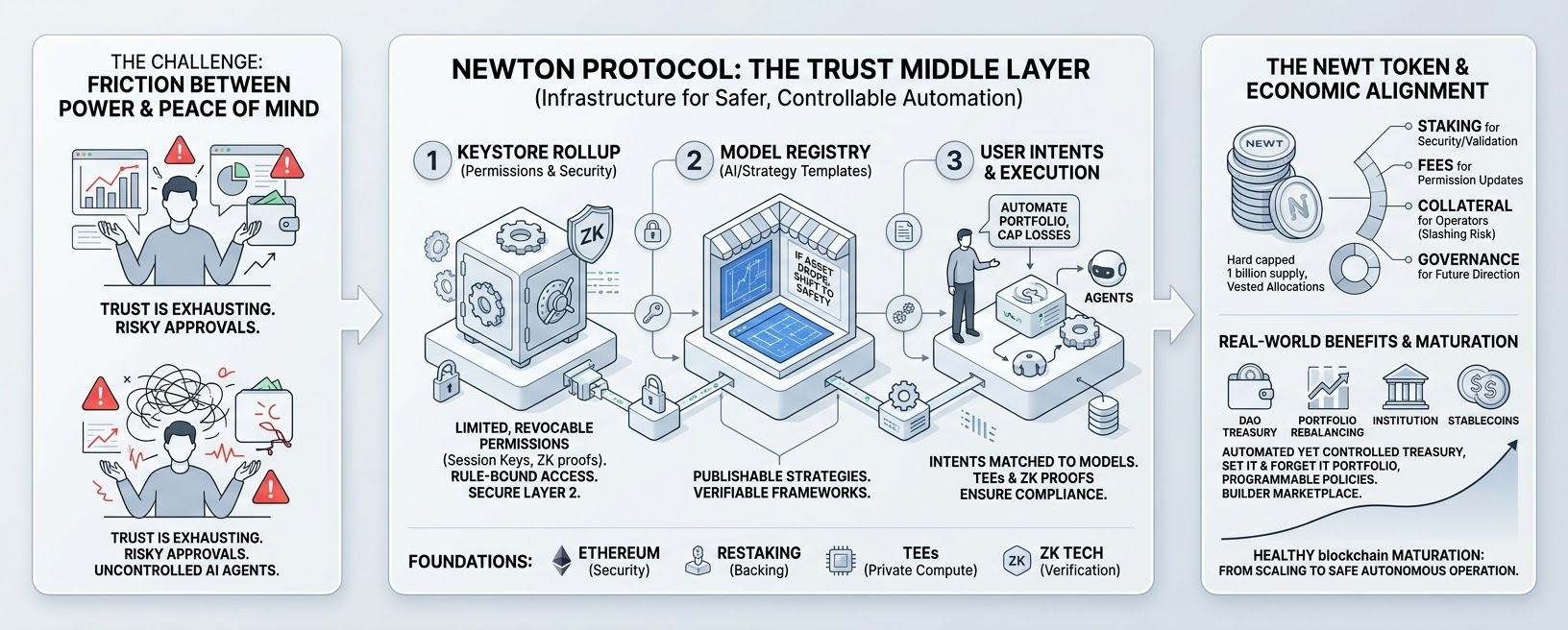

I've spent a lot of time thinking about what holds crypto back from broader, everyday use. For all the innovation in DeFi and smart contracts, managing money onchain can still feel exhausting. You either watch charts obsessively or hand over approvals that make you uneasy, hoping the code—or the AI—behaves. It's that friction between power and peace of mind that stands out to me. Newton Protocol caught my attention because it seems to tackle this head-on, not with grand promises, but by building a focused piece of infrastructure for safer, more controllable automation.
The Everyday Problem It Tries to Ease
Onchain activity has grown enormously—stablecoins, tokenized assets, complex strategies—but the way we authorize actions hasn't kept pace. Most of us still rely on blunt tool approvals or constant manual checks. AI agents sound futuristic and efficient for trading, rebalancing, or treasury tasks, yet trusting them often means crossing your fingers. One wrong move or unexpected market swing, and things can go south fast. Newton isn't trying to reinvent money or AI itself; it's aiming to create a reliable middle layer where you can set clear rules and let agents operate within verifiable boundaries, reducing that blind trust.
Breaking Down the Tech in Plain Terms
The centerpiece is their **Keystore rollup**—basically a specialized Layer 2 focused on handling permissions securely. Rather than giving an agent full access to your wallet, you grant limited, revocable permissions (using things like session keys or zero-knowledge proofs). It’s like issuing a temporary, rule-bound key instead of the master one.
They also have a **Model Registry**, an onchain hub where developers can share and publish agent strategies—think templates like “if this asset drops too much, shift to something safer, but never touch more than this amount.” Users then create “intents” that connect their preferences to these models, with the network enforcing the rules through operators running in secure environments and generating proofs that everything stayed within bounds.
It builds on familiar building blocks: Ethereum for security settlement, restaking for extra backing, TEEs for private computation, and zk tech for verification. Nothing too exotic, but put together thoughtfully for this specific use case. The rollup runs on delegated proof-of-stake, which should help with decentralization over time.
How the Economics Are Set Up
NEWT has a hard-capped supply of 1 billion tokens. It’s used for staking to help secure the network and validate actions, paying fees for permission updates, posting collateral as an agent operator (with the risk of losing some if you mess up), and having a say in governance. The allocation leans toward community incentives and ecosystem building, with vesting schedules that encourage longer-term thinking from the team and early supporters. It feels like an effort to align incentives around actual usage rather than pure speculation.
Potential Real-World Uses and Its Place in the Bigger Picture
I can see this being helpful for everyday users who want “set it and mostly forget it” portfolio management, or DAOs looking for automated yet controlled treasury operations. Developers might find a home in the marketplace for their agent models, earning fees while operating transparently. For institutions or stablecoin projects, it could offer a way to add programmable, auditable policies without sacrificing decentralization.
In the larger story of blockchain, this feels like part of a healthy maturation. We’ve made huge strides in scaling transactions with rollups. Now we’re figuring out how to make sophisticated tools safer and more approachable for autonomous operation. As AI plays a bigger role in crypto, having shared infrastructure for trustworthy execution could help prevent a lot of pain and build more confidence across the board.
Opportunities Alongside the Real Challenges
The promise is appealing: lowering the barrier for meaningful participation by making automation feel less risky. If it works well, it could let more people and organizations engage with onchain finance on their own terms, without needing to become full-time experts.
That said, plenty of hurdles remain. Getting the user experience right for setting complex permissions won’t be easy—crypto UX has tripped up many good ideas before. Scaling the system smoothly, attracting quality agents and developers, and proving the security model under real pressure will all take time. Technical risks around the proof systems or execution environments exist, as does the evolving regulatory picture around AI agents. Competition is fierce, and network effects don’t build themselves.
From where I sit, Newton feels like a sincere attempt to solve a genuine pain point rather than chasing trends. Whether it baecomes a quiet essential piece of infrastructure or needs more evolution, the underlying questions about trust, control, and making powerful tools usable are the ones that will shape the next phase of this industry. It’s worth keeping an eye on how they navigate the inevitable growing pains.
