
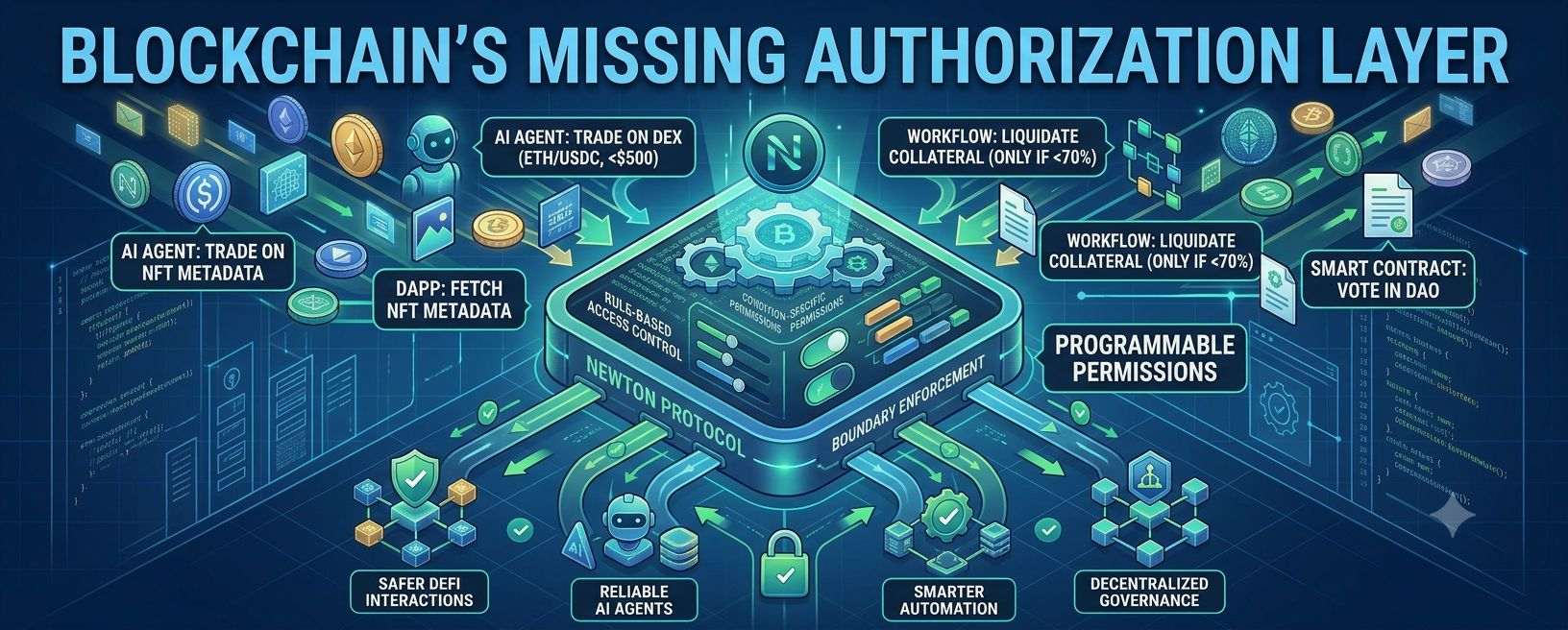
Why Newton Protocol Could Be Blockchain's Missing Authorization Layer
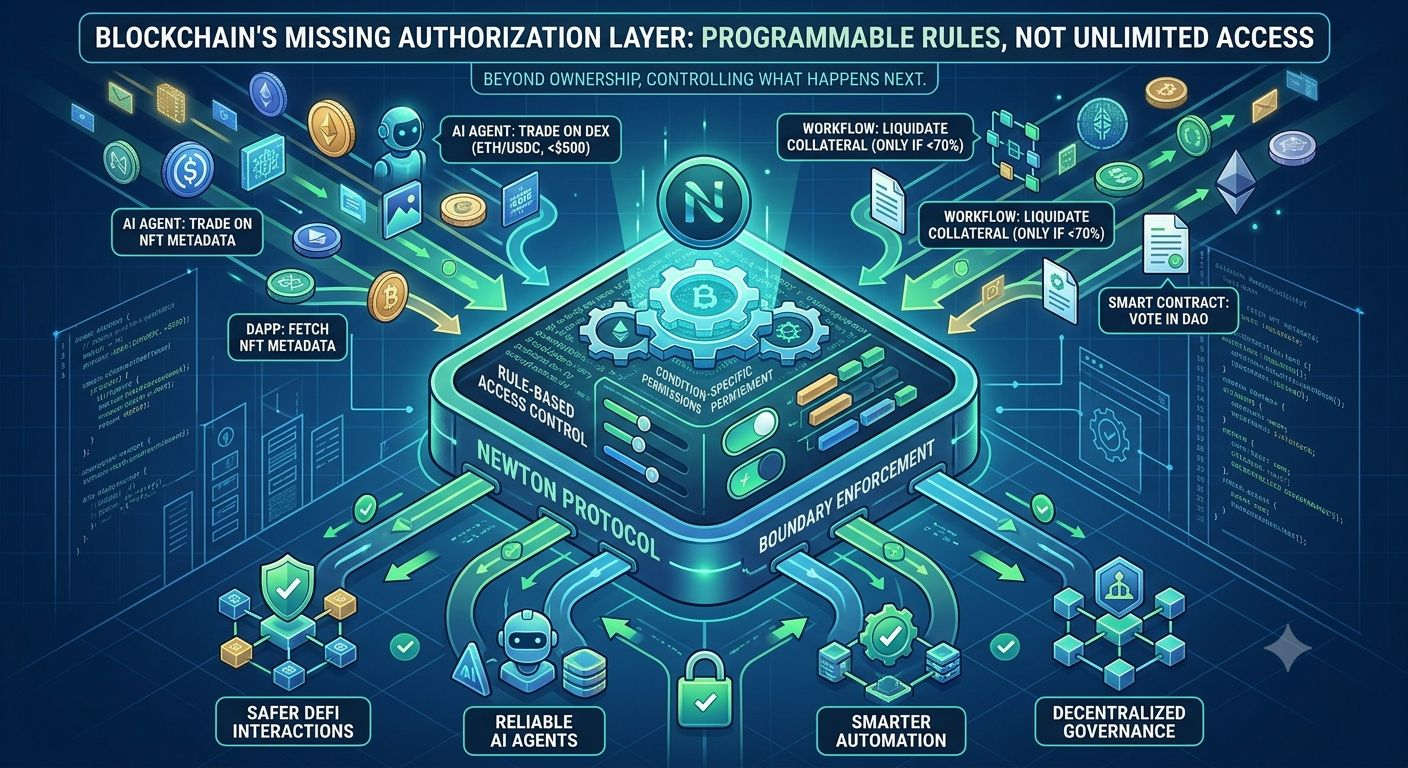
What if the biggest problem in blockchain isn't security, scalability, or adoption...
But the fact that once you give permission, you often give away far more control than you intended?
For years, the industry has focused on solving ownership.
Who owns the asset?
Who controls the wallet?
Who can verify the transaction?
But ownership was never the whole story.
Because proving ownership is one thing.
Controlling what happens next is another.
Today, most blockchain systems operate on a simple principle: if an application or wallet has permission, it often gains far more access than is actually needed. Users are forced to trust that those permissions won't be abused, even when they have little visibility into how that access may be used over time.
That creates a hidden problem.
The future of blockchain isn't just people interacting with smart contracts. It's AI agents, automated workflows, decentralized applications, and systems making decisions on behalf of users.
And those systems need authorization.
Not unlimited access.
Not blind trust.
Authorization.
This is where Newton Protocol introduces a different way of thinking.
Instead of treating permissions as a secondary feature, it treats authorization as infrastructure.
The goal is simple but powerful: allow users to define exactly what actions can be performed, under what conditions, and within which limits.
Think about how the internet evolved.
Modern digital systems don't work because everyone has full access. They work because permissions are structured. Employees have different roles. Applications receive limited privileges. Access is granted with boundaries.
Blockchain, despite all its innovation, is still early in that transition.
Newton Protocol is exploring what programmable authorization could look like in a decentralized world.
If successful, the implications could extend far beyond a single protocol.
Safer DeFi interactions.
More reliable AI agents.
Smarter automation.
And a future where users can delegate actions without surrendering complete control.
The next phase of blockchain may not be about creating more assets.
It may be about creating better rules for how those assets can be used.
Because ownership answers one question.
Authorization answers the one that comes after it.