
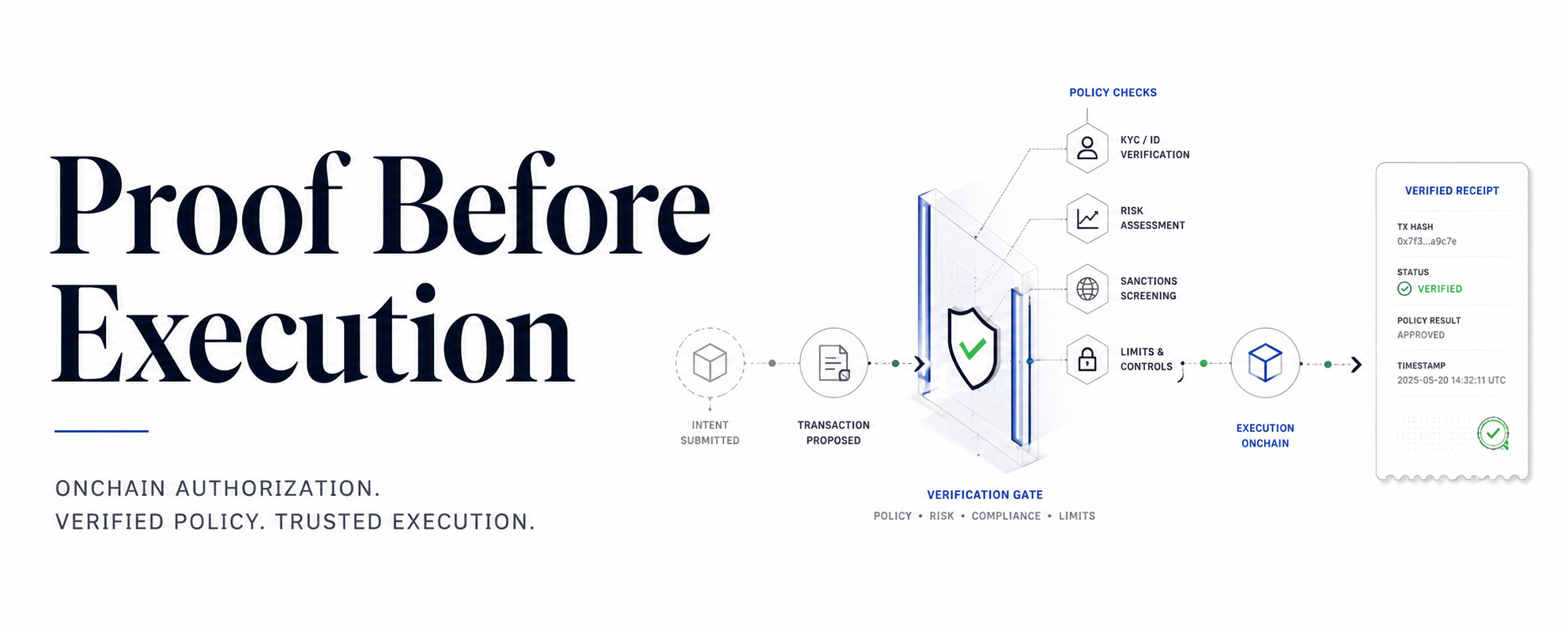

I noticed a small thing while reading Newton Protocol’s whitepaper: the most interesting object in the system is not the transaction. It is the receipt after the transaction was judged.
That sounds boring on purpose. Receipts are not the part of crypto people get excited about. But for institutions, DAOs, stablecoin issuers, and automated agents, a clean audit trail may matter more than another promise that “our controls are good.”
Newton’s idea is not just to check a wallet before execution. It produces a cryptographic compliance receipt that ties together transaction intent, policy, operator responses, aggregate signature, and block number. In investor language, the app is not only saying a rule was followed. It can show evidence that a rule was applied before a specific transaction moved.
That changes behavior around trust.
Onchain compliance still feels like soft infrastructure. A front end can block a user. An analytics tool can flag a wallet. A team can publish policies. But capital does not get durable proof that the control sat next to execution. Newton moves that proof closer to the smart contract, where the contract can reject transactions without a valid attestation.
The investment question, for me, is whether auditability becomes a routing preference.
A bank looking at tokenized assets may not care which chain has the loudest community. A treasury manager may not care that a DeFi venue is technically accessible. They may care about whether they can later explain why a transaction happened and what controls allowed it. That is less exciting than liquidity, but it is often how larger pools of capital move.
The human detail is almost funny. Crypto made settlement feel instant, then discovered grown-up money asks for paperwork. Newton is asking whether the paperwork can become cryptographic instead of PDF-shaped.
There is a real weakness here. A receipt proves that a policy was evaluated, not that the policy was wise. Bad rules can still be automated. Data providers can still be wrong. And Newton’s early privacy model has a tradeoff: operators may see decrypted inputs during evaluation until stronger MPC-style privacy becomes the default.
So I’m not treating Newton as a clean “compliance wins” story. That would be too neat.
The more grounded view is that Newton is testing whether verifiable authorization can become part of capital routing itself. Not because everyone loves compliance. Because when money, agents, and regulation collide, the ability to prove what happened before execution may become hard to ignore.
#NEWT #Newt #newt $NEWT @NewtonProtocol
