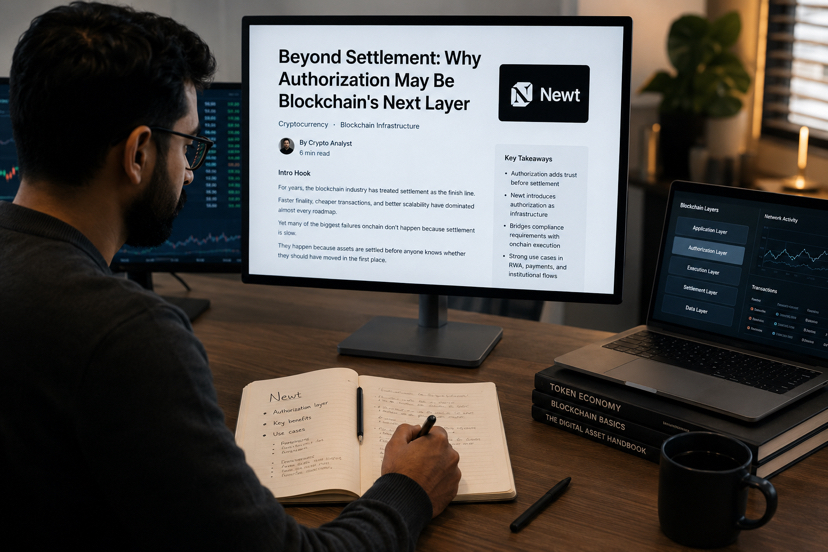

For years, the blockchain industry has treated settlement as the finish line. Faster finality, cheaper transactions, and better scalability have dominated almost every roadmap. Yet many of the biggest failures onchain don’t happen because settlement is slow. They happen because assets are settled before anyone knows whether they should have moved in the first place.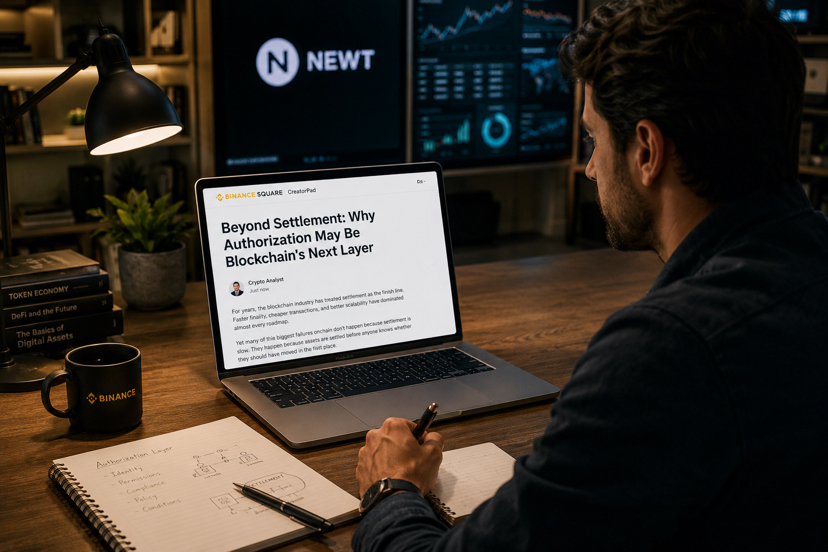
That’s an uncomfortable contradiction.Traditional financial systems spend enormous effort verifying counterparties before money changes hands. Banks confirm identities, screen sanctions lists, verify account details, and coordinate payment instructions. Settlement is only one step in a much longer authorization process.
Public blockchains largely flipped that model. If a transaction is signed with the correct private key, the network settles it. Whether the recipient is trustworthy, whether compliance checks were expected, or whether both parties agreed to the same conditions often sits outside the protocol itself.
As stablecoins continue processing enormous payment volumes and tokenized real-world assets attract institutional attention, that missing authorization layer becomes harder to ignore. Large organizations aren’t simply asking whether a blockchain can settle transactions quickly. They’re asking whether digital assets can move with the same confidence that exists inside regulated financial infrastructure.
This is where Newt introduces an interesting perspective.Rather than competing to build another settlement network, Newt focuses on authorization as its primary problem. The project starts with a simple observation: moving assets securely requires more than cryptographic signatures. It also requires agreement about who is allowed to transact, under what conditions, and with which guarantees.
Instead of forcing every institution to build separate verification systems around blockchain, Newt attempts to make authorization part of the transaction flow itself.
Conceptually, this changes the conversation.
Imagine a global manufacturer paying an overseas supplier with tokenized dollars. Today, the blockchain can confirm that the payment reached the destination wallet. It cannot confirm that both companies completed required compliance checks, that internal treasury approvals were satisfied, or that the receiving organization actually matches the intended counterparty.
Those checks usually happen through emails, legal documentation, banking software, and manual coordination before anyone presses “send.”
Newt’s approach aims to bring those authorization steps closer to the blockchain transaction itself, allowing multiple parties to verify required conditions before settlement occurs.
The result isn’t replacing settlement. It’s adding another decision layer ahead of settlement.
That distinction matters because settlement is irreversible. Authorization exists precisely to reduce the chance of irreversible mistakes.
The practical implications become even clearer when thinking about tokenized real-world assets.
Suppose a financial institution wants to transfer ownership of tokenized bonds between two regulated entities. Ownership isn’t simply about moving tokens.Both sides of a transfer often need to run through licensing checks, verify jurisdictions, get internal approvals, and confirm that everything meets all the legal requirements.
Without a solid authorization framework, developers end up building custom middleware for every single application. That just adds complexity, creates inconsistent standards, and piles on extra operational risk.
If we make authorization a standardized piece of infrastructure instead, applications could simply tap into a shared, reliable verification process—rather than reinventing the wheel every time a new product is built.
From a developer’s perspective, this could simplify enterprise integrations.
From an institution’s perspective, it could reduce operational uncertainty.
From a regulator’s perspective, it provides a clearer framework for understanding why a transaction was approved before settlement occurred.
Of course, the idea also introduces important questions.
Authorization inevitably involves policy.
Who defines the authorization rules?
Who can update them?
How transparent are those decisions?
If different organizations require different compliance standards, interoperability could become difficult unless authorization frameworks remain flexible.
There is also the broader philosophical debate.
One of blockchain’s original promises was permissionless access. Adding authorization layers naturally introduces more structure. Some crypto users will view that as unnecessary friction, while institutions may see it as the missing requirement for broader adoption.
Neither perspective is automatically wrong.
Retail users transferring assets between personal wallets probably don’t need complex authorization workflows.
Large corporations settling millions of dollars across multiple jurisdictions almost certainly do.
That difference suggests authorization may not replace today’s blockchain experience but instead expand it into markets where compliance and coordinated trust already exist.@NewtonProtocol $NEWT #Newt
Compared with most blockchain infrastructure projects that compete on throughput, latency, or transaction fees, Newt is attempting to solve a different category of problem. Instead of asking, “How can transactions settle faster?” it asks, “How can participants know a transaction is authorized before settlement becomes final?”
That’s a subtle shift, but potentially an important one.
Throughout blockchain’s history, infrastructure has evolved in layers. We first focused on consensus. Then scalability. Then interoperability. If institutional adoption continues accelerating, authorization may become another foundational layer that quietly supports everything built above it.
Settlement proves that assets moved.
Authorization explains why they were allowed to move.
Perhaps both are necessary for blockchain to become mature financial infrastructure rather than simply efficient payment rails.
The more I study Newt’s approach, the more interesting the broader question becomes—not whether authorization is useful, but whether blockchain can realistically support mainstream financial activity without making authorization part of its core architecture.@NewtonProtocol $NEWT #Newt
What do you think will matter more over the next decade: building faster settlement networks, or building standardized authorization layers that make those settlements trustworthy in the first place?$SYN