
I'll write it as a reflective first-person piece that follows your requested style.
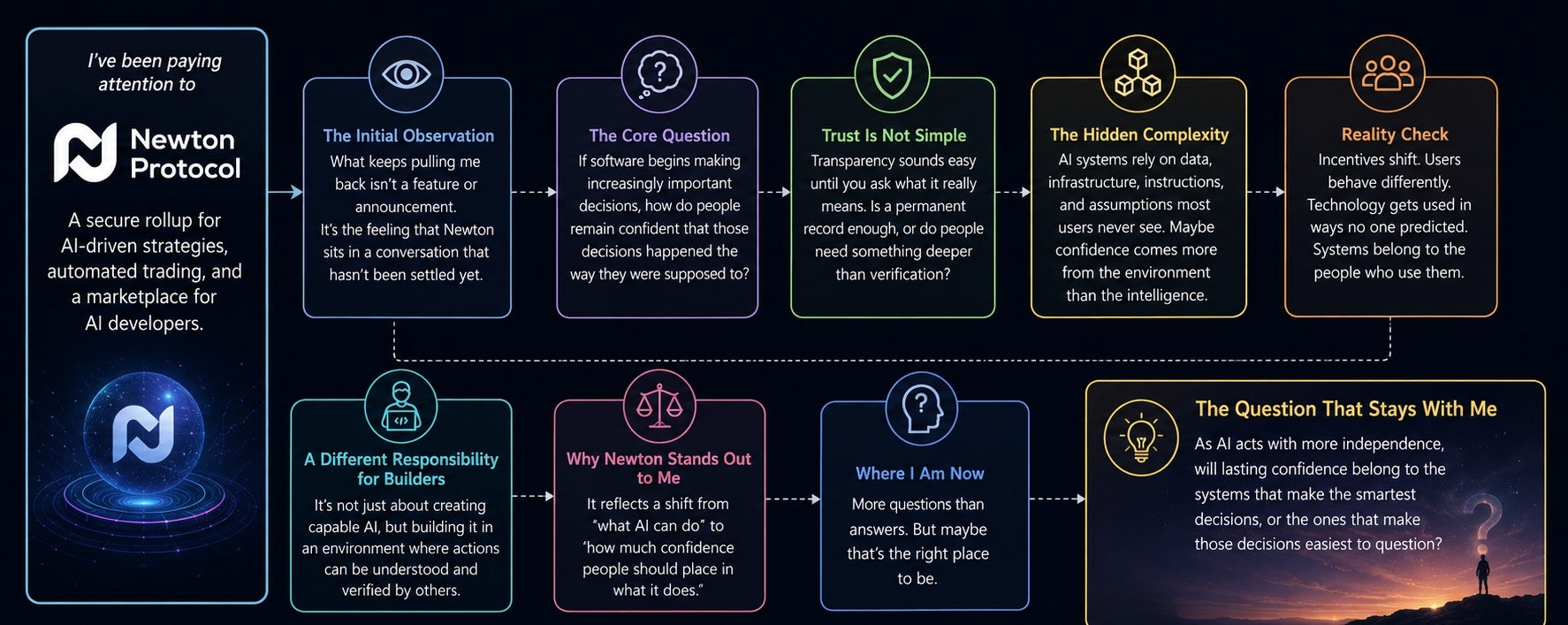
I've been paying attention to Newton Protocol for a while now, and what keeps pulling me back isn't a specific feature or announcement. It's the feeling that it sits in the middle of a conversation that hasn't really been settled yet. Every time I read about AI making decisions or executing strategies on behalf of people, I find myself wondering whether the real challenge is intelligence at all, or whether it's trust.
It's easy to assume that better automation naturally leads to better outcomes, but I've never been completely convinced by that idea. The more capable systems become, the more I think about the moments when things don't go as expected. Those moments tend to reveal what a system was actually built for. Success is easy to admire. Failure usually tells a more honest story.
That is probably why Newton Protocol has stayed on my mind. I don't look at it as another attempt to combine AI with blockchain. I look at it as an attempt to answer a quieter question: if software begins making increasingly important decisions, how do people remain confident that those decisions happened the way they were supposed to?
I don't know if there is a perfect answer. Even transparency sounds straightforward until you ask what it really means in practice. Is it enough to record actions after they happen, or does trust require something deeper than a permanent record? Sometimes I think people ask for verification when what they actually want is reassurance. Those aren't always the same thing.
Another thought keeps coming back to me. AI systems rarely exist in isolation anymore. They rely on data, instructions, infrastructure, and assumptions that most users never see. That hidden complexity makes me wonder whether confidence should come from the intelligence itself or from the environment surrounding it. Maybe the quiet parts of a system matter just as much as the visible ones.
At the same time, I try not to romanticize these ideas. Every new protocol promises cleaner coordination and stronger guarantees, but reality usually turns out to be more complicated. Incentives shift, users behave in unexpected ways, and technology often gets used differently than its designers imagined. That's not necessarily a flaw. It just reminds me that systems eventually belong to the people who use them, not only to the people who build them.
I also think about developers. Building AI is one thing, but building it in an environment where actions can be verified changes the conversation. It introduces a different kind of responsibility. Instead of simply asking whether an agent can complete a task, the question becomes whether someone else can understand what happened afterward. That feels less glamorous, but maybe more important.
Perhaps that's why Newton Protocol continues to catch my attention. It isn't because I expect certainty from it. It's because it reflects a broader shift in how people think about automation. The conversation seems to be moving away from what AI can do and toward how much confidence people should place in what it does.
I'm still watching with more questions than answers. Maybe that's the right place to be. As AI becomes increasingly capable of acting without constant human involvement, will the systems that earn lasting confidence be the ones that make the smartest decisions, or the ones that make those decisions easiest to question?