
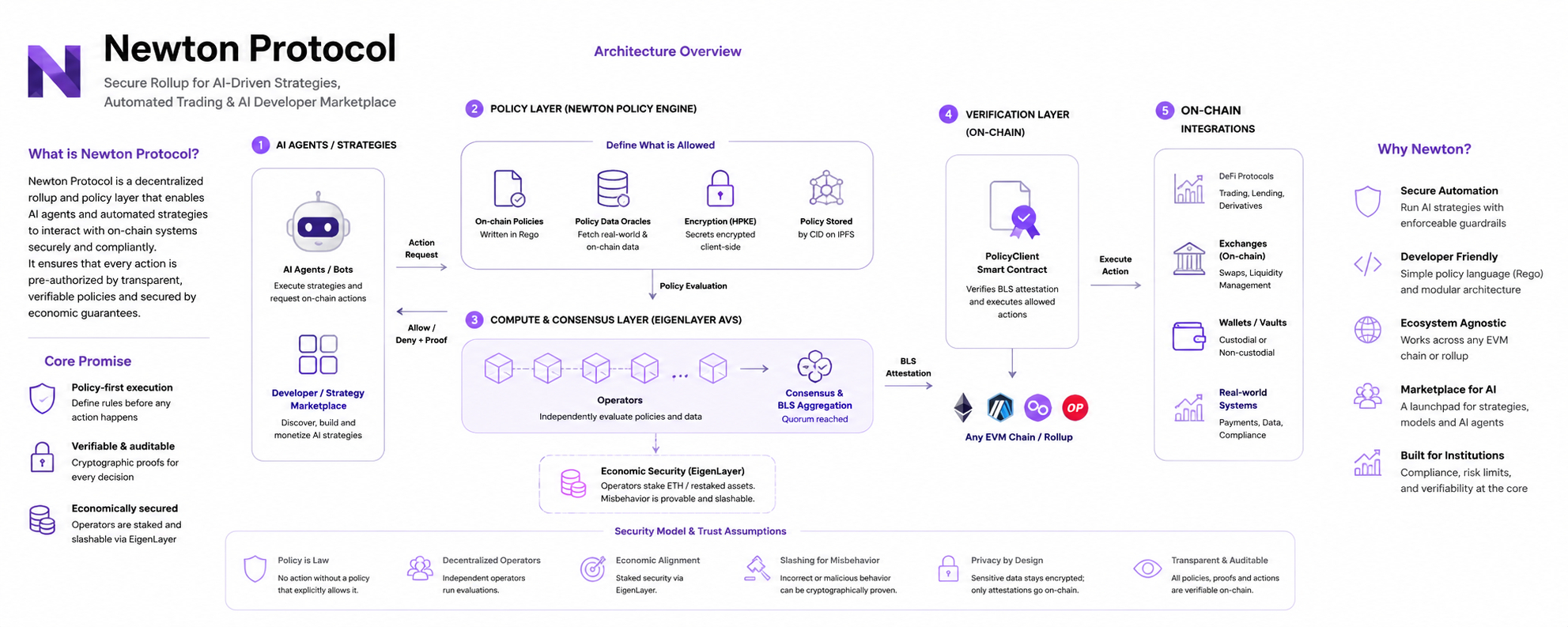
I've been around crypto long enough that I don't get excited very easily anymore.
That isn't because I think the industry has stopped building interesting things. It's more that I've watched too many projects arrive with huge promises, confident roadmaps, and communities convinced they were looking at the future. Most of them faded quietly. Some never shipped what they promised. Others worked technically but never found a reason for people to actually care.
After enough cycles, you stop reacting to headlines. You start paying attention to smaller details.
That's probably why Newton Protocol caught my attention.
Not because it talks about AI. If I'm honest, the moment I see "AI-powered" in crypto, I become a little more skeptical. Every cycle has a trend that everyone wants to attach themselves to. AI just happens to be this cycle's favorite.
What made me stay was something else.
The project seems less interested in making automation smarter and more interested in asking a simple question: what should happen before automated software is allowed to touch someone's assets?
That feels like a much more practical problem.
I've seen enough trading bots go wrong to know that speed isn't usually the issue. The real issue is that software often keeps doing exactly what it was told to do, even after the situation has completely changed.
Markets don't care that your code worked perfectly yesterday.
Neither do exploits.
When I looked into Newton's security model, I didn't come away thinking it had solved trust. I don't think anyone has. In fact, I don't even think that's possible.
Crypto has spent years telling people everything is trustless. I used to believe that too. Now I think it's one of the most misunderstood ideas in the industry.
Trust never disappears.
It just changes address.
Sometimes you're trusting validators.
Sometimes you're trusting bridge operators.
Sometimes you're trusting governance.
Sometimes you're trusting whoever wrote the smart contract.
Sometimes you're trusting data that came from somewhere completely outside the blockchain.
The names change, but trust is always sitting somewhere.
Newton feels a little more honest about that.
Its design still depends on operators behaving correctly, policies being written properly, software working as expected, and outside information being accurate. That's still a lot of assumptions. Anyone pretending otherwise probably hasn't spent much time watching how these systems behave once they're under pressure.
I've learned that security looks very different during a bull market than it does during panic.
Everything feels decentralized while everyone agrees.
The real test starts when incentives change.
I've seen projects that looked incredibly strong until the first serious problem arrived. Then suddenly everyone discovered there were assumptions nobody had really questioned.
That's why I find security models more interesting than token prices these days.
They're not as exciting, but they tell you far more about what a project actually believes.
One thing I genuinely like about Newton is that it seems comfortable putting limits around automation instead of pretending automation should have unlimited freedom.
That might not sound exciting.
Honestly, it probably isn't.
But after watching crypto for years, I've become convinced that boring ideas often survive longer than exciting ones.
Guardrails aren't popular.
Neither are seatbelts.
You only appreciate them after something goes wrong.
I'm still not ready to say Newton has figured everything out.
I don't think any protocol ever does.
The real world always finds new ways to expose weaknesses that diagrams and whitepapers never imagined.
That's just how this space works.
What I do think is that Newton is looking at a problem that's becoming harder to ignore. More automation means more decisions being made without people directly involved. If that's where crypto is heading, then the conversation shouldn't only be about making automated systems more capable.
It should also be about making them harder to misuse.
That's where security becomes interesting.
Not because it promises perfection.
Because it quietly accepts that perfection doesn't exist.
Maybe that's why I've kept thinking about Newton longer than I expected.
Not because I'm convinced it'll become one of the biggest protocols.
Not because I suddenly trust everything it's building.
Just because it feels like one of the few projects that's asking questions I've started asking myself after spending years in this market.
And sometimes that's enough to make me keep watching.
