

When I first looked at Newton Protocol, I almost placed it in the same bucket as every other crypto project using the AI angle. That was my first instinct. Another token, another automation story, another attempt to make trading sound smarter than it really is.
But the more I read into it, the more I felt that Newton is trying to deal with something more serious than just AI trading.
What stood out to me was not the idea that an agent can trade, rebalance a portfolio, or react to market conditions. Those things already exist in different forms. Bots have been around for years. Smart contracts already move money without asking anyone twice. The real question, at least for me, is much more basic: what happens when automated systems get too much freedom?
That is where Newton started to make sense.
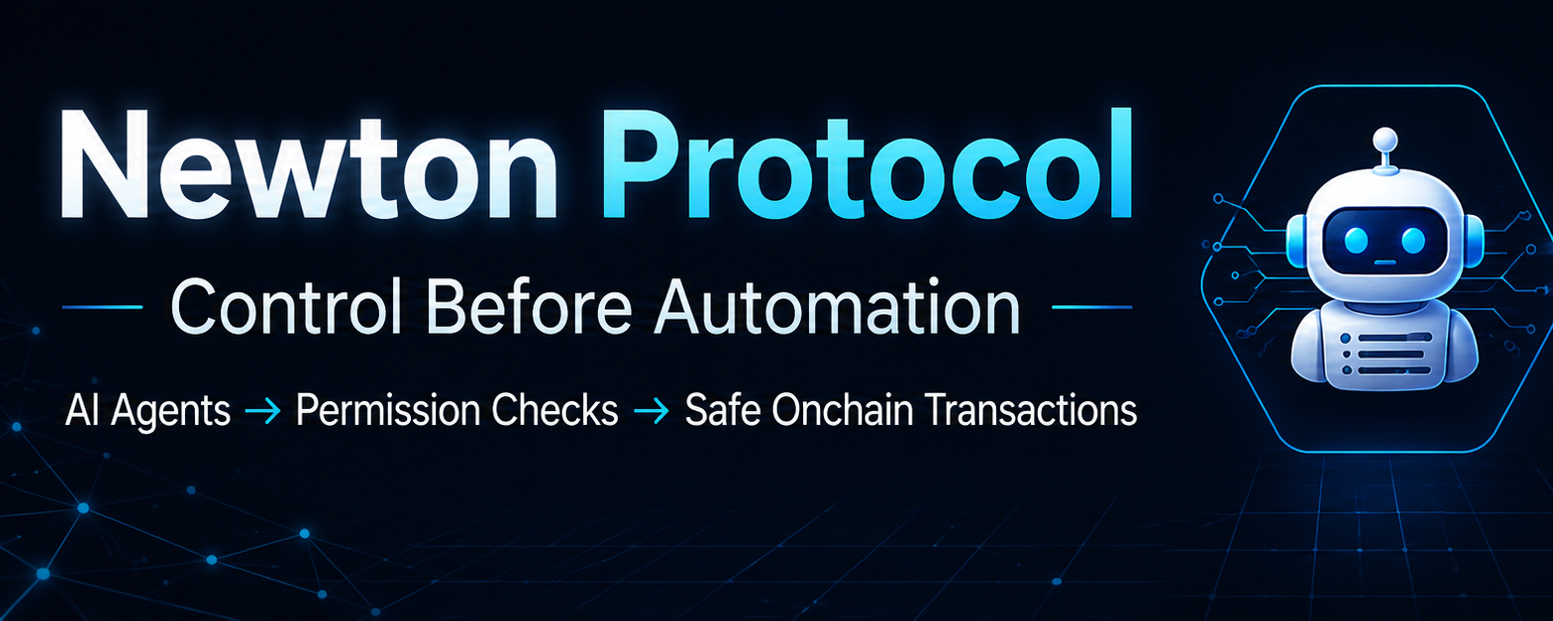
I see Newton less as a flashy AI project and more as a control layer. It is trying to sit between automated software and user funds, checking whether an action should actually be allowed before it happens. That may not sound exciting at first, but in crypto, it is a big deal. One bad approval, one loose permission, one careless connection to the wrong contract, and money can disappear quickly.
I have seen this problem again and again in crypto. People want convenience, but convenience usually comes with trust. You connect a wallet. You approve access. You let a tool manage something for you. At that moment, the risk quietly shifts. The user may think they are saving time, but they may also be handing over more control than they realize.
Newton’s idea is to make that control more precise.
Instead of giving an AI agent or automated strategy wide-open access, the user should be able to set limits. Trade only these assets. Spend only this much. Use only these protocols. Act only under these conditions. If the agent stays inside the rules, the transaction can move forward. If it crosses the line, it should stop before anything happens.
That is the part I find most practical.
I do not think the future of crypto automation will be about letting agents do whatever they want. That sounds dangerous. I think the more realistic future is controlled automation, where software can act quickly but only inside a clearly defined box. Newton seems to be building around that exact idea.
The project’s recent mainnet beta and VaultKit launch make this more interesting because they move Newton away from being just a concept. VaultKit is meant to help onchain vaults apply risk, compliance, and security checks before transactions settle. In simple terms, a vault can decide what is allowed, and Newton can help check those rules before funds move.
That feels important because vaults are not just casual wallets. They can hold serious capital. If automation is involved there, mistakes become much more expensive. A vault manager may want speed, but not blind speed. They may want automatic action, but not careless action. Newton is trying to give them a way to say yes to automation without saying yes to everything.
I also think this explains why Newton’s story goes beyond AI trading. Stablecoins, tokenized assets, vaults, and institutional DeFi all face the same issue in different ways. Money can move onchain very quickly, but rules still matter. Who is allowed to receive an asset? Is the transfer risky? Does the counterparty meet the required conditions? Should a transaction be blocked before it creates a problem?
These are not glamorous questions.
But they are necessary ones.
That is why I find Newton’s direction more grounded than the usual AI-crypto narrative. It is not only saying, “Let agents trade for you.” It is asking, “How do we stop agents from doing the wrong thing?” That second question is much more useful.
Of course, the token side is still risky. NEWT is new, volatile, and very dependent on whether the protocol actually gets used. A token can have staking, fees, governance, and other roles written into its design, but none of that matters much without real activity. For me, the important thing is not just whether NEWT gets listed, promoted, or traded heavily for a few days. I would rather watch whether developers build with Newton, whether vaults actually integrate it, and whether real transactions start relying on its permission system.
Supply also matters. NEWT has a fixed total supply of one billion tokens, and unlocks are scheduled over time. That means the market has to absorb more supply as it comes in. If demand grows because the protocol is being used, that is one thing. If demand is mostly speculation, unlocks can become pressure. I would not ignore that.
This is why I do not see Newton as a simple buy-or-sell story. I see it as a project sitting at the edge of a bigger shift in crypto. The industry has spent years making transactions faster, cheaper, and more automated. Now it has to make them safer. Not safer in a vague way, but safer at the exact point where money is about to move.
That is what Newton is trying to do.
There are still challenges. The system has to be easy enough for developers to use. The data behind its policies has to be reliable. The integrations have to grow. And most importantly, people have to care enough to use it in real products, not just talk about it as infrastructure.
But the core idea feels relevant to me.
As AI agents become more common in finance, I do not think the biggest question will be whether they can act. They will be able to act. The bigger question will be whether they should be allowed to act in a specific moment, with specific funds, under specific rules.
That is where Newton’s bet becomes clear.
It is not betting only on AI. It is betting on control. And in crypto, where one transaction can change everything, control may end up being far more valuable than speed.