I’m watching another cycle where artificial intelligence is becoming the answer to almost every question in crypto. I’ve seen this before. The story changes every few years, but the pattern rarely does. New narratives appear with enormous confidence, attention moves faster than understanding, and somewhere beneath the excitement the same old weaknesses quietly remain. I no longer find myself asking whether a technology is impressive. I spend more time wondering where it breaks once people begin trusting it with real value.
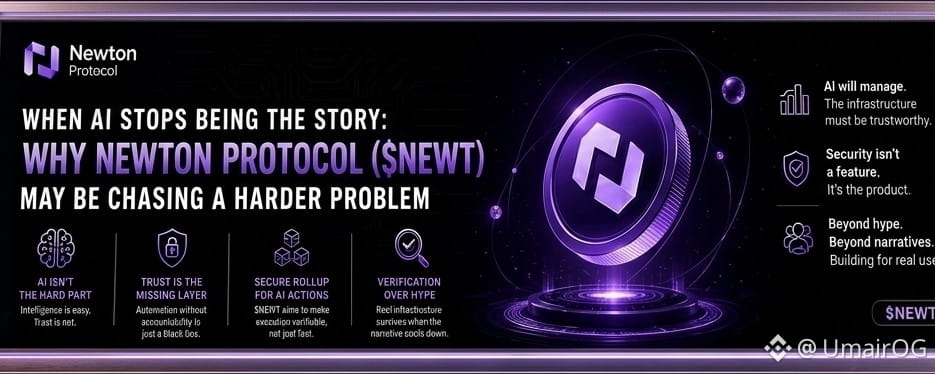
That has slowly changed the way I look at projects like **Newton Protocol and $NEWT**. The AI conversation is interesting, but intelligence has never been the hardest thing to build. Crypto has produced automation for years. Trading bots, smart contracts, execution engines, automated strategies, and endless attempts to remove human decision-making have always existed. Yet most of them eventually reached the same uncomfortable place. Users stopped asking whether they worked and started asking whether they could actually trust them.Trust has always been the missing layer. Automation makes decisions quickly, but speed does not explain why those decisions deserve confidence. Every system that acts without constant human involvement creates another place where assumptions replace verification. At first those assumptions seem harmless because everything appears to function normally. Then market conditions change, incentives shift, unexpected behavior appears, and people realize they have been relying on something they never fully understood.
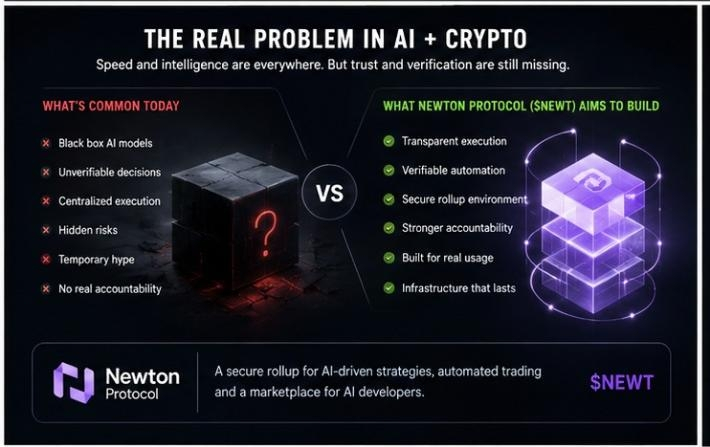
I keep coming back to that problem because it feels larger than AI itself. Intelligence without accountability eventually becomes another black box. Markets already contain enough invisible systems making decisions that few participants can inspect. Adding more sophisticated models does not automatically reduce uncertainty. Sometimes it simply hides uncertainty behind more convincing outputs.That is why $NEWT feels more interesting to observe than many projects describing themselves as AI infrastructure. The part that catches my attention is not the promise of smarter agents or automated strategies. Those ideas are becoming common. What seems more important is the attempt to build an environment where automated actions can exist inside a secure rollup with clearer execution and stronger verification. Whether that ambition succeeds is another question entirely, but at least it begins by acknowledging the problem instead of pretending it disappeared.I also think crypto has developed a habit of confusing capability with necessity. Every launch demonstrates what can be built, but far fewer demonstrate why people will continue using it once incentives become smaller. That distinction usually decides which protocols survive. Temporary attention has never been difficult to create. Dependence is much harder.
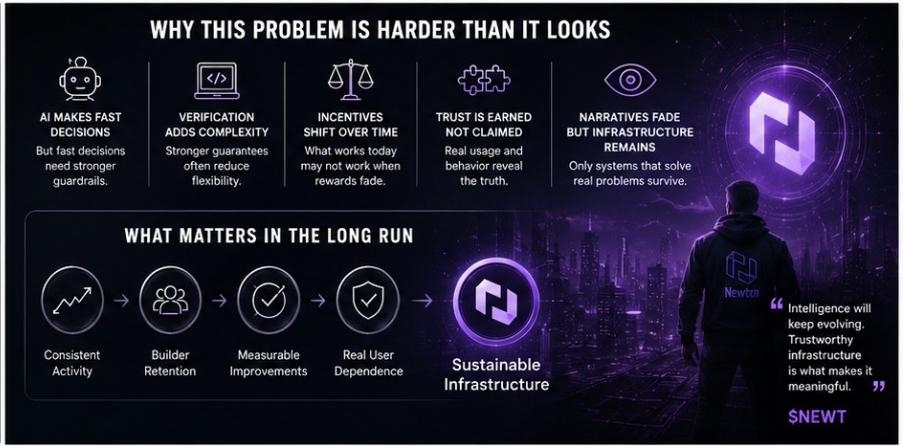
If AI eventually manages portfolios, coordinates trading strategies, interacts with decentralized applications, and moves assets without constant supervision, then the environment around those actions becomes just as important as the intelligence itself. Mistakes made by automated systems can spread much faster than mistakes made by individuals. Security stops being a feature and becomes part of the product itself.Still, I hesitate whenever I hear phrases that sound too complete. Markets rarely reward complete stories. Every architecture contains trade-offs that become visible only after real users begin interacting with it. Verification systems introduce complexity. Security introduces friction. Better guarantees often reduce flexibility somewhere else. Those compromises rarely appear during the first weeks of excitement because nobody is looking for them yet.What interests me most is what happens after the narrative cools down. Developers eventually stop building for headlines and begin solving smaller problems that ordinary users actually notice. Infrastructure either becomes invisible because it works or irrelevant because nobody depends on it anymore. That stage has always mattered more than launch announcements.
I find myself paying less attention to partnerships, announcements, and promises than to behavior over time. Does activity continue after incentives decline? Do builders remain engaged when fewer people are watching? Are difficult technical questions answered with measurable improvements instead of larger narratives? Those signals usually tell me more than any roadmap ever could.@NewtonProtocol Newton Protocol sits in a part of the market where expectations will naturally become very high. AI encourages people to imagine perfect automation while crypto encourages people to expect trustless systems. Combining those two ideas Creates enormous pressure because both are difficult to aChieve independently, let alone together. That does not make failure inevitable, but it does make easy confidence feEl misplaced.
Perhaps that is why I am still watching instead of reaching conclusions. The protocol may eventually prove that secure execution matters as mUch as intelligent execution. It may also discover that verification itself becomes another challenge once systems grow more complex... I do not know which outcome arrives first. After enough years in crypto, certainty feels less useful than careful observation, and sometimes the projects worth following are not the ones making the loudest promises, but the ones quietly trying to solve problems that everyone else learned to ignore.