
I spent part of my evening at a small chai stall near the market, scrolling through crypto updates while waiting for a friend. A man sitting nearby was frustrated because a business payment had been delayed. His friend looked at him and said, "Every financial system has rules. Without them, trust disappears."
It was a simple comment, but it stayed with me.
Later that night, while reading about Newton Protocol, I realized crypto has become incredibly good at moving assets across blockchains, yet one important piece of infrastructure is still missing. Most onchain applications still have to build their own compliance and risk controls from scratch. Every protocol solves the same problem differently, which creates higher costs, inconsistent standards, and unnecessary complexity.
That is exactly the problem Newton Protocol is trying to solve.
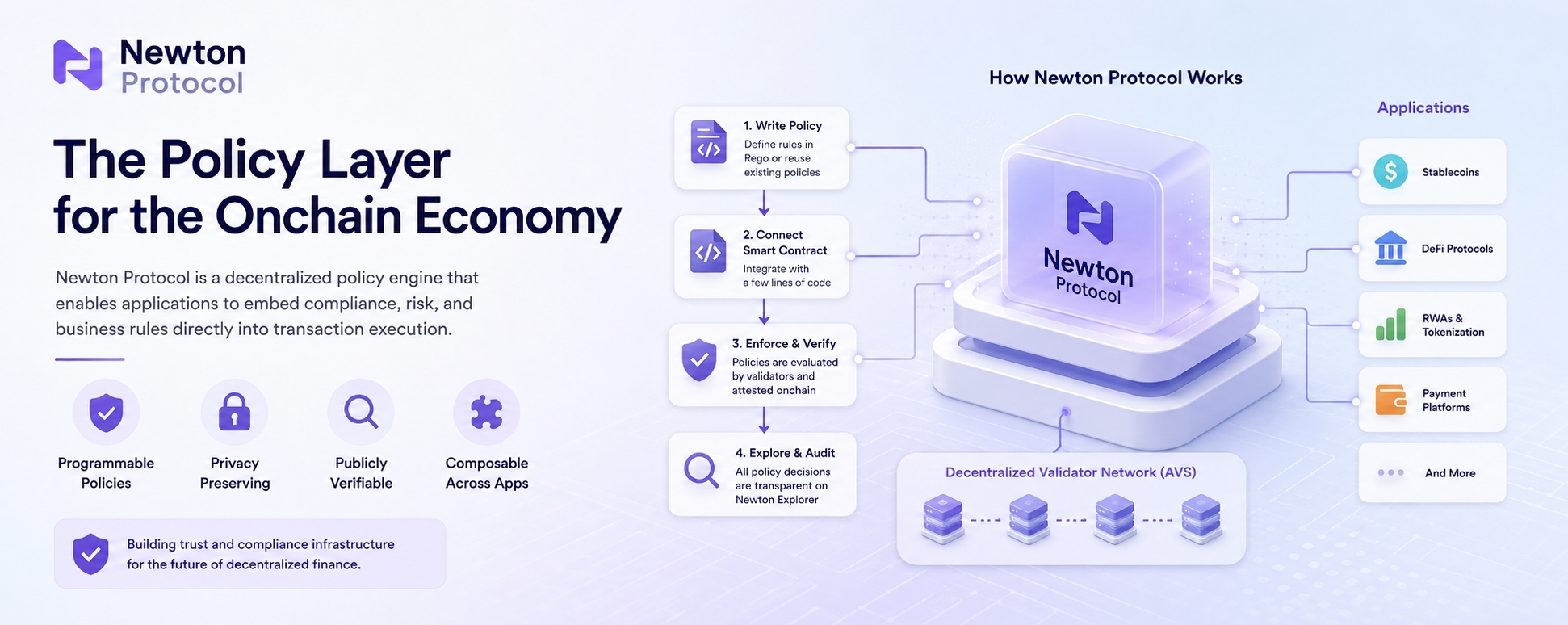
Instead of treating compliance as something every application builds independently, Newton Protocol introduces a shared onchain policy engine. Developers can create policies—or reuse existing ones—that define how transactions should be evaluated before they are executed. These policies can include spending limits, KYC requirements, sanctions screening, jurisdiction restrictions, or other business rules, allowing applications to enforce them consistently without rebuilding the same infrastructure every time.
What I found interesting is how practical the approach feels.
After defining a policy, developers only need to connect their smart contracts to Newton Protocol. From there, policy evaluation becomes part of the transaction flow. Before an action is completed, Newton's validator network evaluates it against the required rules, gathers the necessary data, generates cryptographic attestations, and returns a verifiable decision. Transactions that satisfy the policy proceed normally, while those that fail are automatically rejected.
From the user's perspective, almost nothing changes.
The application still feels familiar.
The difference is happening underneath, where policy enforcement becomes programmable instead of manual.
Another feature that caught my attention is the Newton Explorer. Compliance decisions are no longer hidden inside private systems. Developers, auditors, institutions, and users can verify how policies were applied through a transparent interface, while privacy-sensitive information remains protected through cryptographic techniques such as zero-knowledge proofs.
That combination of transparency and privacy feels especially important.
Many institutions are interested in blockchain technology, but they also need clear evidence that compliance requirements can be enforced consistently. Newton Protocol allows organizations to implement policies directly at the smart contract level instead of relying on disconnected backend systems. For stablecoin issuers, tokenized real-world assets, DeFi protocols, and other financial applications, that could significantly reduce operational complexity while making compliance easier to verify.
I also like that Newton Protocol is designed as shared infrastructure rather than an isolated solution.
If one organization develops a useful policy, others can reuse it instead of starting from zero. Over time, that could create a common policy layer across different applications and networks, making compliance more efficient for developers while improving confidence for institutions and users.
The more I read, the more I stopped thinking about Newton Protocol as another blockchain project competing for attention.
I started seeing it as infrastructure.
Infrastructure rarely generates the loudest headlines, but it often determines whether an ecosystem can support long-term growth.
Crypto has already made huge progress in scalability, interoperability, and user experience. The next phase of adoption will depend on whether applications can also provide the safeguards expected by businesses, regulators, and everyday users.
That is where Newton Protocol stands out to me.
It is not trying to change how people use blockchain.
It is trying to improve the rules that operate behind the scenes.
If crypto is going to support global payments, institutional finance, stablecoins, and tokenized assets at scale, programmable compliance cannot remain an afterthought. It needs to become part of the infrastructure itself.
After spending time learning about Newton Protocol, that feels like its biggest contribution.
Not making crypto more restrictive.
Making it more prepared for the next stage of adoption.