

I keep coming back to one question whenever I think about the future of Web3: what if the biggest obstacle isn't scalability, liquidity, or even regulation—but the fact that everything still feels disconnected? Every new blockchain expands the ecosystem, yet it also adds another wallet, another bridge, another interface, and another layer of decisions for users. More infrastructure has often meant more complexity instead of a better experience.
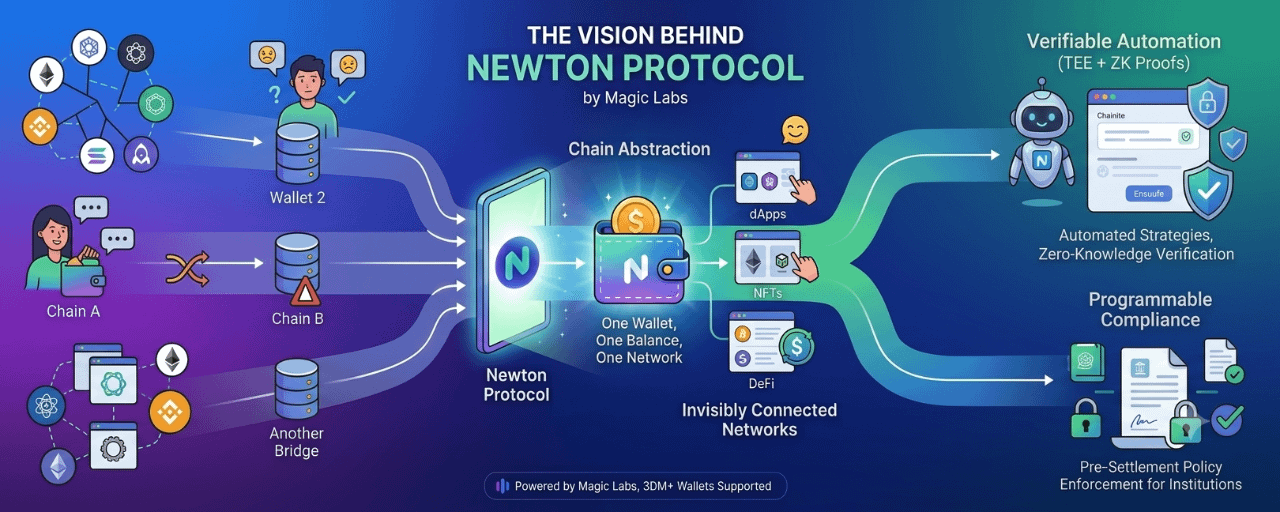
That is why I find the vision behind Newton Protocol more interesting than another discussion about throughput or yield. Rather than building another destination inside Web3, it is trying to make the entire ecosystem feel like one connected network. Magic Labs' goal isn't simply to connect chains—it is to abstract their complexity away so users interact with digital assets without constantly thinking about which blockchain they are on.
I think of it like modern internet browsing. Most people never wonder which servers, protocols, or routing systems deliver a webpage—they simply expect everything to work. Crypto, by comparison, still asks users to understand networks before they can even complete a transaction. Newton's vision of "one wallet, one network, one balance" feels less like adding another layer and more like removing one. If infrastructure such as AggLayer connects blockchains behind the scenes, Newton aims to become the experience layer that makes those connections practically invisible.
What makes this vision stand apart is that it doesn't stop at chain abstraction. It also rethinks automation. Today, many automated DeFi strategies require users to trust centralized bots or surrender unnecessary control over their assets. Newton takes a different approach through verifiable automation, combining Trusted Execution Environments with Zero-Knowledge Proofs so AI agents can execute predefined actions while remaining cryptographically accountable. The goal isn't to replace trust with promises—it is to replace it with verification.
The same philosophy extends to compliance. Instead of treating regulation as something that interrupts innovation after transactions occur, Newton proposes policies that are enforced before transactions settle. Compliance becomes programmable, adaptable, and verifiable rather than reactive. That shift feels important because long-term adoption will likely depend not only on what decentralized applications can do, but also on whether institutions and regulators can confidently participate without compromising the principles of decentralization.
What also gives this vision more credibility is that it isn't being built in isolation. Magic Labs already powers more than 50 million wallets and has supported billions of dollars in transaction volume through applications like Polymarket. That tells me Newton isn't starting from theory—it is evolving from infrastructure that has already operated under real-world demand.
Of course, ambitious visions are easy to describe and much harder to execute. Chain abstraction, AI-driven automation, and programmable compliance each solve meaningful problems on their own. The real challenge is making all three work together so seamlessly that users barely notice the technology underneath. If the experience still feels complicated, the vision falls short no matter how advanced the architecture becomes.
For me, that is what makes Newton Protocol worth paying attention to. It isn't trying to win the race to build another blockchain—it is trying to redefine how people interact with every blockchain. And that feels like a much bigger ambition. As Web3 matures, will the projects that create the most value be the ones building new chains, or the ones that finally make every chain feel like a single network?
@NewtonProtocol #Newt $NEWT $SYN $CAP