
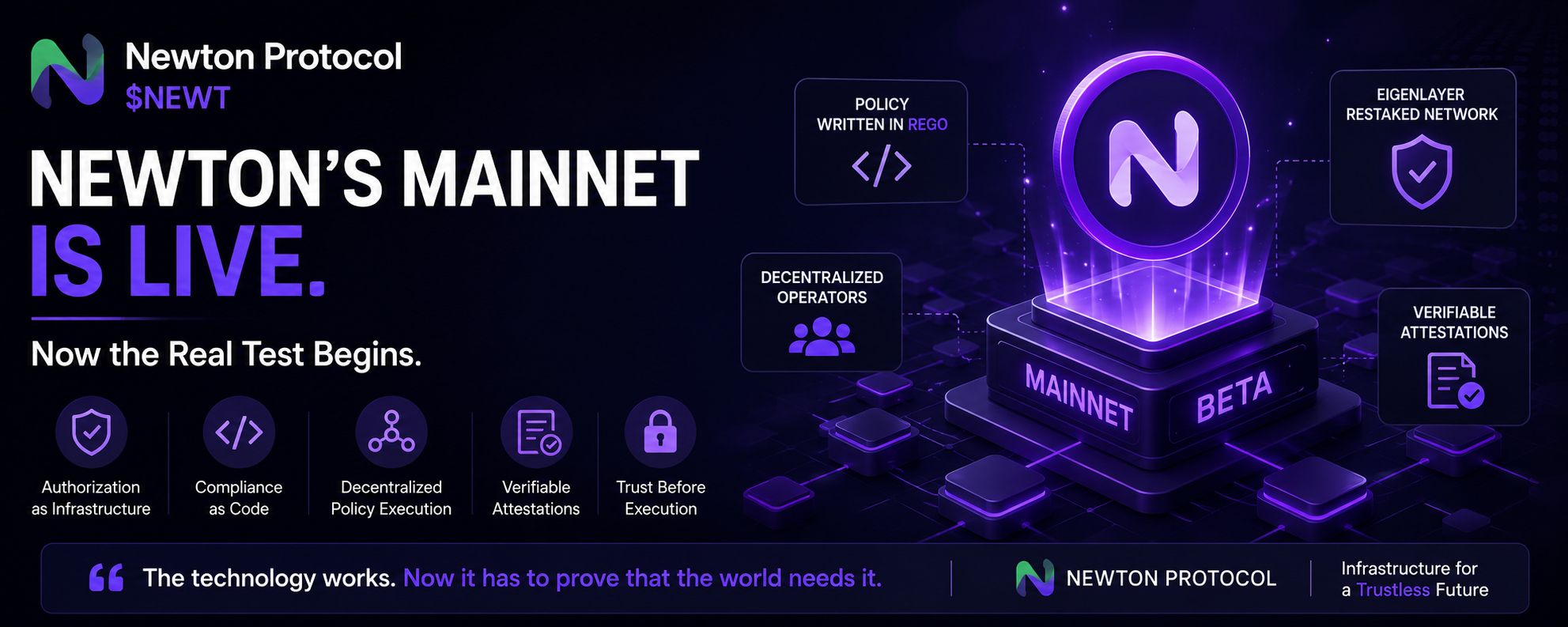

I went back to check on Newton Protocol expecting to find the same conversation I left months ago. Authorization as infrastructure, permission quality as an underrated asset, all the ideas I had been circling. Instead I found something had quietly shifted. Mainnet beta is live. The thing I had only been able to reason about in the abstract now has a chain people can actually transact on.
That changes the question I am asking. It used to be philosophical: should authorization become programmable infrastructure? Now it is operational: is anyone using it yet, and does the architecture survive contact with real transactions?
What stands out to me is how unglamorous the rollout looks next to the price chart. NEWT is trading roughly ninety-four percent below its all-time high, and the token only recently moved past a large cliff unlock, with linear vesting now adding new supply every month. That is the kind of backdrop that usually drowns out everything else in a project's story. Yet underneath the chart, the actual infrastructure piece, builders writing policy in Rego, decentralized operators evaluating those policies through an EigenLayer-restaked network, producing signed attestations anyone can verify, has gone from documentation to something running.
I keep thinking about why that gap exists. Markets price token supply mechanically. Unlocks are scheduled, predictable, easy to model. Adoption is none of those things. So the chart reflects dilution because dilution is the only variable with a known timestamp. Whether developers actually integrate a policy client into a stablecoin or an AI wallet is not a line on a calendar. It happens quietly, deal by deal, and the market has no clean way to price it in advance.
There is a phrase Newton's own materials use that stuck with me: compliance-as-code. I find that more interesting than it first sounds. Compliance has historically been the slowest, most manual layer in finance, audits, legal review, after-the-fact reporting. Turning it into something a smart contract checks before a transaction settles is a different category of claim than most automation projects make. Most agent platforms are trying to make execution faster. This is trying to make the decision before execution legible and provable, which is a narrower and arguably harder problem.
I am also paying attention to where the credibility is coming from. Newton is built by Magic Labs, the same team behind embedded wallet infrastructure used by hundreds of thousands of developers and tens of millions of wallets, with enterprise names like Polymarket and WalletConnect already in their orbit. That lineage matters more to me than any marketing copy, because distribution into existing developer relationships is a real advantage that a brand-new team would have to build from nothing. It also means the upcoming Verifiable Automation Marketplace and the multichain zkPermissions rollup are not pure speculation, there is a team with a track record of shipping wallet infrastructure at scale now shipping policy infrastructure.
None of that resolves the tension I keep coming back to. A protocol can have excellent architecture, a credible team, and still fail to generate enough fee-paying usage to justify its token economics, especially while monthly unlocks keep adding sell pressure that adoption has not yet matched. Institutional recognition, like Newton's recent inclusion on an on-chain finance infrastructure long list, signals credibility, not revenue. Those are different things, and I think it is easy to conflate them when a project is the only one doing something genuinely novel.
So I am watching two numbers that rarely get charted together. How much value is actually flowing through policy checks on mainnet, agent collateral staked, fees generated, attestations produced, versus how much new supply hits the market each month from vesting. If the first number starts compounding faster than the second, the gap between the quiet infrastructure story and the loud price story starts to close. If it does not, mainnet beta becomes one more milestone that proved the technology worked without proving anyone needed it badly enough to pay for it.
I do not know which way this resolves yet. I just know the test has finally started, and it is no longer a thought experiment.