
I'll be honest, when I first came across Newton Protocol, I assumed it was another attempt to attach artificial intelligence to blockchain and call it the future. The industry has become familiar with that pattern. Every few weeks there seems to be another protocol promising autonomous agents, AI-powered finance, or intelligent trading systems that are supposed to change everything. After a while, the language begins to repeat itself, and genuine innovation becomes difficult to separate from carefully designed narratives.
The more I looked into Newton Protocol, however, the less it felt like it was trying to convince people that AI is powerful. That part is already obvious. Instead, the project seems to focus on a question that receives far less attention. As artificial intelligence becomes capable of making increasingly important decisions, who is responsible for those decisions, and what kind of infrastructure can make them trustworthy?
That question feels far more important than another discussion about larger models or faster automation. Intelligence has never been the only challenge. Human history is full of intelligent systems that failed because they lacked accountability, coordination, or clear incentives. AI may become extraordinarily capable, but if the environments where it operates cannot be trusted, its usefulness will always remain limited.
This is where Newton Protocol begins to feel more interesting than I initially expected.
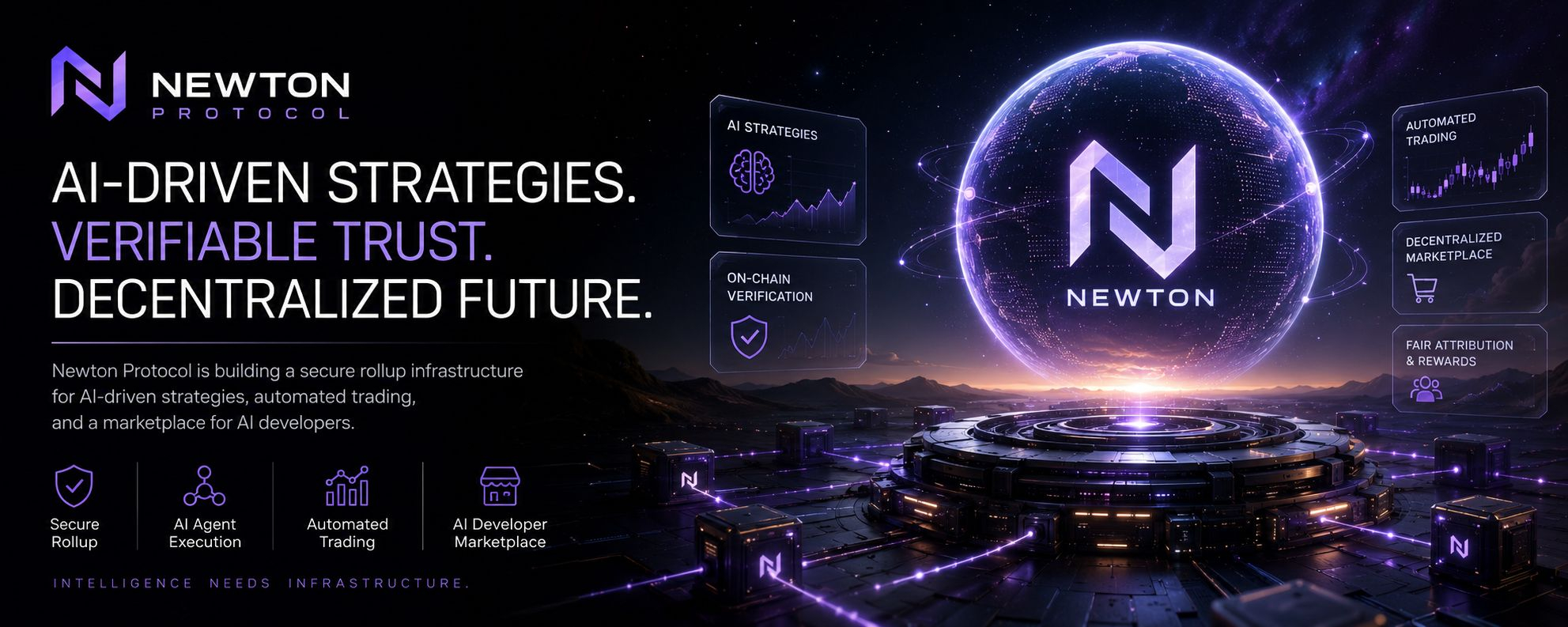
Rather than simply creating another marketplace for AI or another platform for automated trading strategies, the protocol is attempting to build an environment where intelligent agents can operate inside verifiable boundaries. It uses a secure rollup architecture not simply as a scaling solution but as a controlled execution layer where AI-driven strategies can interact with financial systems while remaining observable and economically accountable.
That distinction changes how the entire project should be viewed.
Most blockchain infrastructure was designed around people signing transactions. Every action has an identifiable origin, every transfer follows deterministic rules, and consensus is relatively straightforward because computers are verifying predefined instructions. Artificial intelligence introduces a very different dynamic. AI does not simply follow instructions. It interprets situations, weighs probabilities, adjusts its behavior, and makes decisions that cannot always be predicted in advance.
As soon as autonomous agents begin managing assets, executing trades, or coordinating financial strategies, the challenge is no longer computational power. The challenge becomes trust.
Centralized platforms solve this problem by asking users to trust the company operating the system. Blockchain attempted to remove that dependency by distributing verification across decentralized networks. AI complicates both approaches because intelligence itself becomes an active participant in economic activity rather than merely a tool being controlled by a person.
Newton appears to recognize that this creates an entirely new layer of infrastructure that does not yet fully exist.
Its architecture is not simply about processing transactions efficiently. It is about creating an environment where AI-generated actions can be validated before they become economically meaningful. That may sound like a technical detail, but it reflects something much larger. As machines begin making decisions on behalf of people, verification becomes just as valuable as intelligence itself.
The protocol also introduces an ecosystem where AI developers can contribute strategies and applications instead of treating intelligent systems as isolated products. At first glance, that resembles another developer marketplace, but underneath it sits a more complicated idea about digital ownership.
Artificial intelligence rarely creates value in isolation. A successful model depends on data, infrastructure, developers, validation, computing resources, and users who ultimately place their trust in its output. Every meaningful result becomes the product of many different participants whose contributions overlap in ways that are difficult to measure.
Traditional software economics struggle to represent that complexity because ownership usually belongs to whoever distributes the application. AI makes that assumption increasingly difficult to defend. Value is generated continuously rather than delivered as a finished product. Every decision an AI system makes depends on countless invisible contributions that deserve recognition in some form.
That is why attribution matters far more than it first appears.
It is easy to think of attribution as a technical mechanism that records who built what. In reality, it is an economic question about who deserves to benefit when intelligent systems generate value. If those relationships cannot be made visible, AI economies naturally become centralized because whoever controls distribution captures most of the rewards while everyone else becomes increasingly dependent on platforms they do not control.
Newton's design seems to acknowledge that future without pretending the problem is simple.
The protocol attempts to combine decentralized verification, AI execution, and economic incentives into a structure where participation itself becomes measurable. Validators, developers, infrastructure providers, and users all contribute to an ecosystem that depends on cooperation rather than blind trust. Whether those incentives remain balanced over time is another question entirely, but at least the protocol recognizes that intelligence alone cannot create sustainable systems.
That skepticism should never disappear.
Every decentralized network eventually faces governance challenges that technology alone cannot solve. Token holders accumulate influence. Validators respond to financial incentives. Developers want flexibility while users demand stability. Artificial intelligence introduces another level of uncertainty because the systems themselves continue evolving long after the infrastructure supporting them has been deployed.
Governance therefore becomes less about writing permanent rules and more about managing continuous adaptation. That is an extraordinarily difficult task. A protocol can decentralize infrastructure, but human decision-making rarely becomes simpler simply because it exists on-chain.
Newton will almost certainly encounter these same tensions. There is no architecture capable of eliminating politics from decentralized systems. The best any protocol can realistically hope for is creating institutions that distribute power more fairly while remaining flexible enough to evolve as technology changes.
Perhaps that is what ultimately makes Newton Protocol worth paying attention to.
It does not seem to assume that better AI automatically creates a better future. Instead, it quietly shifts attention toward the systems surrounding intelligence itself. That feels like a healthier direction for the industry. Artificial intelligence is advancing rapidly, but trust, ownership, coordination, and accountability remain remarkably fragile. Those are social problems disguised as technical ones.
In many ways, the protocol reflects a broader shift taking place across digital infrastructure. The first generation of blockchain asked who owns digital assets. The next generation explored how decentralized networks coordinate computation. AI is now forcing an even deeper question: how should autonomous intelligence participate in economic systems where responsibility can no longer be attached to a single individual?
There is no perfect answer to that question, and Newton does not pretend to have one. What it offers instead is an attempt to build infrastructure that treats trust as something that should be engineered rather than assumed.
Whether that approach ultimately succeeds will depend on adoption, governance, technical resilience, and countless factors that cannot yet be measured. But perhaps success is not the only reason projects like this deserve attention. Sometimes the value of a protocol lies in the questions it forces the industry to confront rather than the certainty of its solutions.
As artificial intelligence becomes increasingly woven into financial markets, digital ownership, and autonomous decision-making, the conversation will inevitably move beyond capability. It will become about accountability, attribution, incentives, and the invisible architecture that allows strangers—and perhaps even machines—to cooperate without relying entirely on faith. Newton Protocol is one attempt to build that architecture. It is neither flawless nor guaranteed to define the future, but it reminds us that the next stage of AI may depend less on creating smarter systems and more on creating systems worthy of our trusted
