Last night, I sat in front of my terminal watching my AI trading agent work on-chain. Within a few minutes it had executed dozens of transactions across multiple liquidity pools. Everything looked fine. Trades went through, balances updated, and slippage stayed under control.
Then a simple question crossed my mind.
What if it made the wrong decision?
The blockchain wouldn't know.
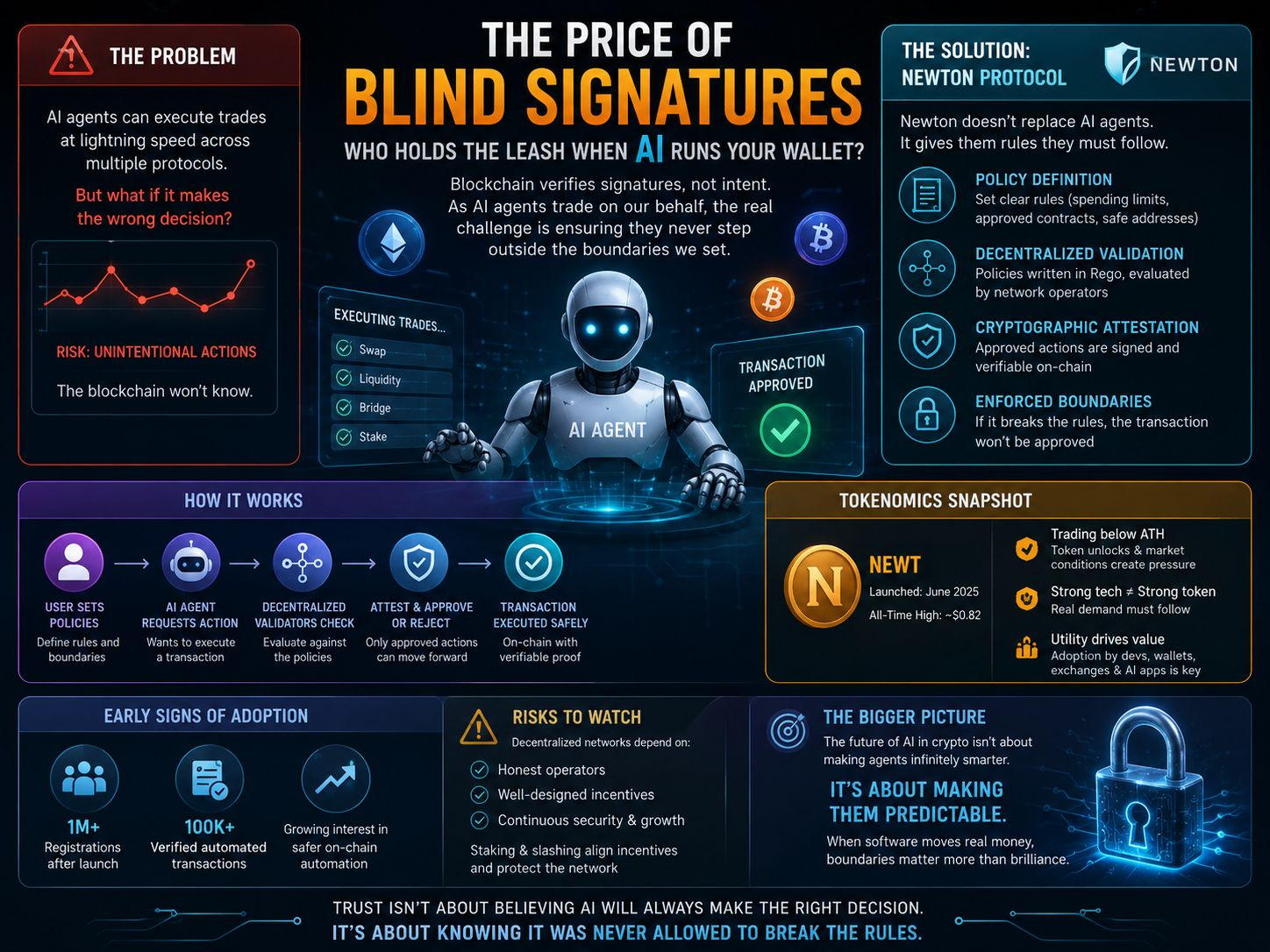
That's when I realized something that had been bothering me for a while. Blockchains are incredibly good at verifying signatures, but they don't understand intent. If a transaction is signed correctly, the network accepts it. It never asks whether that action is actually what the owner wanted.
As more people hand routine decisions to AI agents, that distinction starts to matter.
Maybe the biggest challenge in the next phase of Web3 isn't building smarter agents. Maybe it's making sure they never step outside the boundaries we intended.
That thought led me to spend some time researching Newton Protocol.
Newton isn't trying to replace AI agents. Instead, it focuses on something much less glamorous but arguably more important: giving autonomous software clear rules that it must follow before a transaction is allowed to move forward.
The idea feels surprisingly practical.
Imagine telling your agent, "Never trade above this amount. Never interact with unknown contracts. Never send funds outside these approved addresses."
Instead of trusting the agent to remember those instructions forever, the system checks whether every action fits the rules you already defined. If it doesn't, the transaction shouldn't be approved.
From what I've read, Newton approaches this through a decentralized validation network. Policies can be written in Rego, evaluated by network operators, and approved actions receive cryptographic attestations that can be verified later. The goal isn't blind trust it's making authorization itself verifiable.
As a trader, I appreciate that direction.
Markets don't usually punish people for having bad intentions.
They punish people for making one expensive mistake.
Of course, technology is only one side of the story.
The other side is tokenomics.
NEWT launched in June 2025 and later climbed to an all-time high of around $0.82. Today it's trading far below that level, with token unlocks and broader market conditions putting pressure on the price. That's a reminder that strong technology doesn't automatically create a strong token.
Eventually, real demand has to show up.
If developers, wallets, exchanges, and AI applications actually need Newton's authorization network every day, that creates utility. If they don't, the market will eventually notice.
That's the part I'm watching most closely.
The early adoption numbers are interesting. Newton reported more than one million registrations shortly after launch, along with hundreds of thousands of verified automated transactions. Those numbers suggest there's genuine curiosity around safer on-chain automation, even if it's still early to know how that demand will evolve.
Like every infrastructure project, there are risks.
A decentralized validation network still depends on honest operators and well-designed incentives. Newton addresses that through staking and slashing, giving participants something valuable to lose if they act dishonestly. Whether that model continues to hold up as the network grows is something only time can answer.
The more I think about it, the less I believe the future of AI in crypto is about making agents infinitely smarter.
It's about making them predictable.
Because when software starts moving real money on our behalf, intelligence isn't enough.
Boundaries matter.
Maybe that's where the next layer of trust in Web3 comes from not from believing AI will always make the right decision, but from knowing it was never allowed to break the rules in the first place.