
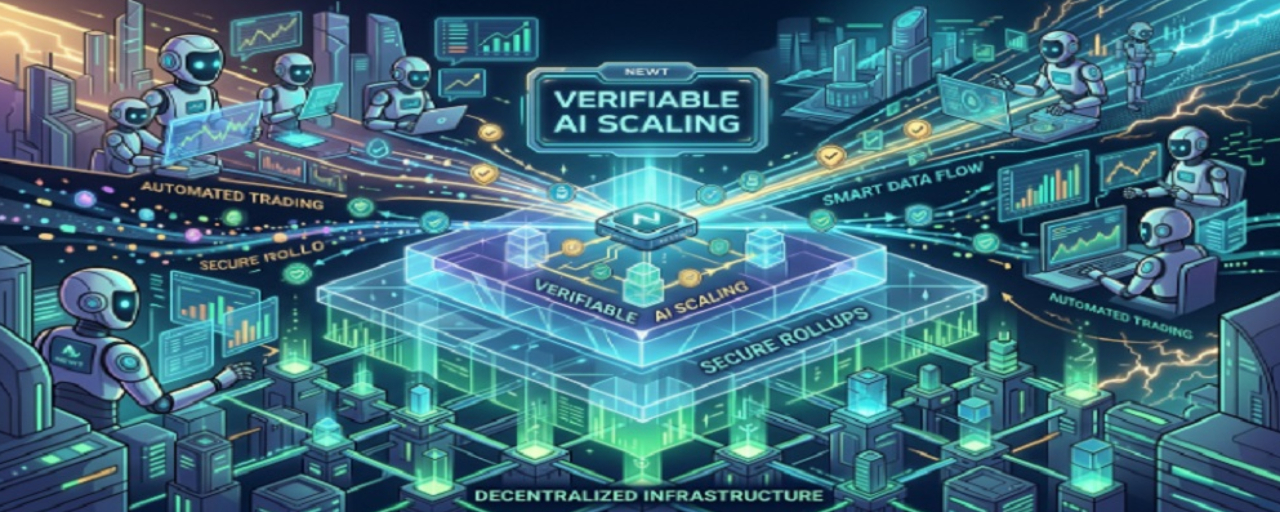

I keep circling back to one question when looking at @NewtonProtocol and its Mainnet Beta experiments. Not whether decentralized AI works in theory, but whether it can actually scale without losing the thing that makes it valuable in the first place.
At a small level, decentralized AI feels surprisingly clean. Agents execute tasks, data is verified, and $NEWT ties incentives together in a way that feels structured rather than chaotic.
But scaling changes the shape of everything. What works for a few AI agents starts to feel very different when thousands of them begin interacting across shared infrastructure.
The part I keep thinking about is coordination. In centralized systems, one controller smooths everything out. In a decentralized setup like #Newt , coordination becomes something that has to be constantly negotiated.
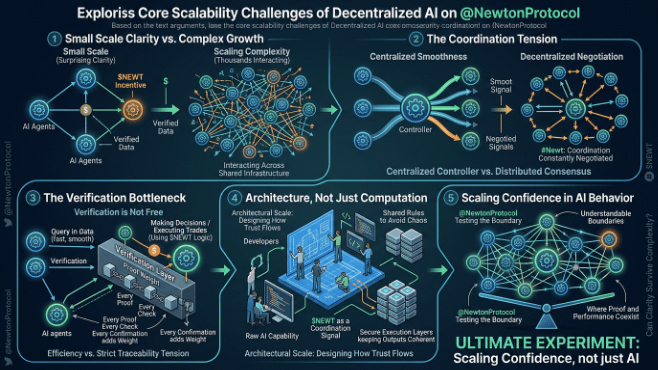
With @NewtonProtocol , the idea of verifiable execution helps, but verification itself is not free. Every proof, every check, every confirmation adds weight to the system.
That weight matters more when AI agents are not just querying data, but actively making decisions, executing trades, or triggering on-chain actions using $NEWT powered logic.
So the question is not only about intelligence. It is about whether intelligence can stay efficient when every step is required to be accountable.
In a way, decentralized AI is trying to solve two problems at once. It wants autonomy for agents, but also strict traceability for every action they take.
That tension becomes more visible when you imagine real usage on @NewtonProtocol , where multiple agents might be competing or cooperating in the same environment.
One agent optimizing a strategy might create ripple effects that other agents need to interpret in real time. Without strong structure, scaling turns into noise.
This is where secure execution layers matter more than raw AI capability. Because scaling AI is not just about adding more models, it is about keeping their outputs coherent.
$NEWT starts to feel less like a token and more like a coordination signal in that system, especially when agents need shared rules to avoid unpredictable outcomes.
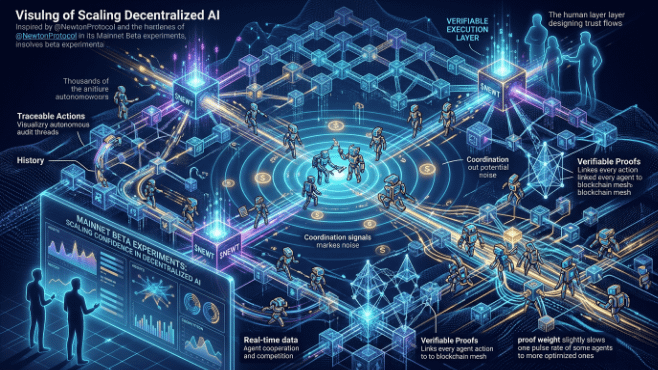
But even then, there is a deeper constraint. Decentralized AI must handle state. Every action leaves history, and history grows faster than most systems are designed to handle.
On @NewtonProtocol, that history is also proof. It is not just storage, it is verification, and that makes scaling both more powerful and more expensive.
I think #newt becomes interesting right at that friction point, where verifiable systems meet the reality of limited throughput.
Because if every AI decision must be proven, then scaling is not just computational. It becomes architectural.
There is also the human layer that often gets ignored. Developers building on NEWT are not just writing logic, they are designing how trust flows between machines.
And trust is fragile when multiplied across thousands of autonomous agents, each interacting in unpredictable ways.
So when people ask if decentralized AI can scale, I do not think the answer is a simple yes or no. It depends on whether verification can stay lightweight enough to not slow everything down.
@NewtonProtocol seems to be testing that boundary, where proof and performance are forced to coexist rather than compete.
Maybe the real experiment is not about scaling AI itself, but about scaling confidence in AI behavior across open systems.
And that is a much harder problem than most people notice at first glance.
If #Newt succeeds in that balance, it will not just be about more AI on-chain, but about AI that remains understandable even when it grows beyond what any single mind can track.
In the end, scaling decentralized AI is really about whether clarity can survive complexity.
