
I used to think settlement was the finish line. Money moves, the block confirms, done. That's how I read every transaction for a long time, and honestly it felt complete. The chain doesn't lie about what happened. It just records it.
But "what happened" and "what should have happened" are different questions, and onchain finance only ever answered the first one.
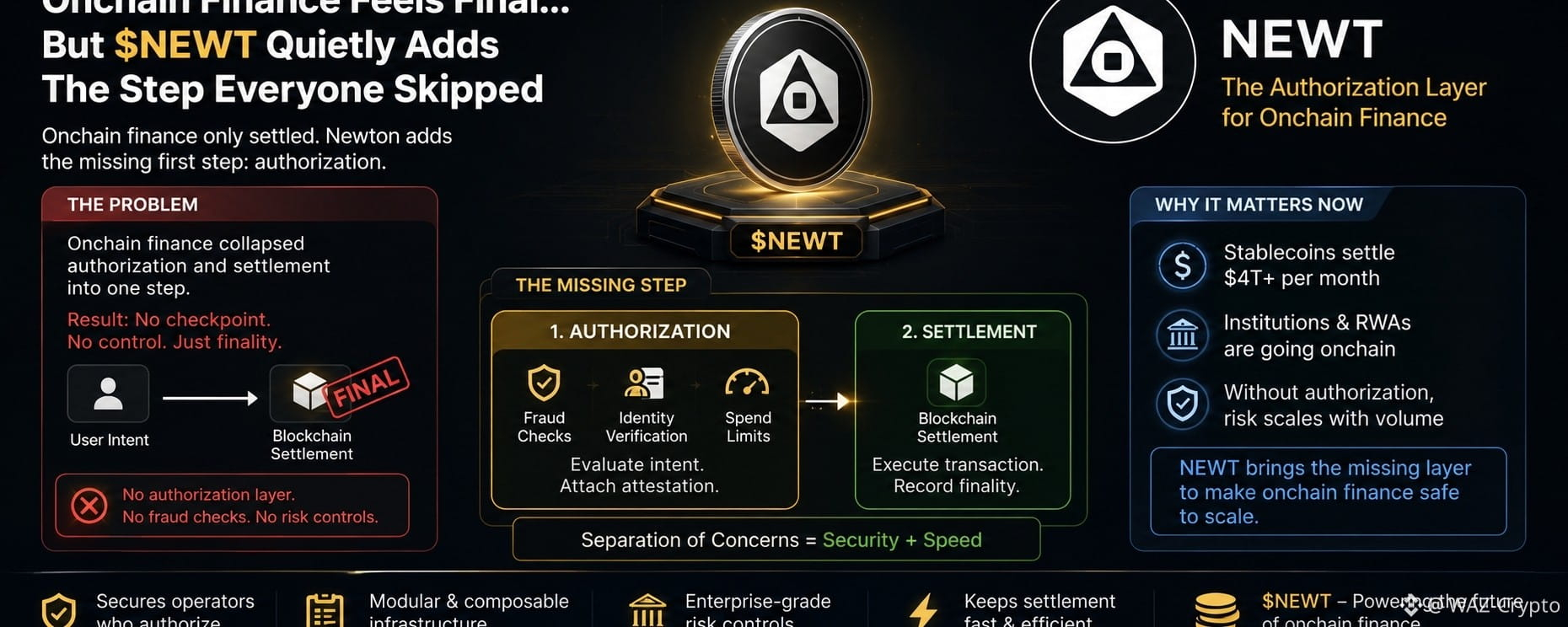
Card networks figured this out decades ago, in a system most people never think about twice. When you swipe a card, the bank doesn't just move money. Something checks first. Fraud rules, balance, identity, spend limits, all evaluated before the transaction is allowed to exist as a settled fact. The authorization happens, then the settlement follows it. Two separate steps, doing two separate jobs.
Onchain finance collapsed that into one step. There was no authorization layer to begin with, so settlement just became the whole process. You ask, the chain does it. No checkpoint in between.
For a long time that felt like a feature, not a gap. Permissionless meant nobody gets to say no. That was the pitch, and it worked, for individuals moving their own money in small amounts where the downside of a mistake was personal and contained.
But the scale changed underneath that assumption.
Stablecoins are now settling more than four trillion dollars a month. That's not a niche use case anymore, that's payment-network volume, moving through rails that were never built with a permission step at all. Tokenized real-world assets are following the same path. Institutions are following the same path. And none of them inherited the one piece of infrastructure that traditional finance considered non-negotiable.
I think this is why the comparisons to Visa always felt slightly off to me. People reach for the analogy because it's familiar, but they usually point at the wrong part of it. They focus on speed, on scale, on global rails. The actual thing worth borrowing isn't any of that.
It's the separation.
Authorization and settlement being two different moments, run by two different logics, is what let traditional finance build fraud controls, compliance checks, and risk limits without rewriting the entire payment rail every time a rule changed. The rail stayed dumb and fast. The intelligence sat in front of it.
Onchain finance never built that front layer. It just kept making settlement faster, assuming speed would eventually solve a problem that was never really about speed.
This is where Newton's framing actually clicked for me. It's not trying to be a better blockchain, or a faster one. It's trying to be the missing first half of a two-step process that crypto skipped by accident, not by design. Evaluate the intent, attach an attestation, then let settlement do what it already does well.
NEWT's role lives entirely inside that first half. Not in moving the funds, but in securing the operators who decide whether the funds should move at all.
Onchain finance didn't need a Visa moment because it needed Visa's speed.
It needed Visa's missing step.
