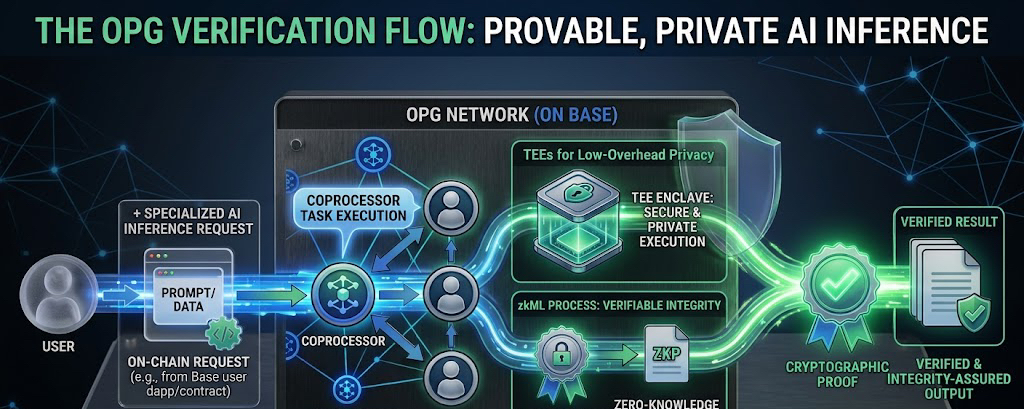
The convergence of artificial intelligence and Web3 is perhaps the most crowded narrative in the current crypto cycle. Scores of protocols promise "decentralized AI," yet most are simply re-skinning centralized models. OpenGradient (OPG), however, is tackling a massive, underlying structural flaw that the rest of the industry is ignoring: the black box dilemma.
When you interact with a centralized AI (like ChatGPT), you are blind-trusting that the provider isn't manipulating the prompt, altering the weights of the model, or serving outdated data. For basic chatbots, that's acceptable. But when AI agents are tasked with managing real financial capital, executing complex smart contracts, or performing cryptographic audits, that lack of transparency and privacy is an absolute disaster waiting to happen. There is no proof of integrity.
OpenGradient addresses this as a specialized, decentralized AI coprocessor built on the Base network. Its core function is to allow developers to offload complex, heavy inference computing to a network of distributed GPU workers. Crucially, OPG doesn't just return a raw result; it employs a dual-verification system to guarantee the computation.
First, it uses Trusted Execution Environments (TEEs) for privacy-preserving, secure hardware enclaves. Second, it integrates zero-knowledge machine learning (zkML) to generate a compact cryptographic proof. This proof guarantees—on-chain—that the specific model requested ran the exact data provided, without any manipulation and entirely in private. This verifiable computation layer is exactly what's required for AI to handle high-stakes decentralized finance (DeFi) or security protocols.
The native token, OPG, underpins this economy, handling inference fees, staking, and decentralized governance. Launched with structural backing from powerhouse investors like a16z crypto and Coinbase Ventures, OPG isn't just riding the AI narrative; it is building the fundamental architecture to make it actually work securely.