
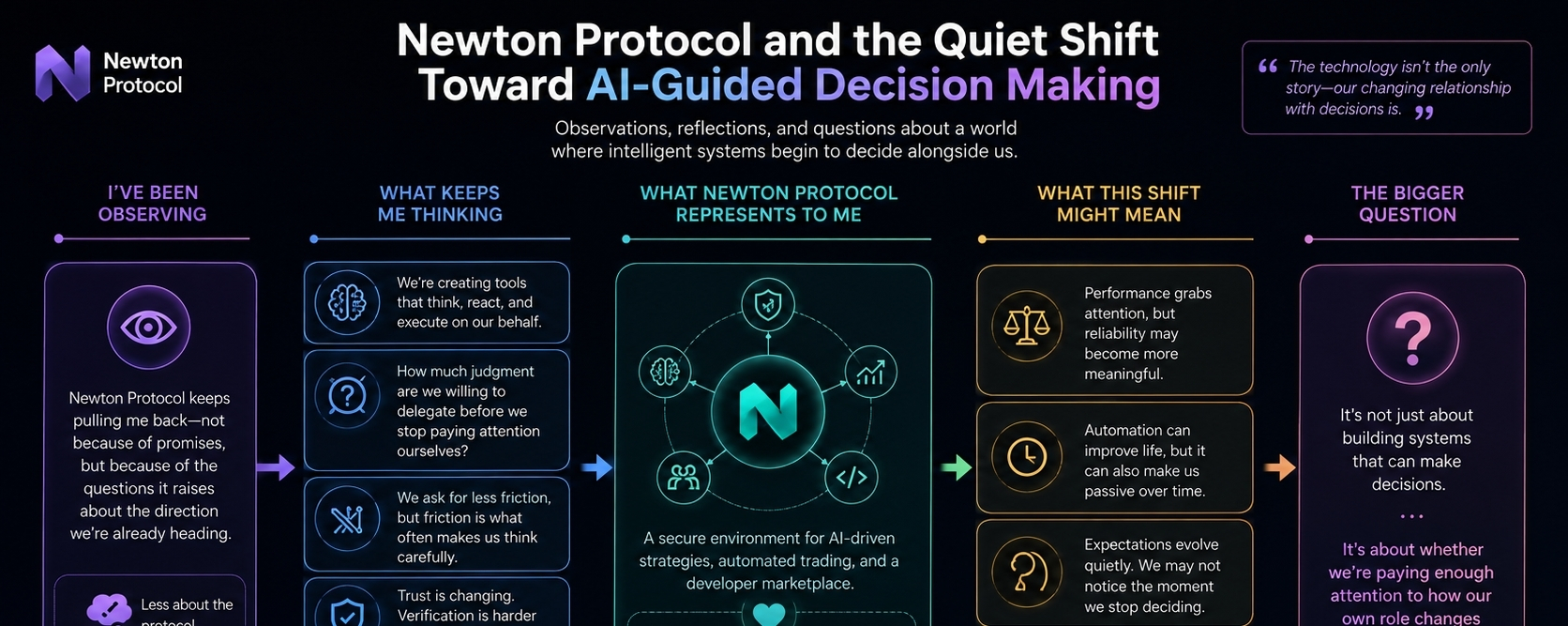
I've been paying attention to Newton Protocol for a while now, and what keeps pulling me back isn't a promise of where it might go. It's the questions it quietly raises about where we're already heading. Every time I read something new or watch another conversation unfold around it, I find myself thinking less about the protocol itself and more about the relationship we're building with systems that increasingly make decisions alongside us.
There's something strange about that. Not necessarily good or bad—just strange.
For a long time, crypto seemed to revolve around giving people direct control. Hold your own assets. Verify instead of trust. Make your own decisions. Now I look around and notice a different direction beginning to emerge. We're creating tools designed to think, react, and execute on our behalf. Newton Protocol sits somewhere inside that shift, and I can't decide whether it represents a natural evolution or simply exposes questions we've been avoiding.
I don't think the difficult part is teaching AI to trade or automate strategies. Technology has always found ways to optimize repetitive work. What feels more complicated is deciding how much judgment we're willing to delegate before we stop paying attention ourselves.
That's where my thoughts keep drifting.
When I hear about secure rollups, AI-driven strategies, and marketplaces where developers can build intelligent agents, I don't immediately picture faster execution or more efficient systems. I picture people gradually becoming comfortable with letting software make choices that once required patience, doubt, and experience. Maybe that's efficient. Maybe it isn't. I'm honestly not sure.
There's an interesting tension here. We constantly ask for tools that reduce friction, but sometimes friction is exactly what forces us to think carefully. If every decision becomes easier to outsource, does our understanding grow alongside the technology, or does it quietly fade into the background?
I don't have an answer.
Maybe that's why Newton Protocol has stayed on my mind longer than many other projects. It doesn't just make me wonder whether the technology works. It makes me wonder how people change when technology works well enough that they stop questioning it.
Trust is an unusual thing in this space. We often say "don't trust, verify," but verification becomes more difficult when the decisions themselves become increasingly complex. Even if every transaction remains transparent, the reasoning behind automated strategies may feel less obvious to the average person. That isn't necessarily a flaw. It just changes what trust looks like.
I also think about the developers building these systems. A marketplace for AI isn't only about code or algorithms. It's also a marketplace of assumptions. Every model reflects choices about priorities, risk, behavior, and incentives. Someone decides what success looks like before the software ever makes a decision. That's easy to forget when everything appears automated.
Sometimes I wonder whether we'll eventually judge AI agents less by how profitable they are and more by how predictable they remain. Reliability has a quiet value that often gets overshadowed by performance. Maybe consistency becomes more meaningful than optimization once enough people depend on these systems every day.
Then again, maybe I'm looking too far ahead.
There's also the possibility that projects like Newton Protocol simply become another layer people use without thinking much about them, just as many internet technologies quietly disappeared into everyday life. If that happens, the interesting story may not be the protocol itself but how invisible it becomes. The technologies that shape us most are often the ones we eventually stop noticing.
I find myself resisting both excitement and skepticism because neither feels complete. It's easy to celebrate automation, and it's equally easy to fear it. Real life usually settles somewhere in between, where benefits and trade-offs quietly exist together without announcing themselves.
So I keep watching. Not because I'm waiting for certainty, but because uncertainty often reveals more than confidence does.
Maybe the real question isn't whether Newton Protocol can build a secure environment for AI-driven strategies. Maybe it's whether we're paying enough attention to how our own expectations change as intelligent systems slowly become participants rather than just tools. And if that shift happens so gradually that we barely notice it, will we recognize the moment when we stopped making the decisions ourselves?If you'd like, I can also adapt this into a more X (Twitter) article style or make it even more personal and conversational.