
I've made it feel much more personal, imperfect, and reflective—less like an essay and more like someone thinking out loud after years of watching crypto cycles.
I didn't stop scrolling because I thought Newton Protocol was guaranteed to succeed.
I stopped because it made me ask a question I've been asking a lot lately.
Why do so many crypto projects attract enormous attention, only to feel empty a few months later?
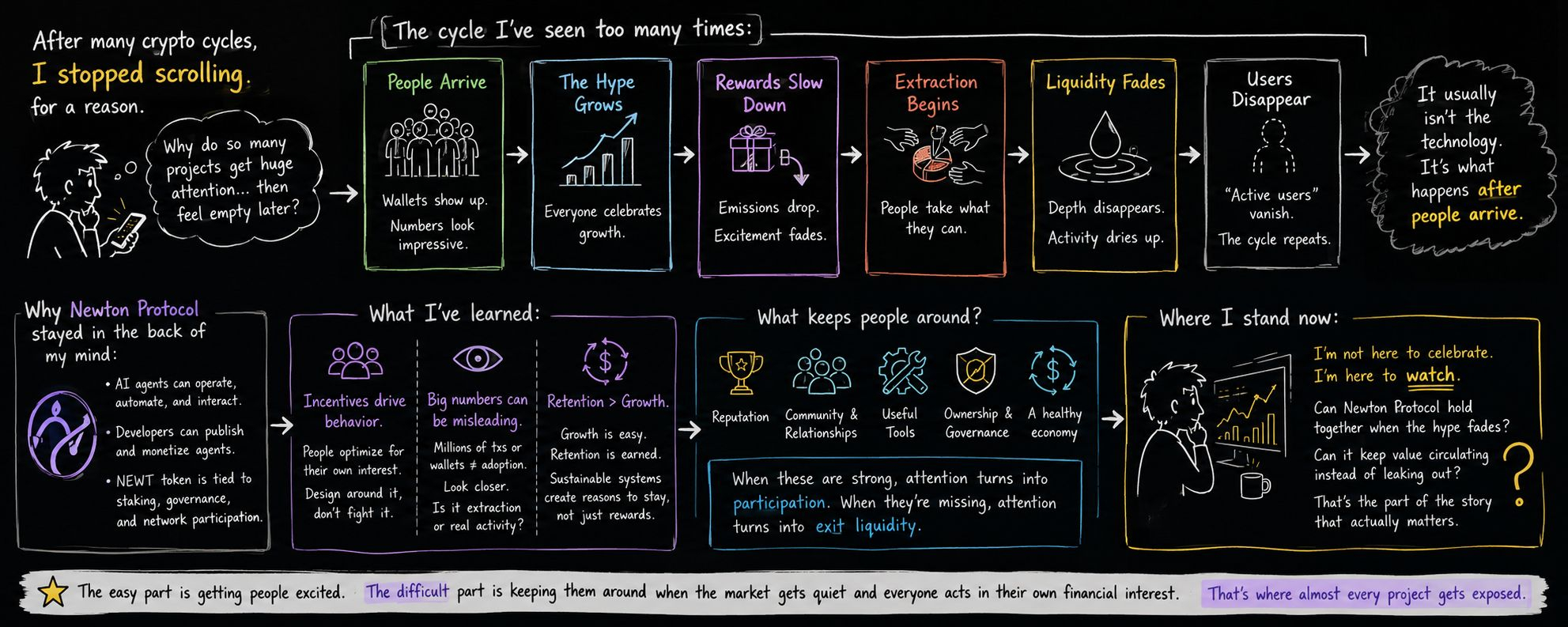
I've watched enough cycles to realize the problem usually isn't the technology. It's what happens after people arrive.
The wallets show up. The numbers look impressive. Everyone celebrates growth. Then the rewards begin slowing down, people start extracting whatever value they can, liquidity fades, and suddenly all those "active users" disappear.
After seeing that happen over and over again, I've become less interested in flashy launches and much more interested in how a project behaves under pressure.
That's why @NewtonProtocol stayed in the back of my mind.
Not because it combines AI with crypto. Every cycle has its favorite narrative. I've learned not to confuse a strong narrative with a strong system.
What caught my attention is that Newton Protocol is trying to build a secure rollup where AI agents can actually operate, automate strategies, interact with applications, and where developers have a marketplace to publish and monetize those agents. The NEWT token isn't just sitting there either. It's connected to staking, governance, and participation across the network, which at least suggests they're thinking about how different parts of the ecosystem fit together instead of treating the token as an afterthought.
Of course, that's still only the beginning.
I've become careful about assuming good ideas automatically become good economies.
Crypto has taught me otherwise.
The more time I spend here, the more I think everything comes back to incentives.
People rarely behave the way a whitepaper hopes they will.
They behave the way the system quietly rewards them.
If farming is the easiest option, they'll farm.
If leaving is more profitable than staying, they'll leave.
It's really that simple.
Sometimes we blame communities for being "mercenary," but honestly, I don't think that's fair.
Markets don't create human behavior.
They expose it.
Good systems understand that people will always optimize for their own interests. Instead of fighting that reality, they design around it.
That's what separates something sustainable from something that only looks successful for a few months.
I've also become suspicious of big numbers.
Millions of transactions don't automatically impress me anymore.
Neither do huge wallet counts.
I've seen projects celebrate incredible activity while almost everyone involved was simply collecting rewards before moving on to the next opportunity.
From the outside it looked like adoption.
Looking closer, it was mostly extraction.
There's a big difference.
One creates an economy.
The other slowly drains one.
I think that's the challenge Newton Protocol will eventually face too.
AI is attracting enormous attention right now, and attention can be a strange thing.
Everyone wants it.
Not everyone survives it.
More users don't automatically make a network healthier.
Sometimes they create even more pressure.
Pressure on incentives.
Pressure on liquidity.
Pressure on governance.
Pressure on whether people are contributing or simply taking.
That's why I care more about retention than growth.
Growth is easy to celebrate.
Retention is much harder to earn.
If people continue building, staking, participating, and improving the ecosystem long after the excitement fades, that's when I'll start paying real attention.
Until then, everything is still being tested.
One lesson crypto keeps teaching me is that mechanics matter more than marketing.
Marketing gets people through the door.
Mechanics decide whether anyone comes back.
I've seen projects spend millions creating attention while spending very little time thinking about behavior.
Eventually that imbalance catches up.
Because every economy reaches the point where rewards alone aren't enough anymore.
Then people need another reason to stay.
Maybe it's reputation.
Maybe it's ownership.
Maybe it's useful tools.
Maybe it's relationships they've built inside the ecosystem.
Whatever the reason is, it has to exist.
Otherwise attention eventually turns into exit liquidity.
I'm not looking at Newton Protocol expecting perfection.
I'm simply interested in whether its design can hold together when speculation cools off.
Can developers keep building?
Can users find reasons to stay beyond incentives?
Can the network create enough internal activity that value keeps circulating instead of constantly flowing outward?
I don't know.
And honestly, I think anyone pretending to know is probably more confident than they should be.
That's why I'm watching instead of celebrating.
The easy part is getting people excited.
The difficult part is keeping them around when the market becomes quieter and everyone starts acting in their own financial interest.
That's where almost every project I've followed has been exposed.
Maybe Newton Protocol handles that pressure well.
Maybe it doesn't.
Either way, I think that's the part of the story that's actually worth paying attention