
Newton Mainnet Beta: The Authorization Layer for DeFi Automation
I was going through Newton's mainnet beta documentation and something stopped me.
Most blockchain automation works like this: you write a smart contract, deploy it, and hope it does what you expect. If something goes wrong, you're left with a transaction hash and a lot of questions.
Newton does it differently. Every automated action gets cryptographically verified. When an agent executes a trade or moves funds on your behalf, it produces a proof that the action stayed within your predefined boundaries. Not just a log entry. A cryptographic receipt.
That changes the trust model entirely.
Instead of trusting the agent or the developer, you trust the math. The protocol combines TEEs (Trusted Execution Environments) with ZKPs (Zero-Knowledge Proofs) to verify that every operation was performed exactly as authorized. No shortcuts. No blind spots.
Newton is building what they call a "verifiable automation layer" — a policy engine that sits between your wallet and the agent, checking every transaction before it settles. Spend limits, counterparty checks, collateral requirements — all enforced programmatically with auditable proofs.
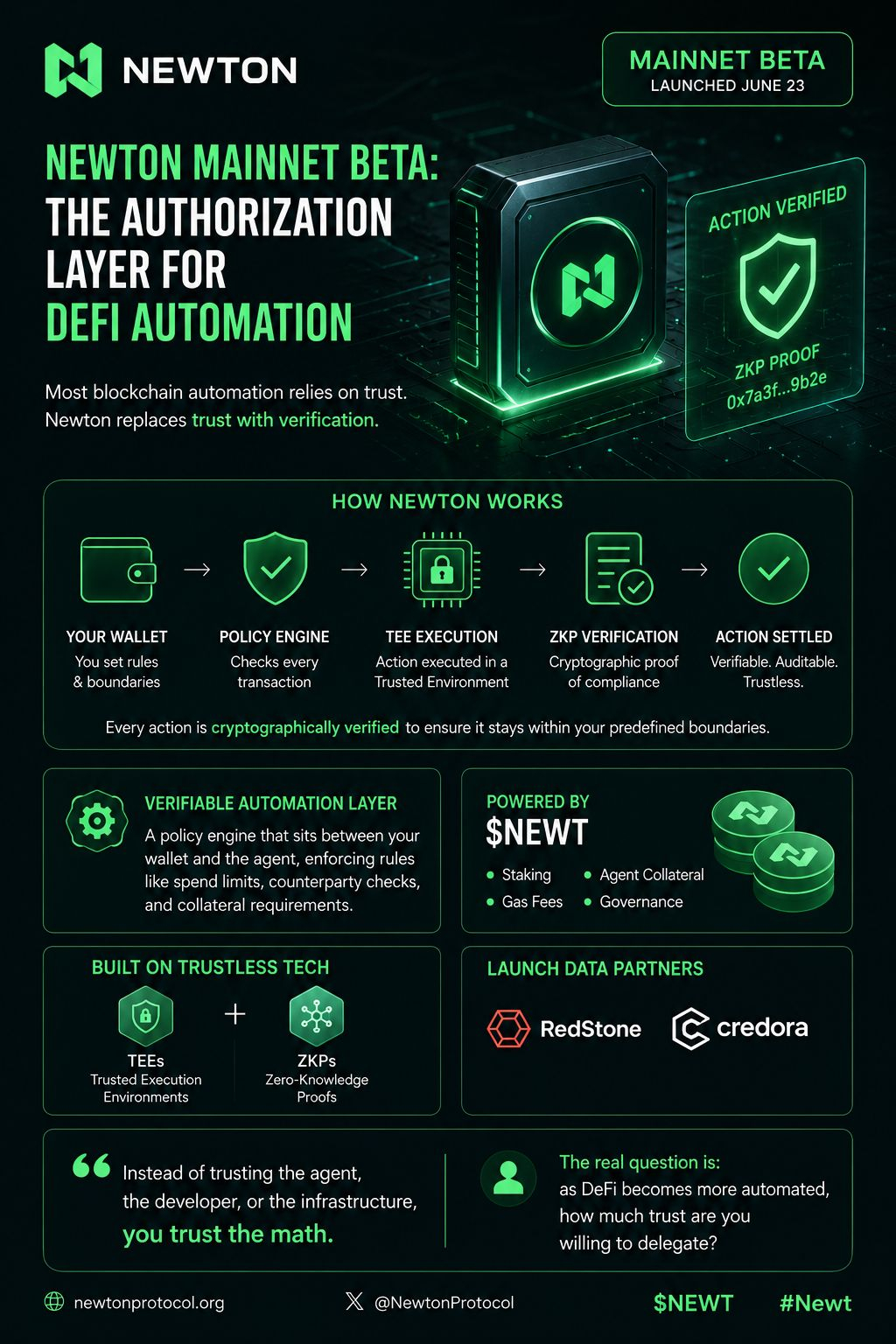
The mainnet beta launched on June 23 with VaultKit SDK, a toolkit that lets developers define programmable transaction rules. RedStone and Credora are already integrated as launch data partners.
What caught my attention wasn't just the technology. It was the gap Newton is trying to close.
Right now, DeFi automation relies on trust. You trust the bot operator. You trust the developer. You trust the infrastructure. Newton is trying to replace trust with verification — making automation safer for institutions and individuals alike.
$NEWT powers this ecosystem — used for staking, gas fees, agent collateral, and governance. ~264M tokens currently circulating.
For me, the real question is: as DeFi becomes more automated, how much trust are you willing to delegate?