
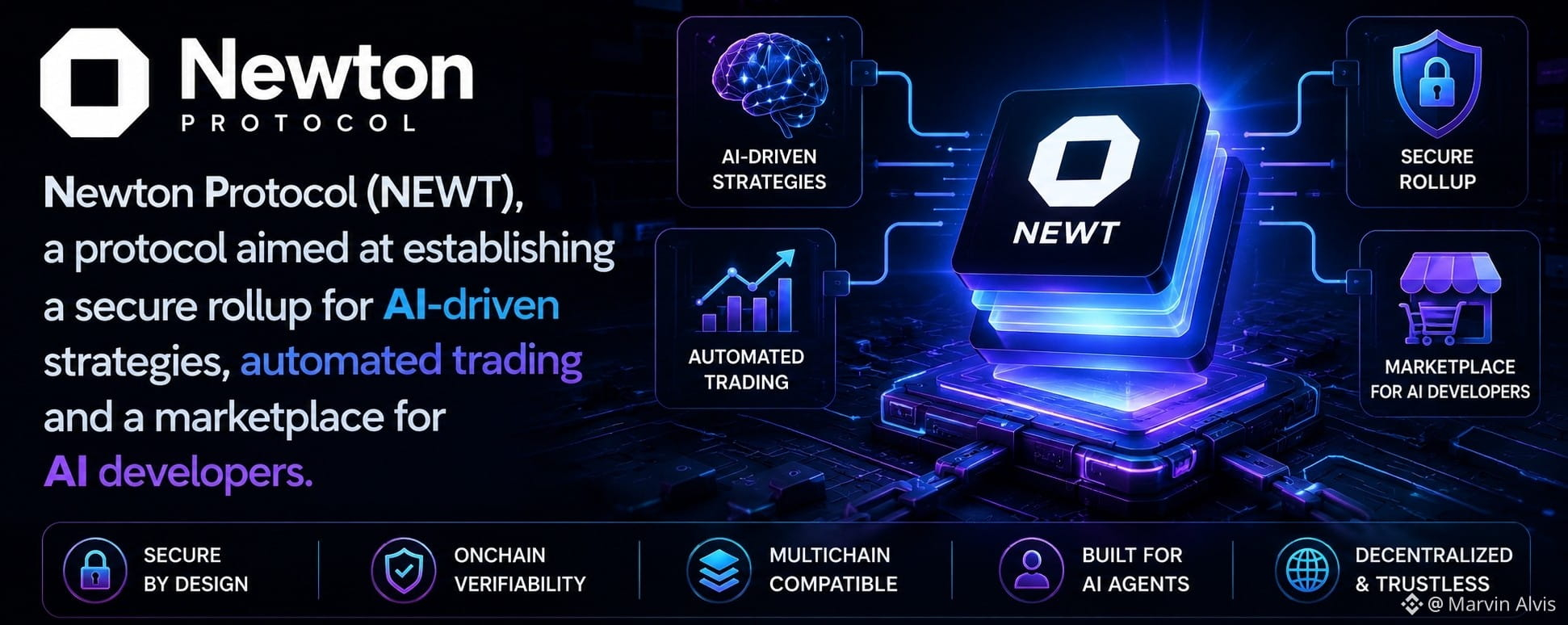
I’ve been watching Newton Protocol, and what keeps pulling my attention back is not the token or the launch noise. It’s the plainness of the problem it keeps returning to: smart contracts are still blind to a lot of offchain context, while real financial activity keeps moving faster and getting more automated. Newton’s own docs say that clearly — the protocol is meant to handle spend limits, sanctions screening, fraud prevention, and other rules before a transaction executes, not after damage is already done. Binance described the project’s 2025 launch in similar terms, framing it as a secure rollup for AI-driven strategies, automated trading, and a marketplace for AI developers.
What Newton is actually trying to be
The simplest description is that Newton Protocol is a decentralized policy engine for onchain transaction authorization. The project says it is built as an EigenLayer AVS, with the goal of encoding, verifying, and enforcing rules directly in smart contracts. Its public website calls it “the authorization layer for onchain finance,” and its docs repeat the same idea in more technical language: Newton is there to bridge offchain data with smart contracts so a protocol can decide whether a transaction should go through before settlement, not after. That matters because the project is not positioning itself as just another wallet, DeFi app, or AI tool. It is trying to sit underneath them, like a set of rules the rest of the stack has to obey.
That framing is not random marketing language. In the project’s whitepaper, Newton argues that onchain finance already moves huge amounts of value — more than $700 billion monthly across stablecoins and tokenized assets, by its own estimate — but that transactions are still not authorized onchain before they happen. The gap it keeps naming is a familiar one in ordinary life: a system can be very fast and still be badly placed if the checks happen too late. Newton’s whole thesis is that the check should happen first.
How the machinery fits together
Newton’s architecture is built around a clean separation between defining a policy, evaluating it, and enforcing it. The docs describe it as a three-layer system. Policies are written in Rego, published to a registry, and paired with WASM policy data oracles that fetch external information at evaluation time. Tasks are submitted through a Gateway, operators in the Newton AVS evaluate the policy, and BLS signatures are aggregated into a consensus proof that can be verified onchain. The same documentation also says policies are content-addressed on IPFS, which makes the rule set auditable instead of hidden in a private backend.
That structure feels more serious than the average “compliance for crypto” pitch because it does not reduce everything to a blacklist. The docs show policies working with multiple kinds of inputs: KYC data from Veriff and Persona, sanctions and wallet screening from Chainalysis and Magic Labs, anti-Sybil checks from Human Passport, vault and yield data from Vaults.fyi, macro and Treasury data from Massive, gas data from Etherscan, and social data from Neynar. The point is not just to block a transaction. It is to let the policy express why a transaction should be allowed, delayed, capped, or rejected. That is a much more human way to think about control: not one giant yes-or-no switch, but a set of practical rules that can be adjusted as conditions change.
The project also puts a lot of weight on verifiability. Its docs say every compliance decision is backed by a BLS attestation rather than reputation, and that only hashes and commitments are put onchain, with no PII or sensitive data exposed. The privacy layer encrypts secrets client-side with HPKE before they are used by operators, and the project’s glossary explains that operators decrypt the envelope during task evaluation to run the WASM oracle. That is an important detail because it shows Newton is not just promising confidentiality in the abstract; it has made privacy part of the actual workflow.
Why AI agents keep showing up in the story
One reason Newton has attracted attention is that it maps neatly onto the current wave of AI agent design. The docs explicitly call out the risk that a smart contract cannot tell whether an AI agent is hallucinating, whether a user is sanctioned, or whether a transaction violates a corporate spend policy. That is a sharp way of saying something simple: autonomy without guardrails is easy to imagine and hard to trust. Newton’s AI agent security materials try to solve that by letting developers set per-action limits, enforce human oversight, and stop unauthorized spending before it happens.
This is also where the project’s “marketplace” angle starts to make sense. In the NEWT token announcement, the foundation said model developers would be able to list AI models and agents in the Newton Model Registry, with operators serving them and developers receiving a royalty share of fees when their models are picked up. That is a notable design choice because it turns the protocol into more than a compliance rail. It suggests a future where policies, agent behavior, and incentives all sit in the same system, rather than being patched together across separate products. Binance’s launch description — secure rollup, AI-driven strategies, automated trading, and a marketplace for AI developers — lined up with that picture even before the broader token narrative settled.
Still, this is where the project’s ambition can also become a burden. A marketplace for AI developers sounds elegant on paper, but marketplaces are slow to mature unless they solve a very specific pain point. Newton is trying to make that pain point “trusted execution with policy,” which is real enough. Whether it becomes sticky enough for developers to build around is a different question. The docs show the idea; adoption has to do the rest.
The part that looks more real than the average crypto launch
There are a few signs that Newton is not just a whitepaper with a token attached. The official blog says mainnet beta went live on June 23, 2026, and that Newton was live on Base and Ethereum enforcing rules onchain, starting with DeFi vaults. The same official site says the team supports partners from architecture through integration and launch, with docs, pre-built policies, and direct access to the Newton team. That sounds less like a one-off release and more like a product team trying to make adoption easier in the boring, necessary way.
The ecosystem work also looks more concrete than vague partnership talk. In late 2025 and early 2026, Newton’s official blog shipped integrations with Magic Labs wallet risk data, Vaults.fyi, Etherscan, Veriff, Persona, Human Passport, and other data sources. The official docs also say Magic Labs will make the Newton SDK available to more than 200,000 developers and 50 million wallets. Whether every one of those users becomes an active Newton user is another matter, but the distribution path is at least visible. Newton is not starting from zero social rails. It is piggybacking on an existing wallet and developer footprint.
I also think the developer experience matters more here than people sometimes admit. Newton’s quickstart says a first policy evaluation can be simulated in five minutes using the TypeScript SDK, with an OFAC sanctions screening example and no smart contract deployment required. The docs show a "simulateTask" dry run, a "newton-cli" flow, and SDK references for TypeScript, RPC, command line tooling, and contract addresses. That may sound mundane, but in infrastructure work, mundane is often what makes the difference between a concept and a habit.
Multichain support, and why that matters more than it sounds
Newton also spends real effort on multichain design. The docs say the protocol supports policy evaluation across multiple chains, with AVS operators running on Ethereum as the source chain and PolicyClient contracts deployed on destination chains like Base and Base Sepolia. The system uses a BN254 certificate verifier on the destination chain to validate operator attestations against cached operator state. In practical terms, that means the policy decision can be made in one place and enforced in another, which is exactly the kind of thing you need if you want a policy layer instead of a chain-specific trick.
This matters because most real adoption problems are messy. Institutions use more than one chain. DeFi vaults move. AI agents don’t stay politely inside a single contract or a single network. If Newton wants to be the layer where rules live, it has to survive that mess instead of pretending it does not exist. The multichain docs suggest the team understands that.
Token, governance, and the part that deserves a careful eye
The NEWT token sits at the center of the network’s incentives. The official token repository says NEWT is used for staking, gas fees, permission updates, and governance, and the token announcement says the total supply is fixed at 1 billion, with 215 million circulating at launch. The same announcement breaks distribution into community and internal categories, and says the token is used not only for network security and gas but also for the Newton Model Registry, where developers can list models and earn royalty shares. That is a more functional token design than many launches, because it ties the asset to specific protocol jobs rather than leaving utility vague.
The governance and foundation structure also matter. The docs say the Magic Newton Foundation was formed in October 2024 as a Cayman Islands foundation company, with two BVI subsidiaries handling token issuance and operations. The governance docs describe a Phase 0 model dated September 2025, which tells you something important: governance exists, but it is still early. The conflict-of-interest policy adds another layer of seriousness, with a 36-month vesting schedule and 12-month cliff for certain allocations, plus a third-party structured selling program for leadership and core contributors. That kind of detail does not make a protocol perfect, but it does show an attempt to behave like a system that expects to be watched.
That said, token structure can be both a strength and a warning sign. A fixed supply and transparent allocation are helpful, but they do not remove the basic risk that a young network can still feel centralized in practice if the operator set, the foundation, and the key integrations remain concentrated. Newton’s own materials are honest enough to show that the project is still in a formative stage, even as it describes itself in very large terms. That tension is worth keeping in view instead of smoothing over.
What feels promising, and what still needs time
What looks strongest so far is the clarity of the problem statement. Newton is not trying to be everything at once. It keeps returning to one hard question: how do you make automated onchain action trustworthy before it happens? The combination of Rego policies, operator attestations, privacy-preserving data oracles, and cross-chain enforcement is coherent enough that you can imagine real teams using it for stablecoin transfers, institutional DeFi, and AI agent controls. The official docs are unusually concrete for a protocol still proving itself, and the quickstart, explorer, and integration pages suggest a team that knows the value of making difficult infrastructure feel usable.
The caution is just as plain. Mainnet beta is still beta. Governance is still described as Phase 0. The protocol depends on external data sources, operator networks, and careful policy design, which means trust is distributed across more moving parts than a simple smart contract. And because the project is aimed at compliance, AI, and financial automation all at once, it sits in a part of the market where regulation, product reliability, and user trust can change the story very quickly. None of that makes the project weak. It just means the hard work is still ahead of the headlines.
I keep coming back to that basic idea because it feels larger than crypto. A lot of systems only look impressive when nothing goes wrong. The more useful ones are the ones that keep the rules close at hand when the pace gets fast, the context gets messy, and nobody has time to clean up later. Newton Protocol is trying to live in that second category. Whether it holds up there will depend less on its slogans than on whether people keep trusting it when the market is busy, the policies are changing, and the easy answers run out. That is usually where the real story starts.