

Everyone assumes new crypto regulation means more paperwork.
More disclosures, more reporting forms, more compliance officers reading PDFs after the fact.
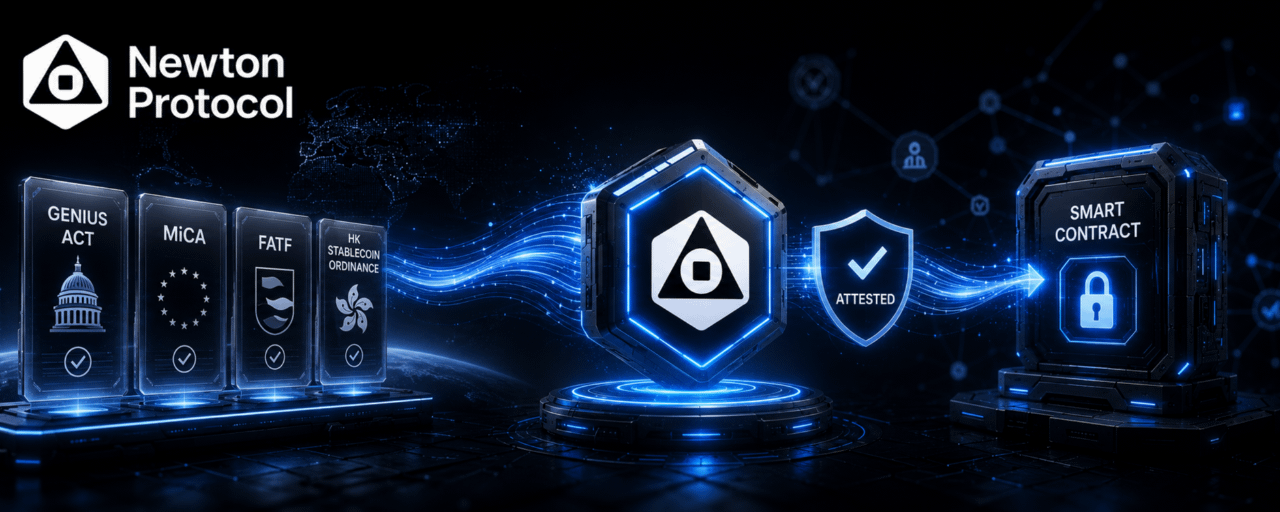
That's not actually what the GENIUS Act, MiCA, FATF, or Hong Kong's Stablecoin Ordinance are asking for.
Traditional financial compliance runs at the interface layer.
KYC happens once, at onboarding. Transaction monitoring runs after the fact, as surveillance - alerts come in, someone reviews them, action gets taken days or weeks later.
That model assumed a custodian controlling execution.
In onchain finance, nobody controls execution. Users call smart contracts directly.
A sanctions-screened UI doesn't stop anyone from calling the contract straight - through a fresh wallet, a different RPC, a VPN to mask jurisdiction.
Regulators have noticed.
The frameworks below all share one demand, even if none of them phrase it the same way.
The GENIUS Act, signed into law in July 2025, requires reserve and redemption rules plus ongoing compliance controls for U.S. stablecoin issuers - not just onboarding checks.
Hong Kong's Stablecoin Ordinance, effective August 2025, demands the same from licensed issuers there.
FATF's Travel Rule guidance wants originator and beneficiary information transmitted with every qualifying transfer, not collected once and forgotten.
MiCA in the EU expects ongoing transaction monitoring from crypto-asset service providers, not a single onboarding screen.
Every one of these frameworks wants enforceable controls at the transaction level.
Audit evidence that a policy was actually applied - not logs claiming monitoring happened somewhere in the background.
That's the exact shape of problem @NewtonProtocol was built to solve.
Newton evaluates a policy against every transaction intent before it settles, and produces a cryptographic attestation - not a log entry, not an API response an application can quietly ignore.
The policy itself is written in Rego, the same language enterprises already use for cloud access control, and evaluated independently by a decentralized network of operators staked through EigenLayer.
That matters for the part regulation rarely talks about directly: cost.
Global financial crime compliance spending already exceeds $206 billion a year, with the average institution spending close to $73 million annually on AML and KYC work alone, much of it manual review.
Automating that screening at the transaction level, with cryptographic evidence attached, doesn't just satisfy a regulator. It removes a meaningful chunk of headcount-driven cost from the process.
The attestation gets recorded onchain.
A regulator can verify a policy was applied to a specific transaction without ever touching the underlying personal data, since the chain only sees proofs, never the identity behind them.
This doesn't mean Newton replaces a compliance department.
Issuers still define the policy. They still own the relationship with their KYC providers and sanctions data feeds.
What changes is where enforcement actually happens - at the smart contract, not in a dashboard nobody outside the company ever sees.
Regulation usually arrives years after the technology that needs it.
This time, the rules are already written before most of the infrastructure exists.
The open question is whether anyone actually builds the layer that satisfies them - instead of just claiming to.