
When people talk about blockchain security, the conversation usually revolves around protecting assets after a transaction is submitted.
I think that mindset is starting to change. The next generation of infrastructure won't be defined only by faster execution or lower fees.
It will be defined by how intelligently decisions are made before execution even begins.
That is one reason why the long-term FHE vision of @NewtonProtocol caught my attention.
Today, many applications need to decrypt sensitive information before they can verify whether a transaction satisfies security, compliance, or business policies.
While effective, this approach exposes data during the verification process and forces developers to balance privacy against functionality.
Newton is exploring a different direction.
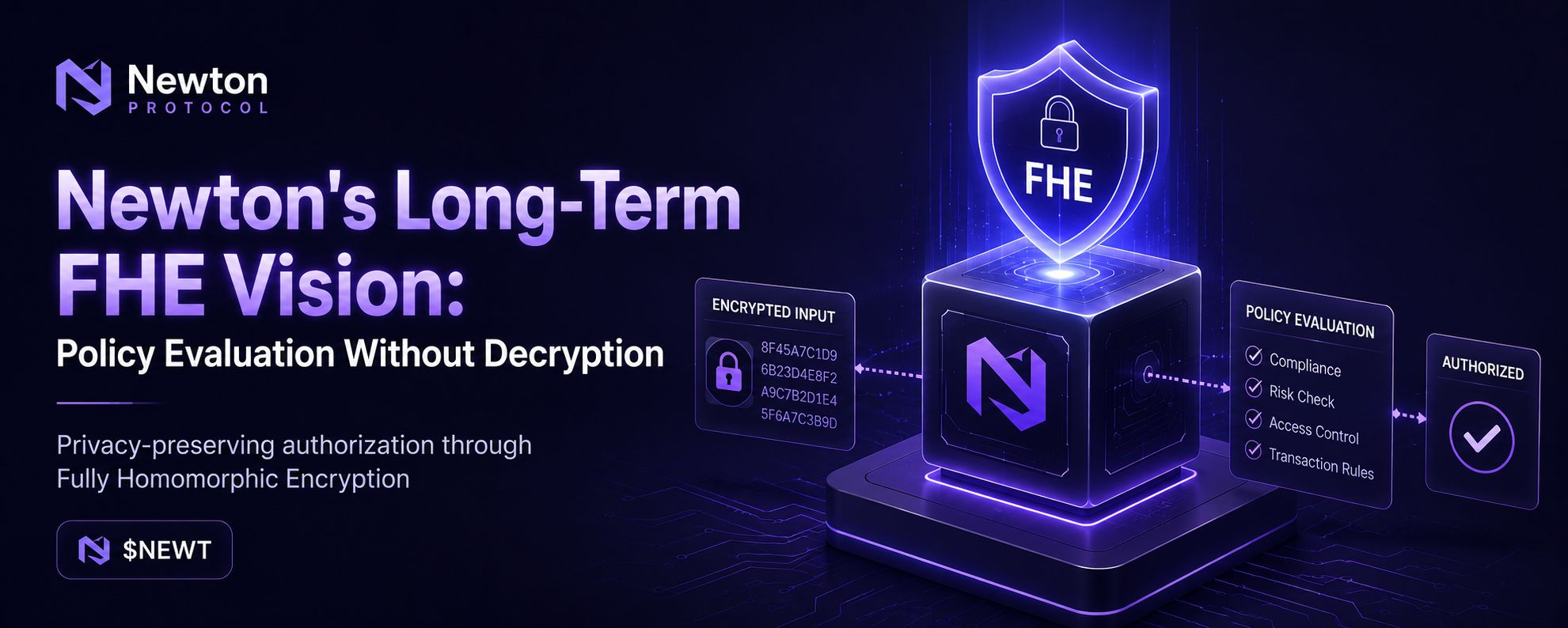
Its long-term vision around Fully Homomorphic Encryption (FHE) aims to make policy evaluation possible while data remains encrypted.
Instead of revealing confidential information to make a decision, the system can evaluate predefined rules without exposing the underlying data.
If this capability continues to evolve, it could remove one of the biggest compromises developers face when building decentralized applications.
I believe this becomes especially valuable as blockchain technology expands into enterprise software, digital identity, financial services, and AI-powered applications.
These sectors require strict privacy standards, yet they also need programmable authorization that can automatically enforce complex policies.
An encrypted evaluation model has the potential to support both objectives simultaneously.
The Newton Mainnet Beta is already introducing a foundation for programmable authorization before transactions reach final settlement.
That design moves security closer to the point where decisions are actually made instead of relying only on monitoring after execution.
Looking ahead, integrating FHE into this architecture could strengthen that approach by allowing policy checks to happen without decrypting sensitive inputs.
To me, this represents more than a technical upgrade.
It reflects a broader shift in how decentralized infrastructure may evolve. Trust should not require unnecessary exposure of private information.
The strongest systems will be those that can verify, authorize, and protect data at the same time.
If Newton continues advancing this long-term vision, $NEWT could become part of an infrastructure layer designed not only for transparent execution but also for privacy-preserving authorization.
That is a direction I believe deserves close attention as Web3 moves toward real-world adoption.
