
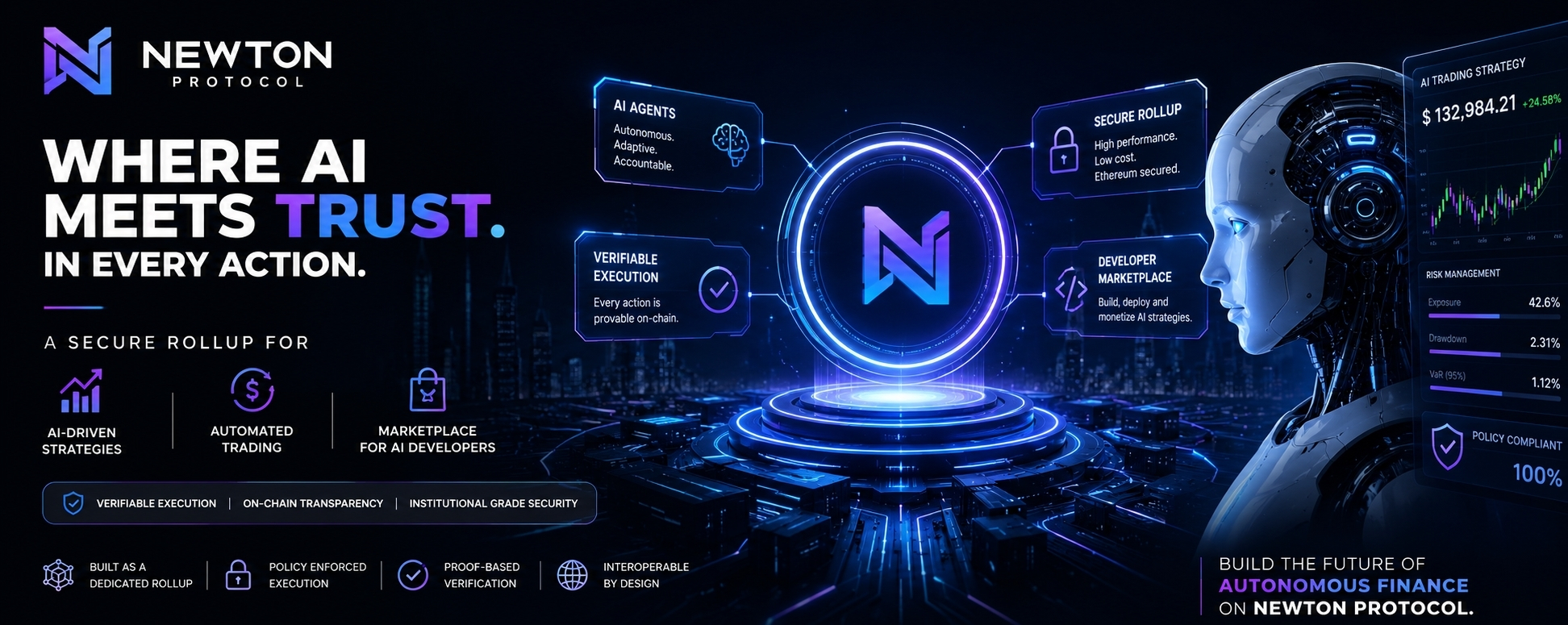
I'm noticing something interesting every time I spend more time researching AI and blockchain infrastructure. Most discussions revolve around bigger models, faster inference, or the next autonomous agent that promises to automate everything. When I started looking into Newton Protocol (NEWT), I expected another project trying to ride that same wave. Instead, I found a team asking a completely different question. Rather than asking how AI can become smarter, they're asking how AI can become accountable when real money, real assets, and real decisions are involved.
When I started connecting information from technical papers, developer discussions, blockchain research, and the broader direction of autonomous finance, I realized that Newton Protocol isn't really competing in the intelligence race. It's addressing the layer that almost everyone ignores until something goes wrong: execution.
I noticed that today's AI can already generate strategies, analyze markets, recommend trades, and automate complex workflows. The impressive part is no longer whether AI can make decisions. The difficult part is proving that those decisions followed predefined rules without hidden changes, unauthorized actions, or unexpected behavior. That's a much harder problem than simply building another model.
I'm noticing that the blockchain industry has solved similar trust problems before. Bitcoin removed the need to trust a central bank for digital money. Smart contracts reduced dependence on intermediaries by making agreements executable through code. Rollups improved scalability while inheriting security from larger networks. Newton Protocol feels like the next logical step in that progression. Instead of focusing on transactions alone, it focuses on whether autonomous systems can execute decisions that everyone else can independently verify.
The more I researched, the more I realized that this idea becomes increasingly important as AI moves beyond answering questions and starts controlling financial operations. An AI agent that manages liquidity, executes trades, allocates treasury funds, or interacts across multiple blockchains isn't just generating text anymore. It's making decisions that have financial consequences. At that point, trust cannot rely on promises or reputation. It has to rely on infrastructure.
I noticed that Newton Protocol approaches this challenge by treating policies almost like programmable guardrails rather than optional guidelines. Instead of hoping an autonomous system behaves correctly, the protocol aims to make correct behavior enforceable. That subtle difference could end up being far more valuable than another incremental improvement in model performance.
When I think about enterprise adoption, this approach makes even more sense. Large financial institutions rarely reject AI because it lacks capability. They hesitate because they cannot always prove how an autonomous decision was made or whether it complied with internal rules and external regulations. Intelligence without accountability creates operational risk. Newton appears to recognize that reality from the beginning.
I'm noticing another overlooked aspect that deserves more attention. Newton isn't only building infrastructure for AI execution; it's also creating an ecosystem where AI developers can build and deploy strategies inside a framework designed around verification. That changes the conversation entirely. Instead of developers competing only on how intelligent their models appear, they may eventually compete on how predictable, transparent, and trustworthy their autonomous systems become.
When I started comparing Newton with many AI-related blockchain projects, I realized that most of the industry still concentrates on computation. Projects compete over decentralized GPUs, model hosting, inference speed, or access to computing resources. Those are important foundations, but computation alone doesn't solve governance. Newton seems to be positioning itself around what happens after computation..when an intelligent agent actually performs an action that affects users or markets. @NewtonProtocol
I noticed that this distinction could become increasingly meaningful as decentralized finance becomes more automated. Markets are already influenced by algorithms operating continuously without human intervention. As those algorithms evolve into AI agents capable of adapting their own strategies, verifying execution may become more valuable than optimizing another few milliseconds of processing speed.
I'm noticing that many investors still evaluate AI infrastructure through familiar metrics like token performance, exchange listings, community growth, or short-term adoption. Those numbers matter, but they rarely explain whether the underlying architecture solves a structural problem. Newton's biggest opportunity may not come from speculative excitement at all. It may come from becoming part of the invisible infrastructure that autonomous financial systems eventually depend on.
When I step back and look at the bigger picture, I think Newton Protocol is betting on a future where AI isn't judged solely by how intelligent it appears, but by whether its actions can be independently verified. That feels like a much deeper thesis than simply attaching AI to blockchain. $BTC
I started this research expecting another familiar narrative about artificial intelligence and crypto. I finished it with a different perspective. I'm noticing that the real bottleneck for autonomous systems may not be intelligence anymore. It may be trust. If AI is going to manage capital, coordinate transactions, execute financial strategies, and operate continuously without human supervision, then transparent and verifiable execution becomes just as important as the intelligence behind every decision. $ATM
That's why Newton Protocol stands out to me. It isn't trying to convince the world that AI can think. It's trying to build the infrastructure that allows the world to trust what AI actually does. #Newt $NEWT
