
Something I keep returning to from my time trading prediction markets is how often the thing that catches you isn't the trade itself, it's what happens at the settlement layer. I watched a withdrawal get flagged and reversed on a platform I used regularly, not because of anything I did wrong, but because a backend compliance check ran after the transaction was already in motion. The rule existed. The enforcement was real. But the timing was off, and the resolution was opaque. That experience left me with a sharper interest in where exactly rules get applied in the transaction lifecycle, before execution or after it.
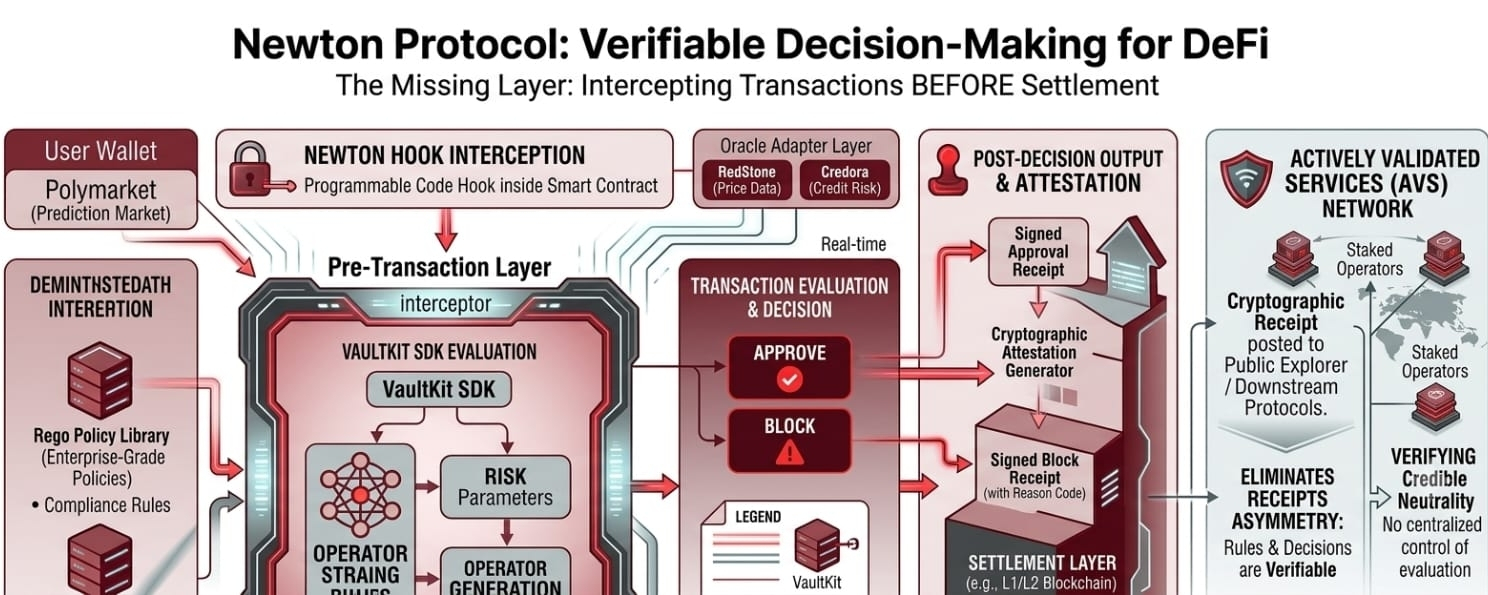
That's the angle I've been studying Newton Protocol from. Not the AI agent framing the broader market keeps anchoring on, but the specific design choice to intercept transactions before they settle rather than monitor them afterward. With the mainnet beta now live, the VaultKit SDK lets developers write programmable rules in Rego, the same policy language used in enterprise infrastructure, and deploy them as a lightweight code hook directly inside smart contracts. Every transaction that touches a Newton-integrated vault passes through that evaluation layer first, and what comes out the other side isn't just an outcome, it's a signed receipt explaining the decision. What struck me about the Polymarket integration specifically is that this wasn't a theoretical compliance demo; it was step-up verification running on live withdrawal volume.
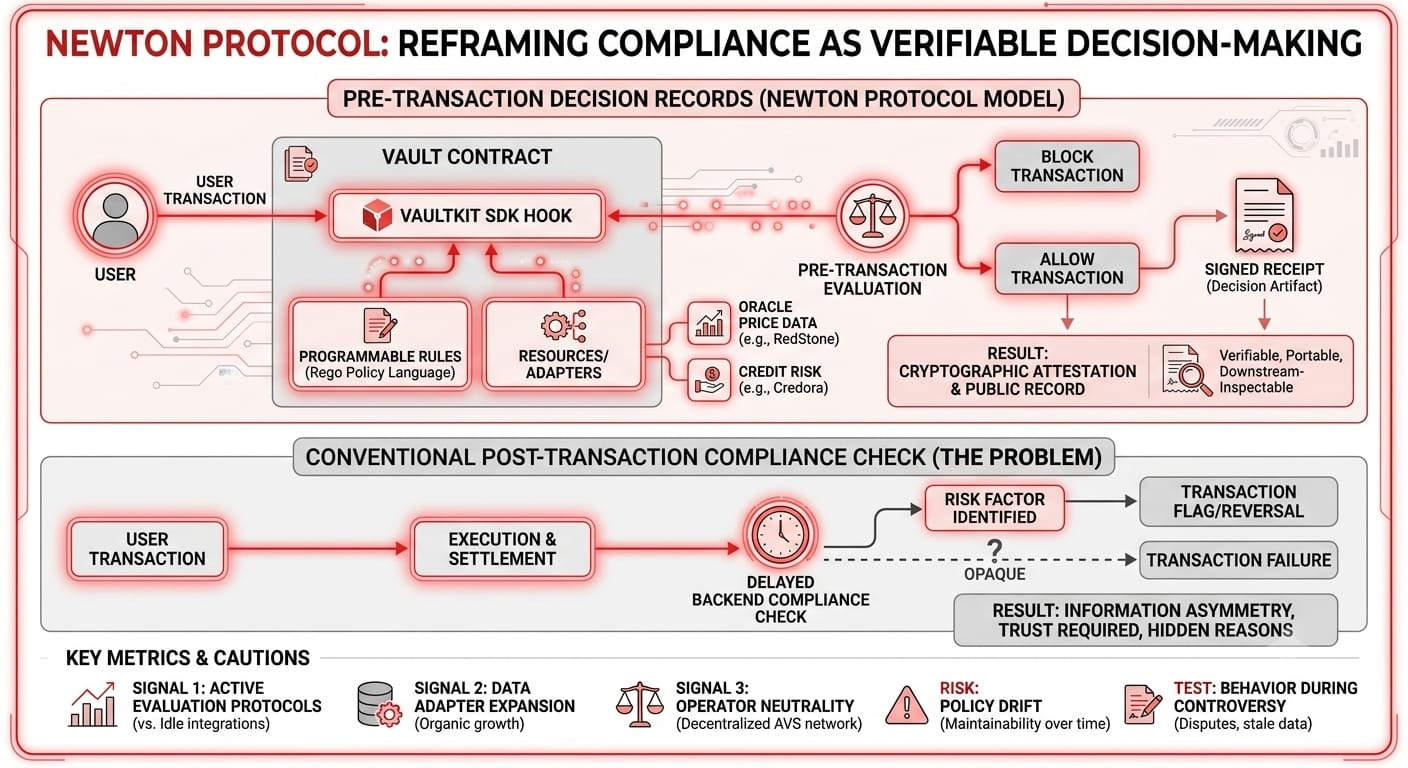 The reframing I think most people miss is treating this as a compliance product. That framing is too narrow. What Newton is actually building is a decision record infrastructure that happens to start with compliance use cases. Every signed attestation the network produces is a portable, verifiable artifact, meaning any downstream protocol can inspect the history of a vault's policy evaluations without trusting the vault curator directly. That's a fundamentally different trust primitive than whitelists or offchain KYC databases. The information asymmetry between a protocol deployer who knows their own risk rules and a counterparty who has to take their word for it starts to collapse once every enforcement decision exists as a cryptographic receipt on a public explorer.
Where I stay cautious is around the weight of distribution. The Magic Labs integration opens access to over 200,000 developers and 50 million wallets, which sounds like a strong head start, but distribution and sustained usage are different things. Developers adding a Newton hook at launch doesn't automatically mean they keep their policy configurations updated as regulations shift or their user base changes. Policy drift, where rules get deployed and then quietly ignored or left stale, is a real behavioral risk in compliance infrastructure, and it's arguably harder to detect in a decentralized system than in a centralized one. The question of whether teams actually iterate on their Newton policies over time, rather than treating them as a checkbox at deployment, hasn't been answered by anything I've read yet.
The signals I'm personally watching aren't about volume or market cap. I want to see how many unique protocols have policies actively evaluating transactions on a rolling basis versus how many integrated once and went quiet. I'm watching whether the oracle adapter layer, currently anchored to RedStone for price data and Credora for credit risk, expands with additional data providers independently rather than through announced partnerships, because organic provider growth would suggest developers are pulling in new data sources based on real policy needs. Operator count and geographic distribution within the AVS network also matters to me as a proxy for the credible neutrality the architecture is selling, since that neutrality only holds if no small group of restakers controls evaluation outcomes.
Whether programmable pre-transaction enforcement becomes a default expectation in DeFi or remains a feature that institutions use and retail ignores is a question I don't think the market has formed a real opinion on yet. The infrastructure is live, the design logic is coherent, and there are real deployments generating real receipts. What I haven't seen is evidence of how the system behaves when a policy produces a controversial block, when a user disputes an evaluation, or when a data adapter returns a stale feed during high volatility. Those edge cases are where authorization layers either earn long-term trust or quietly get routed around.
#JDVanceDisclosesBTCHoldings $H #TrendingTopic $BASED #Notcoin #JDVanceDisclosesBTCHoldings