
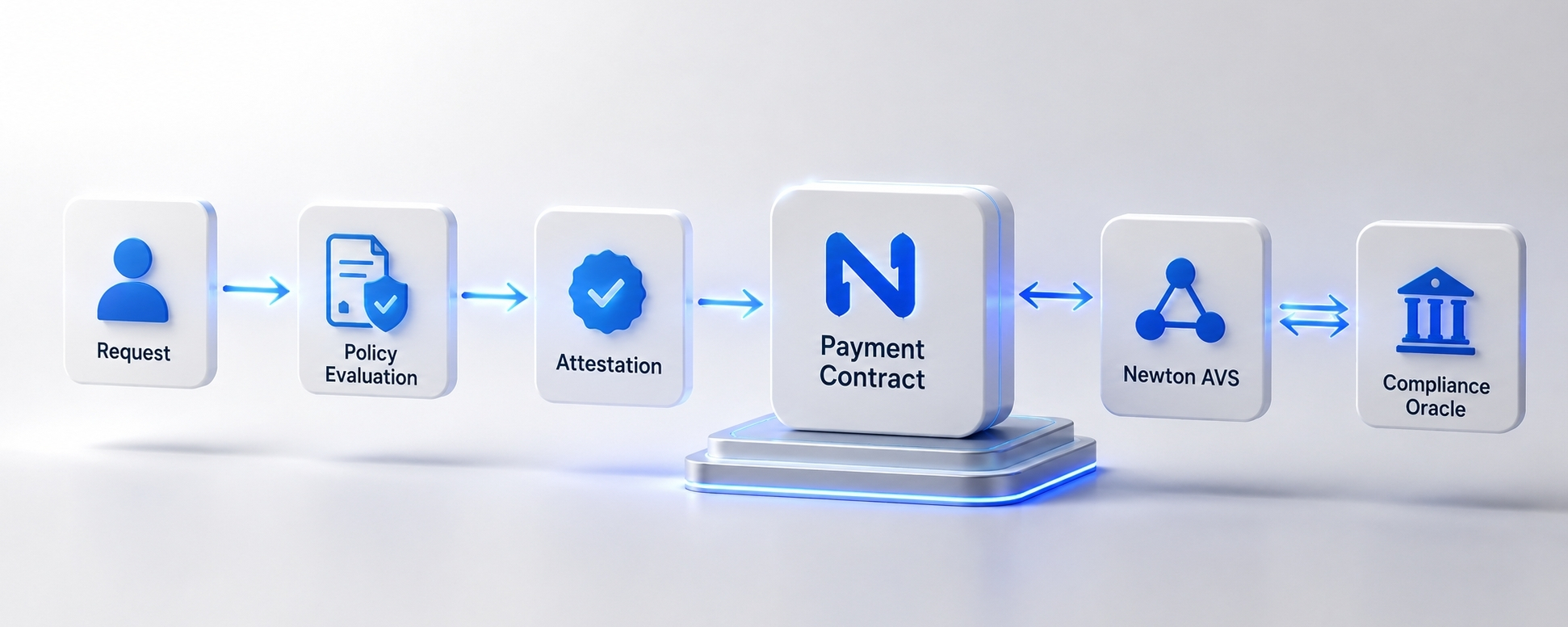

When I first opened Newton Protocol's payment architecture, I expected to see a simple transaction flow.
Instead, I found myself following the arrows between different components for several minutes.
The reason was simple. The diagram doesn't begin with a transfer. It begins with a request, followed by policy evaluation and an attestation before the payment contract decides whether to continue. Following the arrows was easier than I expected. I didn't have to keep guessing what each part was doing.
I kept looking back at the point where the attestation comes into the flow. It helped me understand why that step is there before anything moves forward. Rather than describing this in abstract terms, the workflow shows where that validation fits into the sequence.
I also noticed the note explaining that there isn't an off-chain server sitting in the critical path. That's a small sentence, but it helped me understand the overall design philosophy much better when I looked back at the diagram.
I think architecture diagrams are often underestimated.
A feature list can tell you what a protocol claims to support, but a workflow explains how those ideas are expected to work together. That's usually where I spend the most time whenever I read technical documentation.
Another thing I liked was that every box in the diagram has a clear purpose. The payment contract, Newton AVS, the compliance oracle and the attestation each have their own role in the process. Following the arrows between them made the flow much easier to understand than reading a block of text.
After reading through this section, I wasn't left thinking about marketing terms or headline features.
I was thinking about the sequence.
What happens first?
What happens next?
Where is the decision made?
For me, those questions are often more useful than asking how many features a protocol has.
That's probably why I enjoy reading architecture pages. They don't just describe a system they show how the individual pieces fit together. When the documentation does that well, understanding the protocol becomes much easier.