
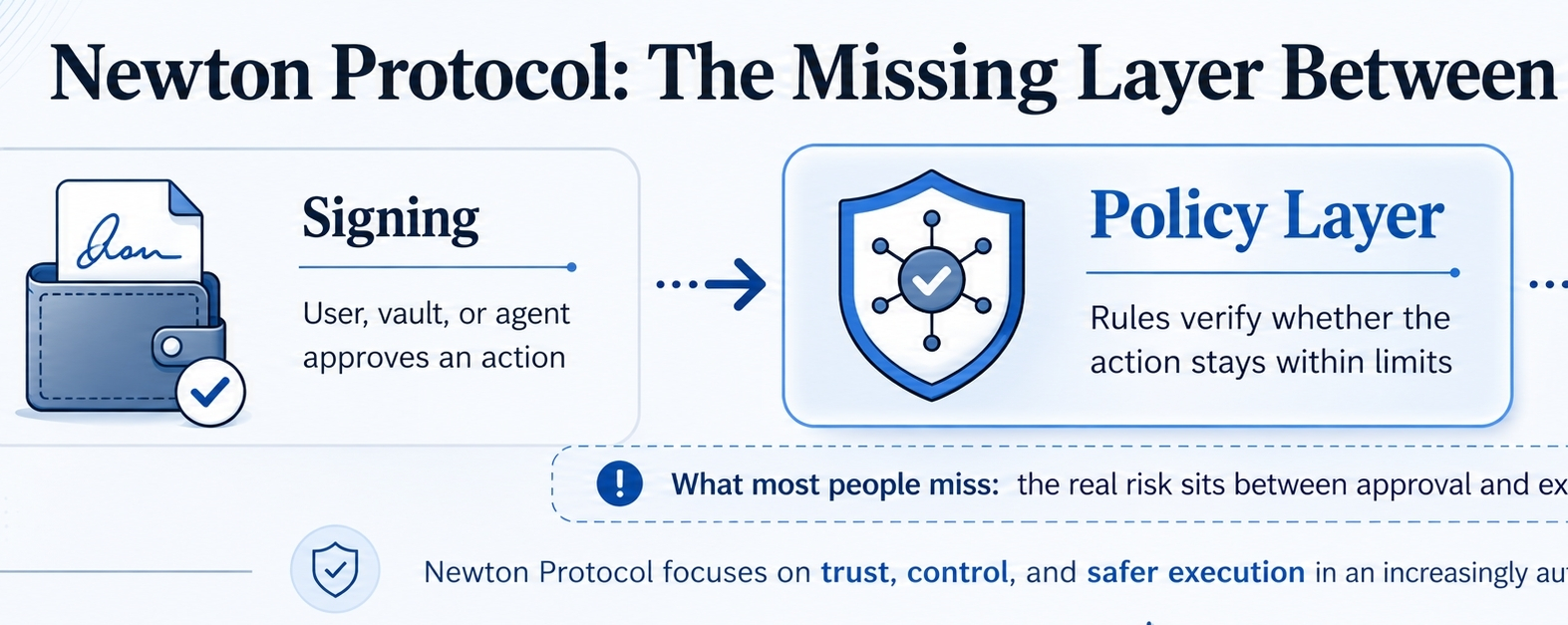
I’ve been thinking about Newton Protocol because it is looking at a part of Web3 that most people still ignore.
Everyone talks about wallets, signatures, transactions, speed, and final settlement. But Newton is focused on the space in between, where a user or system has already approved an action, but that action has not yet fully played out onchain.
That space may sound small, but it is where a lot of risk actually lives. A wallet can sign. A vault manager can update a strategy. An agent can follow an instruction. A contract can accept the action. But none of that always answers the deeper question: was this action still inside the rules it was supposed to follow?
This is why Newton Protocol feels relevant. It is not only trying to make Web3 more automated. It is trying to make automation safer and more controlled before execution happens. In a market where AI agents, vaults, DeFi strategies, and tokenized assets are becoming more active, that kind of control starts to matter.
The older crypto model was simple. If you had the key, you could act. If the transaction was valid, the chain would settle it. That model worked well when most users were directly controlling their own actions. But Web3 is no longer that simple. More decisions are being delegated to curators, protocols, bots, agents, and teams.
Newton Protocol is trying to add a policy layer before execution. In simple terms, it allows rules to be checked before a transaction goes through. That could mean checking whether a vault action stays within its limits, whether an agent is allowed to perform a certain task, or whether a wallet is acting inside a defined policy.
This is important because many problems in crypto are not just technical bugs. They are control problems. Sometimes the rule exists somewhere, but not where it matters. It may exist in a team agreement, a risk document, a dashboard, or a promise to users. But when the transaction is executed, the chain only sees whether the action is valid, not whether it was wise, authorized, or aligned with the original policy.
Newton is trying to bring that missing check closer to the transaction itself. That does not make it a perfect solution, but it does make the idea serious. The more Web3 depends on delegated execution, the more it needs a way to separate permission from unlimited control.
There is a fair criticism here. Adding a policy layer can also add complexity. It can create new trust assumptions. It can become another system that developers must depend on. Some users will always prefer direct self-custody, simple contract interaction, and no extra layer between them and the chain.
That criticism makes sense. Crypto should not become so controlled that it loses the openness that made it valuable in the first place. Not every transaction needs policy checks. Not every user wants guardrails. A fully open environment still has a place in Web3.
But Newton Protocol is pointing toward a real structural shift. As more capital moves through vaults, agents, stablecoins, and onchain financial products, the question will not only be whether a transaction can settle. The question will be whether it should have been allowed to reach settlement at all.
That is the part I find most interesting about Newton. It is focused on the layer where intent, rules, and execution meet. If Web3 becomes more automated, this layer will become more important, not less.
Newton still has to prove that its approach can work at scale. It has to show that the system is secure, practical, and useful for real builders. But the problem it is addressing is real. The next phase of Web3 may not only be about faster chains or better wallets. It may be about building trust into the moments before transactions become final.