
I have been looking into Newton Protocol with the same mindset I have developed after spending years watching crypto reinvent itself every cycle. At some point, the excitement fades and curiosity replaces it. Every few years, the industry discovers a new narrative that promises to redefine everything—ICOs, DeFi, NFTs, metaverse worlds, real-world assets, and now artificial intelligence. Some of those ideas produced genuine innovation, many produced extraordinary speculation, and almost all of them arrived wrapped in language that suggested the future had already been decided. That history makes it difficult for me to approach any new project with immediate enthusiasm, yet Newton Protocol kept pulling my attention back because it seems less interested in making AI appear magical and more interested in asking how autonomous systems can be trusted once they begin handling real value.
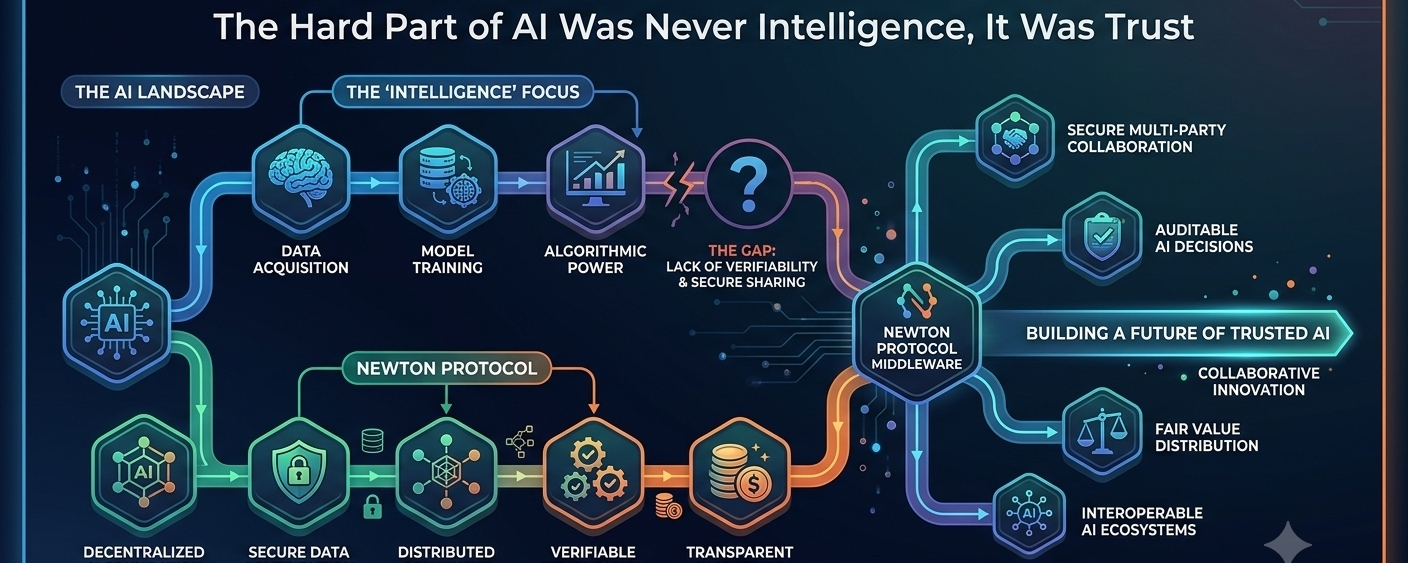
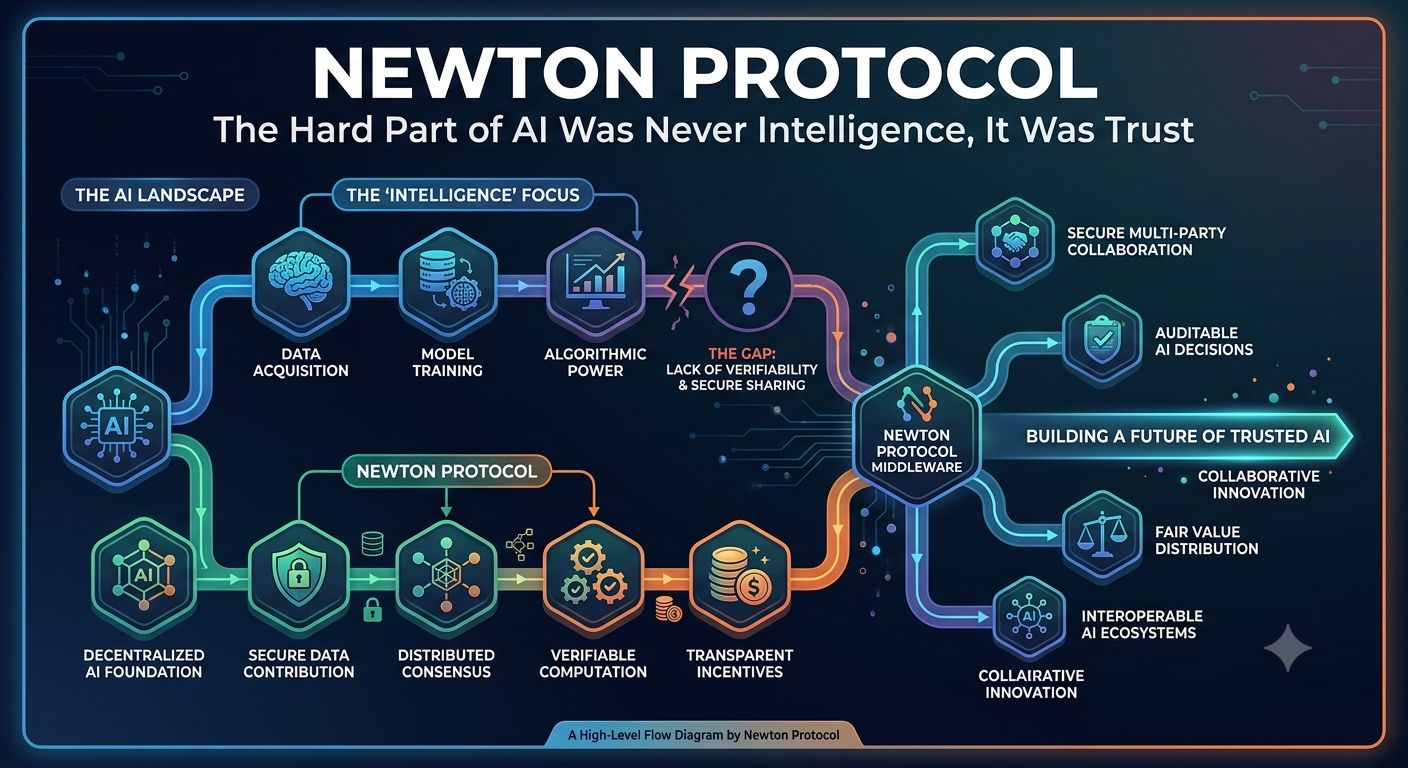
The more I thought about it, the more I realized that intelligence itself may not be the difficult problem anymore. AI models are improving at a remarkable pace, capable of analyzing markets, generating strategies, automating workflows, and responding faster than any human could reasonably hope to. The uncomfortable question begins after those decisions are made. If an AI agent manages a portfolio, executes trades across decentralized exchanges, or reallocates assets during volatile markets, who decides the limits of its authority? Newton Protocol attempts to answer that by building a secure rollup where programmable policies, cryptographic verification, and permissioned execution become part of the infrastructure rather than an afterthought. Instead of assuming that AI deserves unrestricted control, the protocol tries to ensure every automated action remains inside boundaries defined by the user.
What strikes me about this approach is that it quietly shifts the conversation away from performance and toward accountability. For years, crypto has focused on removing intermediaries, but autonomous software introduces an entirely different coordination problem. People are no longer trusting banks or brokers; they are beginning to trust algorithms that may operate continuously without supervision. Newton Protocol appears to recognize that trust cannot simply be assumed because a model performs well during testing. It has to be encoded into the rules governing how that model interacts with assets, applications, and other participants on the network. Whether those safeguards prove sufficient is impossible to know today, but acknowledging the problem feels more valuable than pretending it does not exist.
Still, history encourages caution. Crypto has never struggled to produce technically ambitious systems. Its greatest challenge has always been convincing ordinary users to change established habits. Security often loses to convenience, and complexity frequently becomes the hidden cost of innovation. Every additional permission layer, verification mechanism, governance process, or execution policy can improve safety while simultaneously making the experience more intimidating. A protocol may satisfy engineers yet remain inaccessible to everyone else. Newton Protocol will eventually have to confront that reality because adoption rarely depends on elegant architecture alone. It depends on whether people actually understand what they are delegating to autonomous software and whether they feel comfortable doing so.
There is also the practical question of scale. A controlled demonstration rarely resembles a live financial system where thousands of independent agents operate simultaneously, external data becomes inconsistent, liquidity shifts without warning, and transaction volumes spike unexpectedly. The protocol's architecture is designed to support secure execution for AI-driven strategies while providing a marketplace where developers can deploy and distribute intelligent agents. That vision sounds coherent because infrastructure and ecosystem reinforce one another, yet marketplaces are notoriously difficult to cultivate. Developers build where users already exist, while users gravitate toward applications that solve immediate problems. Breaking that circular dependency has challenged countless blockchain ecosystems before, and Newton Protocol will not be exempt simply because its focus is artificial intelligence.
The NEWT token also deserves more scrutiny than it typically receives during discussions dominated by technological ambition. I have become increasingly skeptical whenever tokens appear attached to otherwise interesting software, largely because too many have existed primarily as speculative instruments rather than essential components of their respective networks. Newton assigns the token several responsibilities, including staking, governance, transaction fees, and coordinating incentives across participants building and securing the ecosystem. Those roles appear internally consistent, but documentation alone cannot create utility. Sustainable demand emerges only when developers build applications people genuinely use and when network activity becomes substantial enough that the token performs an economic function impossible to ignore. Until then, the distinction between necessity and aspiration remains unresolved.
What I find myself appreciating most is not that Newton Protocol promises certainty, but that it focuses on a problem likely to outlast today's excitement around AI. Autonomous systems will almost certainly become more capable over time, whether they operate inside financial markets, enterprise software, logistics, healthcare, or entirely different industries. Questions surrounding authority, verification, responsibility, and constrained decision-making will become increasingly important regardless of which blockchain eventually succeeds or whether blockchain proves to be the preferred foundation at all. That uncertainty makes the project interesting without making its success inevitable.
After enough years in this industry, I have stopped searching for projects that claim to change everything. Those stories rarely survive contact with reality. Instead, I look for ideas that continue to feel relevant even after speculation fades and market attention shifts somewhere else. Newton Protocol leaves me with cautious curiosity rather than conviction. It may become an important layer for AI-driven finance, it may struggle against adoption barriers that have frustrated countless protocols before it, or it may simply contribute concepts that future systems refine. At this stage, none of those outcomes feels impossible, and perhaps accepting that uncertainty is a far healthier place to begin than believing the future has already been written.
