
In the silent, humming cathedrals of modern data centers, a new kind of intelligence is being born. It is not the cold, calculating logic of a simple if-else statement, nor the chaotic noise of a meme-fueled market. It is something more akin to an organic nervous system—a network of algorithms that learn, adapt, and ultimately, execute with a precision that borders on the prescient. This is the frontier of AI-driven finance, and at its bleeding edge stands a protocol that is less a piece of software and more a digital ecosystem: Newton Protocol (NEWT).
To understand Newton is to understand a paradox. It is simultaneously a sanctuary for the most aggressive, high-frequency trading strategies and a democratic marketplace for the architects of those very strategies. It is a fortress built on cryptographic certainty, yet its gates are wide open for the global collective of AI developers. It is, in essence, the world’s first attempt to build a self-sustaining economy of intelligence, and it is happening on-chain.
The Crucible: Why Traditional Infrastructure Fails the Algorithmic Mind
Before we can appreciate Newton’s architecture, we must first understand the terminal illness it seeks to cure: the inherent latency between thought and action. In the world of high-frequency trading (HFT) and complex AI strategies, milliseconds are not just money; they are the difference between life and death for a strategy. Traditional finance (TradFi) has spent billions on microwave towers and fiber optic cables to shave microseconds off transaction times. Yet, when these strategies are ported to the decentralized world, they suffocate.
Ethereum’s base layer, for all its security and decentralization, is a swamp. Gas fees fluctuate wildly, finality is a relative concept, and the sheer congestion renders many sophisticated AI models obsolete. The industry’s response—the rollup—was a necessary first step, but often a blunt instrument. They offered scalability by sacrificing something else: sovereignty, interoperability, or the specific execution environment required by advanced machine learning models.
Newton Protocol emerges not as just another rollup, but as a Bounded Verifiable State Machine. This isn't merely jargon; it is a philosophical shift. It posits that an AI’s decision-making process, while complex, should be bounded—encapsulated within a verifiable framework that ensures the outcome is as immutable as the code that produced it. This creates a "sandbox of certainty" where the chaotic evolution of machine learning is kept in check by the rigid discipline of the blockchain.
The Architecture of a Digital Psyche
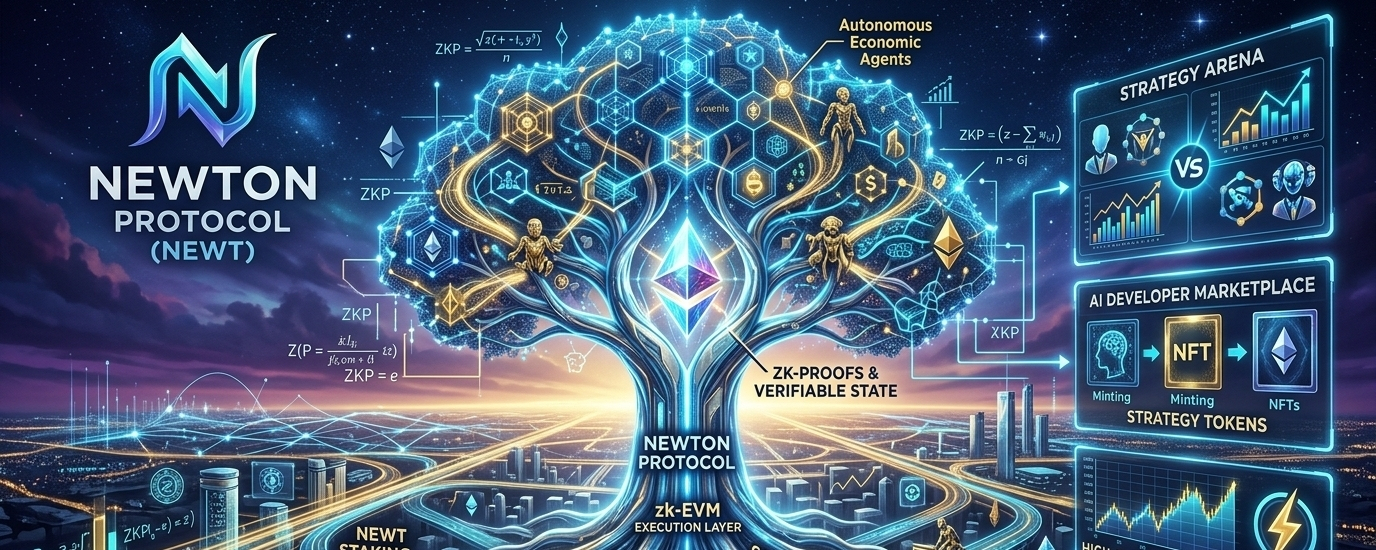
To visualize Newton, imagine a vast, crystalline tree. Its roots are anchored in the bedrock of the Ethereum mainnet, drawing security and finality. However, the trunk—the execution layer—is composed of a new, highly optimized material. This is the zk-EVM at the heart of Newton, but it is not a passive receiver of transactions; it is a kinetic engine.
1. The Nervous System: The Bounded Verifiable State Machine
Where other rollups treat AI models as external oracles feeding data into the chain, Newton assimilates the AI logic into the rollup itself. The execution environment is tailored to host deterministic models, allowing for "on-chain inference." This is a monumental leap. It means that a trading strategy doesn't just query an AI model; it is the AI model.
· The "Bounded" Aspect: This is the security net. In the wild, LLMs and RL agents can "hallucinate" or drift into unpredictable sub-optimal states. Newton’s architecture employs cryptographic proofs to "bound" this behavior. The protocol defines a "state transition function" for the AI. For every action the AI takes, a proof is generated that the action was derived from a specific, sanctioned version of the model, using a specific, verifiable input. If the model tries to "go rogue," the transaction is invalidated by the consensus mechanism.
· The "Verifiable" Aspect: This is the translator. Using zero-knowledge proofs (ZKPs), Newton allows the blindingly fast, parallel computation of AI strategies to be condensed into a single, succinct proof that is verified on the L1. This means we don't need to force the Ethereum network to run a neural network (which would be economically ruinous). Instead, we just prove to Ethereum that the neural network ran correctly.
2. The Heart: The Automated Trading Engine
This is the pulse of the protocol. It is a permissionless, non-custodial execution layer where developers deploy "Strategies."
· Adaptive Game Theory: Unlike simple bots that follow a static "if-then" logic, Newton’s engine is designed for dynamic, probabilistic strategies. These are not just "buy low, sell high" scripts. They are systems that perform on-chain sentiment analysis, liquidity pool depth monitoring, and volatility matrix construction, all in real-time.
· Latency Arbitrage: The rollup architecture allows for instant finality within the rollup. This creates a "fast lane" for high-frequency strategies. While the rest of the world waits for block confirmations, Newton traders can execute complex arbitrage loops across multiple DeFi protocols in a single, atomic bundle, secured by the cryptographic guarantees of the rollup.
3. The Soul: The AI Developer Marketplace
This is perhaps Newton’s most audacious feature: the democratization of alpha. Historically, elite quantitative trading firms guarded their algorithms like the Crown Jewels. Newton flips this paradigm into a collaborative economy.
· Tokenized Intelligence: Developers mint their AI models as NFTs (Non-Fungible Tokens) or ERC-1155 semi-fungible tokens. These are not static JPEGs; they are dynamic "Strategy Tokens."
· The Subscription/Revenue Model: Users (traders, DAOs, or other protocols) can subscribe to these strategies. The marketplace utilizes a "Pay-per-Inference" or "Profit-Sharing" model. When a strategy makes a trade, the developer receives a micro-fee, settled instantly via the NEWT token.
· The "Arena" and Developer Veto: To mitigate the "black box" risk (where a developer deploys malicious or incompetent code), Newton introduces a reputation system. Strategies are back-tested in a simulated "Arena" environment where their performance is benchmarked publicly. Furthermore, the protocol allows for a "Developer Veto" mechanism—a governance layer where top-tier developers can flag or suspend a strategy if it displays anomalous, market-manipulating behavior, fostering a self-regulating ecosystem of high-quality intelligence.
The Economic Alchemy: The Role of the NEWT Token
In the center of this digital psyche lies the NEWT token—the alchemical agent that transmutes computational power into economic value. It is not just a gas token; it is a three-fold key.
1. The Utility (Gas & Fees): The fundamental layer. All transaction fees, inference costs, and deployment fees are settled in NEWT. However, due to the zk-rollup compression, these fees are a fraction of the L1 cost, allowing for high-frequency trading that is economically viable.
2. The Governance (The Phronesis Token): In Aristotelian philosophy, Phronesis is practical wisdom. NEWT is a governance token, allowing holders to vote on protocol parameters—the cost of inference, the speed of the sequencer, the risk parameters of the strategy arena. This creates a "Wisdom of the Crowds" dynamic where the users who understand the system best dictate its evolution.
3. The Staking (The "Bond of Integrity"): To deploy a strategy, developers must stake NEWT. If their strategy acts maliciously (attempting a sandwich attack, for example) or suffers a catastrophic loss due to poor coding (as opposed to market volatility), a portion of the stake is slashed and redistributed to the affected users. This aligns incentives, ensuring that developers are only deploying their highest-quality work.
The Ecosystem: A Renaissance of Autonomous Agents
When we look beyond the code, we see the emergence of a new "Digtal Polis." Newton is not just a platform; it is the biosphere for a new kind of life—the Autonomous Economic Agent (AEA).
· The End of Passive Holding: The era of "HODLing" is giving way to "Active Strategy Allocation." Users no longer need to be experts in technical analysis or Solidity. They simply choose an "Alpha Agent" from the marketplace, deposit their assets, and let the machine work. It is asset management for the AI age.
· The Composability of Intelligence: Because the strategies are wrapped in ERC-standards, they can be composed. An on-chain arbitrage strategy can be used as a primitive within a larger "Macro Strategy" that yields-farms the rewards. This leads to "Strategy Legos," creating exponentially complex financial instruments that are managed purely by autonomous code.
· The Shifting Role of the Developer: The developer morphs from a "coder" into a "Digital Farmer." They are not just writing scripts; they are cultivating algorithms. They are tweaking data sets, refining reward functions, and competing in the "Arena" to produce the best yield, essentially "mining" alpha.
The Road Ahead: The Tipping Point of Trust
The greatest hurdle for Newton Protocol is not technical; it is psychological. For the masses to trust an "AI-Managed Treasury," they must be convinced of two things: the infallibility of the cryptography and the integrity of the model.
· The "GOD" Problem (God Object Dependency): If a single developer creates the "God Strategy" that controls 40% of the TVL, the protocol risks centralization. The roadmap likely includes mechanisms to cap strategy exposure, encouraging a diverse ecosystem of "specialist" agents rather than a single "generalist" overlord.
· The "Black Swan" Training Gap: The models are trained on historical data. What happens when the market structure fundamentally changes (e.g., a global regulatory shift)? Newton must implement "continuous learning" loops where the model is constantly retrained on the latest blocks, pulling data directly from the blockchain to ensure relevance in an ever-evolving landscape.
Conclusion: The Mirror of the Market
Newton Protocol ultimately offers a mirror to the market itself. It suggests that the invisible hand of the market is evolving into a visible, albeit complex, machine. It is a bet that the future of finance is not about who has the fastest fiber optic cable, but who has the most elegant algorithm, and that the best way to discover that algorithm is to let a thousand agents bloom on a shared, secure, and verifiable substrate.
In the grand narrative of Web3, we have moved from the "Internet of Value" (Bitcoin) to the "Internet of Contracts" (Ethereum) to the "Internet of Computation" (Rollups). Newton Protocol is vying to be the spearhead of the next wave: the "Internet of Intelligence."
It is a place where code meets cognition, where risk meets reward, and where the dream of decentralized, autonomous finance finally learns to think. As the protocol matures, it may just prove that the best trader on the blockchain is not a human, and the most trusted entity is not a bank, but a mathematically verifiable, bounded, and brilliantly chaotic set of algorithms—all working in concert to build a new, intelligent financial order.
