
The biggest shift in crypto may have nothing to do with making transactions faster.
I've spent years watching new blockchain projects promise cheaper fees, higher throughput, or faster settlement. Those things matter, but lately I've been asking myself a different question:
What if the most important innovation isn't moving money faster but deciding whether it should move at all?
That question is exactly why Newton Protocol caught my attention.
At first glance, it doesn't sound exciting. It isn't selling the next viral meme narrative or another AI buzzword. Instead, it's focused on something most people ignore: authorization.
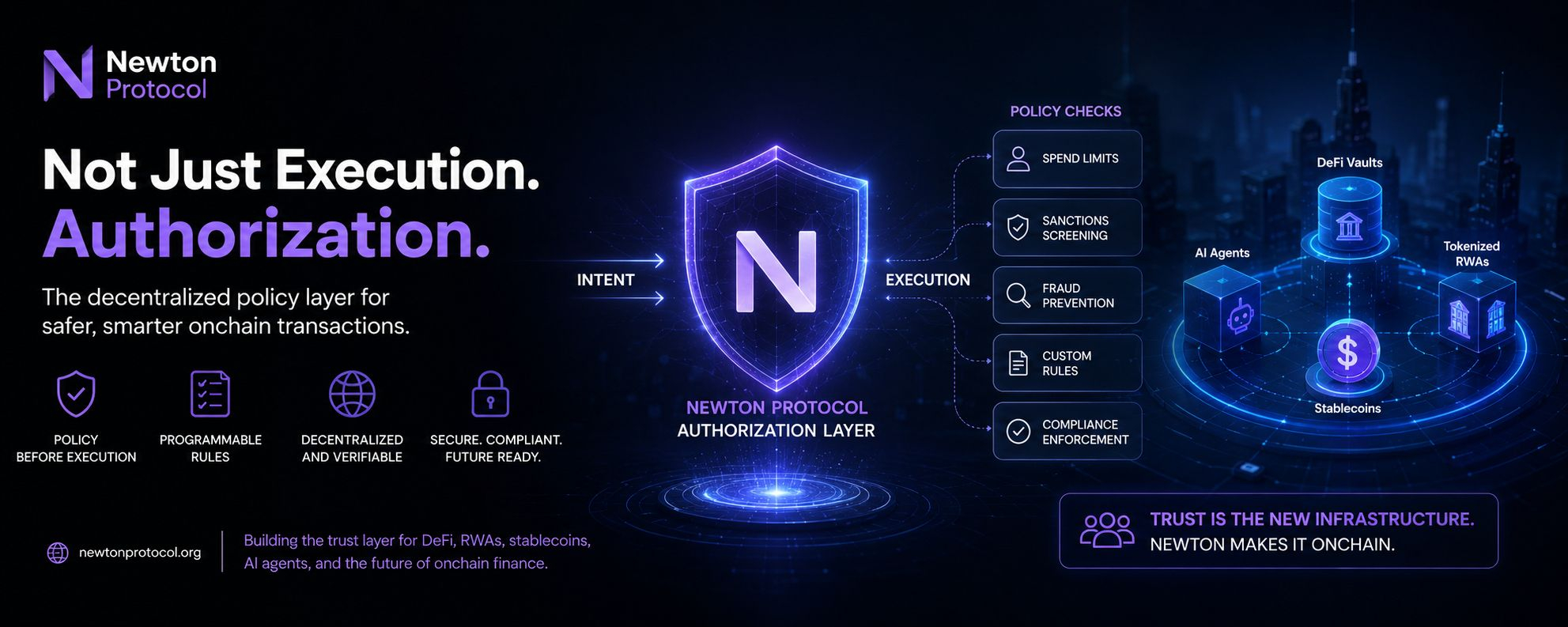
Think about it this way. Today, most blockchain infrastructure is designed around execution. Once a transaction is signed, the network's job is to process it as quickly and efficiently as possible. But real financial systems don't work like that. Banks, companies, investment funds, and even individuals operate with rules. Spending limits exist. Compliance checks exist. Fraud detection exists. Someone decides whether an action should happen before it actually does.
Crypto has become incredibly good at execution. It hasn't become equally good at decision making.
That's the gap I think Newton Protocol is trying to fill.
Instead of simply processing transactions, it introduces a programmable policy layer between intention and execution. Before assets move, predefined rules can evaluate the transaction. That could mean checking spending limits, screening for compliance requirements, enforcing treasury policies, or applying custom security rules.
To me, that's a much bigger idea than it first appears.
I don't see Newton as another DeFi project. I see it as infrastructure for trust.
The interesting part is that these policies aren't meant to be fixed forever. They can evolve as regulations change, businesses grow, or applications require new logic. Developers don't have to rebuild an entire protocol every time a rule changes. The policy becomes modular rather than hardcoded.
That's a subtle shift, but I think it's an important one.
I've also been thinking about where crypto is heading over the next few years. Everyone is excited about AI agents managing wallets, tokenized real-world assets, and institutions bringing larger amounts of capital onchain.
Those ideas sound exciting, but they all create the same problem.
Who decides what those systems are allowed to do?
An autonomous agent without guardrails isn't intelligence it's risk.
Institutional money won't rely solely on hope that every transaction is correct. It will expect programmable controls that are transparent, verifiable, and adaptable. That's where an authorization layer starts looking less like an optional feature and more like essential infrastructure.
Another reason I find Newton interesting is because it feels practical.
I've missed enough crypto narratives to recognize the difference between a catchy slogan and a product solving a real problem. Newton isn't trying to replace blockchains. It isn't competing with smart contracts either. It's adding another layer that existing applications can use when they need stronger governance and better control.
That makes the opportunity feel different.
Of course, having a good idea doesn't guarantee success.
Authorization only becomes valuable if developers actually build with it. Adoption is still the biggest challenge. User experience matters. Cross-chain support matters. Competition will grow. And because compliance changes across different regions, Newton has to remain flexible without becoming overly centralized or difficult to use.
Those are real risks, and I don't think they should be ignored.
Still, I keep coming back to one thought.
The internet didn't become essential because websites loaded faster. It became essential because invisible infrastructure quietly solved difficult problems behind the scenes.
Crypto may be entering a similar phase.
We've spent years optimizing execution. Maybe the next chapter is about optimizing judgment.
If that happens, authorization could become one of blockchain's next foundational building blocks rather than another temporary narrative.
I'm not saying Newton Protocol is guaranteed to dominate the market. Crypto doesn't work that way.
But I do think it's asking one of the smartest questions I've seen in a long time.
Not "How do we execute more transactions?"
But "How do we make sure the right transactions are executed in the first place?"
To me, that's a far more interesting problem and possibly a far more valuable one to solve.#newt $NEWT @NewtonProtocol #NEWT